US outlines plan to avoid war with China over Taiwan

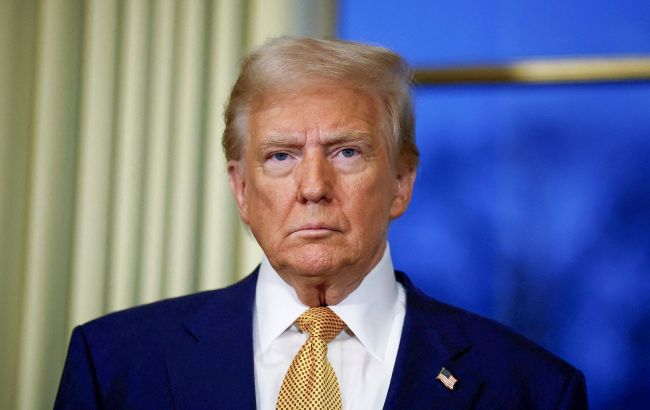 Photo: US President Donald Trump (Getty Images)
US President Donald Trump seeks to prevent conflict with China over Taiwan and the South China Sea by strengthening the military capabilities of the United States and its allies, according to Reuters.
The Trump administration outlined its approach in an official document, the National Security Strategy, published on December 5, amid increasing pressure from Beijing on Taiwan and Japan, including the deployment of ships in nearby waters this week.
"Deterring a conflict over Taiwan, ideally by preserving military overmatch, is a priority," the document states.
It is reported that the new strategy contains stronger language regarding Taiwan than the document produced during Trump's first term.
In the 2017 National Security Strategy, Taiwan was mentioned three times in a single sentence, reflecting traditional diplomatic language.
However, the new strategy includes eight references to the island across three paragraphs and notes that "there is, rightly, much focus on Taiwan" due to its strategic location in key trade waters and its dominance in semiconductor production.
"We will build a military capable of denying aggression anywhere in the chain of islands stretching from Japan to Southeast Asia," the document states.
At the same time, it emphasizes that US armed forces cannot and should not act alone.
"Our allies must step up and spend - and more importantly do - much more for collective defense," the strategy notes.
The document also states that this will strengthen "US and allies' capacity to deny any attempt to seize Taiwan" or any other actions that would "make defending that island impossible."
Conflict over Taiwan
On November 24, US President Donald Trump and Chinese leader Xi Jinping held a phone conversation.
During the call, the Chinese leader outlined Beijing's core position on Taiwan. Xi emphasized that "Taiwan's return to China is an integral part of the post-war international order."
At the same time, Beijing reaffirmed its hardline stance against any expression of Taiwanese autonomy.
Earlier, the spokesperson for China's Taiwan Affairs Office, Pen Qinen, stated that Beijing does not rule out the use of force against the island while expressing willingness for "peaceful reunification" under the "one country, two systems" model.
It is worth noting that China has long considered Taiwan part of its territory and labels its government "secessionist." Historically, remnants of the anti-communist Kuomintang, which lost the civil war to Mao Zedong, established themselves on the island in 1949.
Meanwhile, the authorities in Taipei insist that Taiwan is a sovereign state with its own political and economic system.
China’s People’s Liberation Army regularly conducts large-scale exercises near the Taiwan Strait, practicing blockade scenarios and potential invasion plans.
At the same time, Western intelligence agencies warn that China could invade Taiwan as early as November 2026.