Ukrainian forces strike Russian missile carriers, fighter and helicopter

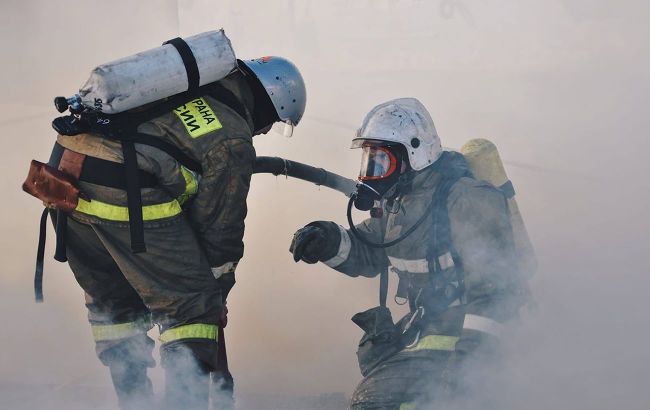 File photo: A fire broke out in Novorossiysk following a drone attack (Getty Images)
The first details have emerged regarding the nighttime attack on Novorossiysk and Anapa. Russian missile carriers, a carrier-based fighter jet, and a helicopter were hit, according to Robert "Madyar" Brovdi, commander of the Ukrainian Armed Forces' Special Operations Forces.
On the night of September 9, Ukrainian forces launched a comprehensive strike against a naval base in Novorossiysk. Many military vessels, including missile carriers, were targeted.
At the same time, near Anapa, drones destroyed a Su-33 carrier-based fighter jet and a Mi-8 helicopter. And in the Gelendzhik area, Ukrainian drones struck two radar reconnaissance systems:
- Kasta 2E2 station
- 92N6 radar, part of the S-300/S-400 anti-aircraft missile system.
Fuel oil terminal on fire in Novorossiysk
Drones also attacked the city of Novorossiysk itself in the Krasnodar Krai of Russia overnight. As a result of the Russian strikes, a massive fire broke out at the fuel oil terminal.
Ukrainian forces strikes Russian missile carriers, fighter and helicopter pic.twitter.com/Jv4Qew6Mga
— RBC-Ukraine (@NewsUkraineRBC) September 9, 2026
The facility is Novorossiysk Fuel Oil Terminal LLC—one of the key enterprises of the Novorossiysk transportation hub. It is part of the Novorossiysk Commercial Sea Port, Russia's largest seaport in terms of cargo transshipment volume.
The terminal specializes in the storage and transshipment of fuel oil and light petroleum products. Its throughput capacity is approximately four million metric tons per year.
In addition to the industrial facility, the fire spread to at least one apartment building on Kunikova Street.
Updated at 12:16 p.m.
President Volodymyr Zelenskyy emphasizes that Ukraine is responding to Russia's daily terrorist attacks effectively and almost across the entire territory.
According to him, significant results were achieved over the past 24 hours in the Krasnodar region of Russia. On the territory of a naval base, a terminal used for oil shipments, military harbor facilities, and Russian warships, including carriers of Kalibr cruise missiles, were struck.
We are responding to Russia’s daily terrorist strikes – effectively and practically across its entire map. Over the past 24 hours, there have been results in Novorossiysk, in the Krasnodar region. A naval base was hit, including a terminal used to load oil, military port… pic.twitter.com/Szoqds72Xc
— Volodymyr Zelenskyy / Володимир Зеленський (@ZelenskyyUa) September 9, 2026
"I thank the warriors of the Security Service of Ukraine, the Unmanned Systems Forces, the Ukrainian Navy, Defense Intelligence, and the State Border Guard Service for their precision. I thank everyone developing our long-range sanctions capabilities, so that Russia’s war is increasingly felt where it came from," the head of state notes.
SBU details
The Security Service of Ukraine (SBU) reported that, together with the Special Operations Forces, they struck the naval base in Novorossiysk, missile ships, and key Russian infrastructure targets
Strikes were recorded on the Novorossiysk naval base and military harbor facilities, as well as many Russian Black Sea Fleet ships carrying Kalibr cruise missiles.
Fuel oil storage facilities and the infrastructure of the Sheskharis terminal, which is used for oil shipments, were also targeted.
"Fires have been reported on the territory of the naval base and the fuel oil terminal. Explosions in the areas where the ships are based have also been confirmed," the SBU states.
A large-scale fire was reported in Novorossiysk following a series of explosions in the port infrastructure area. Eyewitnesses captured the intense fire on video, while local authorities acknowledged only the fact that a drone attack had been repelled, without reporting any damage or casualties.
Russia is suffering significantly greater losses than Ukraine in the conflict in the Black Sea. Operations at the port complex in Novorossiysk were already at a minimum even then, and shipment volumes were approaching zero.