Abu Dhabi talks continue: Key developments from the second day of Ukraine-US-Russia meetings


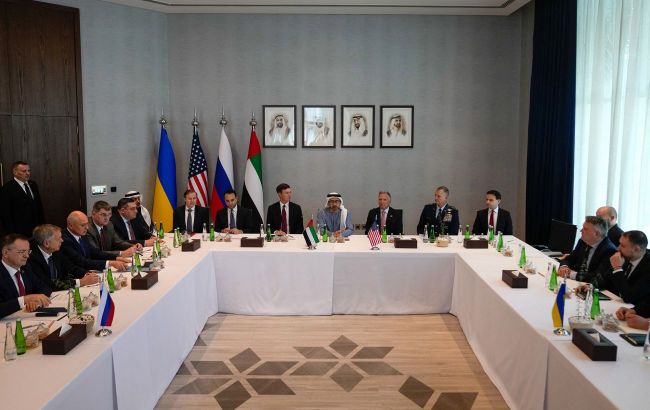 Photo: Ukraine, Russia and the United States are holding talks in Abu Dhabi on November 10-11 (Getty Images)
The second day of talks between Ukraine, the United States and Russia on resolving the war will take place in Abu Dhabi, the capital of the UAE, on Wednesday, November 11.
Here is everything we know about the negotiations so far – in RBC-Ukraine's report below.
Latest developments:
Updated at 09:39 a.m. Ukraine wants to secure funding to maintain an 800,000-strong army for at least 10 years after the war ends, AFP reports, citing a senior Ukrainian source.
This is necessary to ensure the country can defend itself against possible future Russian aggression.
Following a meeting involving Ukraine, the United States, European countries and NATO, the parties also reaffirmed their shared commitment to establishing a postwar European security architecture.
What to expect from the second day of talks
According to sources cited by RBC-Ukraine, on the second day of negotiations, the parties will discuss a possible ceasefire, energy issues and security in the Black Sea.
According to Russian media reports, the meeting is scheduled to begin at 10:00 a.m. Kyiv time.
Western media have reported that after the meetings in Abu Dhabi, Steve Witkoff and Jared Kushner may travel to Moscow and then to Kyiv.
How the first day of talks unfolded
The first day of negotiations in Abu Dhabi took place on Tuesday, November 10. The meeting lasted about 4.5 hours. Following the talks, the parties confirmed that they would continue their work the next day (RBC-Ukraine covered the events of the first day of negotiations in a separate report).
There were no detailed official comments directly from the participants in the meeting. However, Ukrainian President Volodymyr Zelenskyy described the talks as constructive and quite substantive, noting that reaching agreements with the Russians is difficult. He said he had received a report from the Ukrainian negotiating team.
US Secretary of State Marco Rubio, who did not take part in the meeting, also described the talks as very productive but stressed that much work remained to be done.
Among the American participants, Jared Kushner gave a comment to the press. According to him, Russian dictator Vladimir Putin is "ready for peace under the right conditions."
According to a source cited by RBC-Ukraine, the main topics on the first day of negotiations were the future security architecture and security guarantees for Ukraine, Europe and Russia.
The parties also discussed the possibility of a large-scale prisoner exchange. According to Zelenskyy, options include exchanges in a "1,000 for 1,000" or "1,500 for 1,500" format.
The Russian side also raised the territorial issue. Zelenskyy stressed that such matters should be discussed at the level of national leaders.
According to RBC-Ukraine, the Russian delegation also brought up Moscow's proposals to change the European security architecture, which Putin had promoted during talks with then-US President Joe Biden in December 2021.
At the time, Russia demanded, among other things, that NATO abandon further expansion, reduce the military presence of its allies in countries that joined the Alliance after 1997, and restrict military cooperation with post-Soviet states outside NATO, including Ukraine.
According to the publication's source, the Russians linked the start of the war to the Biden administration's refusal to accept these demands. Meanwhile, the American side was trying to understand what exactly Moscow feared and why it needed security guarantees.
Is Europe taking part in the negotiations
On the first day of talks, before the trilateral meeting, the Ukrainian delegation held separate consultations with representatives of the United States, the EU, NATO and European countries to coordinate common positions with its partners.
Representatives of the E4 format — the United Kingdom, France, Germany and Italy — as well as the European Union and NATO took part in the coordination meetings.
The United Kingdom was represented by National Security Adviser Jonathan Powell; Germany, by the Chancellor's foreign policy adviser Günter Sautter; France, by the president's diplomatic adviser Emmanuel Bonne; and Italy, by the Prime Minister's adviser Fabrizio Saggio.
The European Union was represented by Ursula von der Leyen's chief of staff, Björn Seibert, and the European Council President's adviser, Anna-Maria Boura. NATO was represented by Jeffrey van Leeuwen, director of the Secretary General's office.
Following the consultations with partners, trilateral negotiations took place involving the Ukrainian, American and Russian delegations.
However, the question of European representatives' participation in the negotiations with Russia remains open.
According to Zelenskyy, Europe must decide by the end of November who will represent it in talks on ending the war. He stressed that it would be desirable to make this decision during the Coalition of the Willing meeting in Germany on November 19.
Meanwhile, Danish Prime Minister Mette Frederiksen refused to represent Europe in negotiations with Russia. In her view, European institutions themselves should take part in the talks.
Moscow, for its part, opposes the European Union's involvement in the negotiations. Russian Foreign Minister Sergey Lavrov claimed that Europeans supposedly "only want to buy time for Ukraine" and suggested that they "stay at the hotel" in Abu Dhabi.
The United States, however, is insisting that the EU be given a seat at the negotiating table, according to Politico. Finnish President Alexander Stubb was previously mentioned among the possible candidates for the role of Europe's representative. Shortly before the negotiations, he and Norwegian Prime Minister Jonas Gahr Støre called Putin.
Members of the Ukrainian, US and Russian delegations
As a reminder, the Ukrainian delegation is headed by Foreign Intelligence Service chief Rustem Umerov. Its members also include Presidential Office chief Kyrylo Budanov, head of the Servant of the People parliamentary faction David Arakhamia, First Deputy Head of the Presidential Office Serhii Kyslytsia, and Deputy Chief of the Defense Intelligence of Ukraine Vadym Skibitskyi.
The American side is represented by US presidential special envoy Steve Witkoff and Donald Trump's son-in-law, who is also his special envoy, Jared Kushner.
The Russian delegation is headed by Putin's aide Vladimir Medinsky. Its members also include GRU chief Igor Kostyukov, representatives of the Russian Armed Forces General Staff, Yuriy Zhiharlovsky and Aleksandr Zorin, representatives of the FSB, including Dmitry Minaev and Alexey Komkov, and Russian Deputy Foreign Ministers Mikhail Galuzin and Sergey Ryabkov, among others.
Read also: Putin lives in different reality: Zelenskyy on Russia's claims at Abu Dhabi talks