US, Ukraine and Russia meet for peace talks: Key players, sticking points and expectations


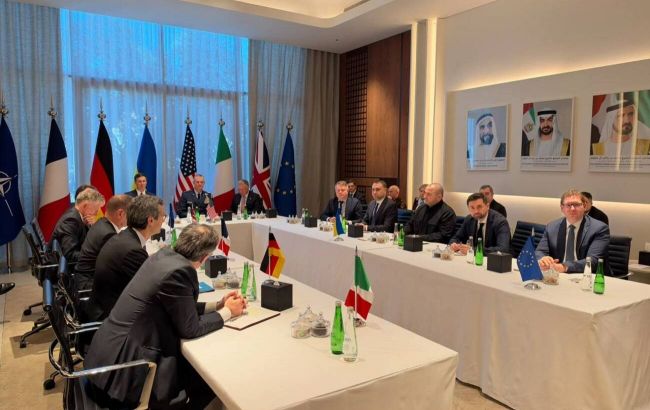 Photo: US presidential envoys Jared Kushner and Steve Witkoff (RBC-Ukraine)
Ukraine, the United States, and Russia are resuming trilateral talks on ending the war for the first time since February. The meetings in Abu Dhabi are scheduled to last two days. Meanwhile, the Ukrainian delegation will hold separate consultations with European partners, NATO, and the EU.
Here is everything we know about the negotiations so far – in RBC-Ukraine's report below.
Latest developments:
Updated at 9:35 a.m. The Ukrainian delegation in Abu Dhabi has already begun a meeting with European representatives and Trump's envoys
"The first meeting is with representatives of the United Kingdom, France, Germany, Italy, NATO, and the European Commission, who will also be joined by US special envoys Steve Witkoff and Jared Kushner. We will compare positions and coordinate our next steps ahead of the next stage of negotiations," said Rustem Umerov, head of the Ukrainian delegation.
According to him, Ukraine's key priorities are ending the fighting, securing reliable postwar security guarantees, Ukraine's economic recovery and development, and humanitarian measures.
Updated at 9:19 a.m. Ukraine's delegation in Abu Dhabi begins meeting with European representatives and Trump's envoys
Next, the talks will move to a trilateral format involving Ukraine, the United States, and Russia.
The Ukrainian delegation has arrived in the UAE for the negotiations. Budanov has shared a photo of the delegation.
"Long journey, a lot of difficult work ahead, but most importantly, we need concrete results," the head of the Presidential Office captioned the photo.
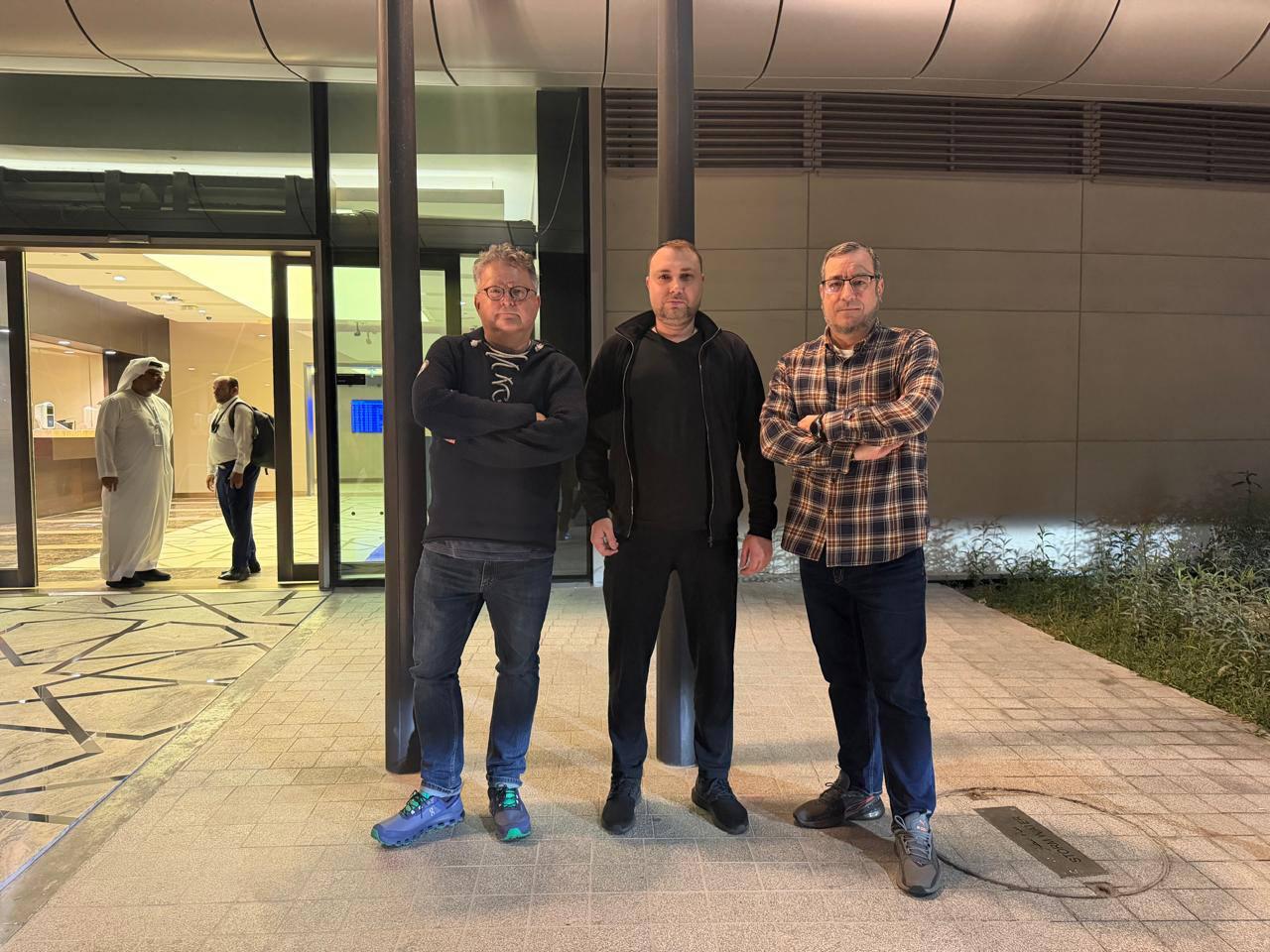
Photo: Sergiy Kyslytsya, Kyrylo Budanov, Vadym Skibitskyi (the head of the Presidential Office)
Who is on the negotiating teams
The meetings are expected to cover security guarantees, humanitarian issues, a territorial settlement, and Ukraine's postwar recovery.
Ukraine:
-
Rustem Umerov, head of the Foreign Intelligence Service (delegation head);
-
Kyrylo Budanov, head of the Presidential Office;
-
David Arakhamia, head of the Servant of the People parliamentary faction;
-
Sergiy Kyslytsya, first deputy head of the Presidential Office;
-
Vadym Skibitskyi, deputy head of Ukraine's Defense Intelligence.
United States:
-
Steve Witkoff, US President's special envoy;
-
Jared Kushner, Trump's son-in-law and US President's special envoy.
Russia:
-
Vladimir Medinsky, aide to Russian dictator Vladimir Putin (delegation head);
-
Igor Kostyukov, head of Russia's military intelligence agency (GRU);
-
Yuri Zhigarlovsky and Alexander Zorinsky, representatives of the Russian General Staff;
-
Alexey Komkov, head of the FSB's Operational Information and International Relations Service;
-
Dmitry Minaev, head of the FSB's Counterintelligence Operations Department;
-
Deputy Foreign Ministers Mikhail Galuzin and Sergey Ryabkov;
-
Elena Podobreyevskaya, deputy head of the Kremlin's Domestic Policy Directorate for Humanitarian Policy;
-
Alexey Polishchuk, director of the Russian Foreign Ministry's Second CIS Department;
-
Oleg Postnikov, director of the Foreign Ministry's Department for Nonproliferation and Arms Control.
According to Russian media reports, trilateral talks between Ukraine, Russia, and the United States in Abu Dhabi are scheduled to begin at 9:50 a.m. Kyiv time.
Europe's involvement
Separate coordination meetings with the Ukrainian delegation will be held by representatives of the E4 group (the United Kingdom, France, Germany, and Italy), the EU, and NATO.
The European representatives include:
-
United Kingdom: National Security Adviser Jonathan Powell;
-
Germany: Chancellor's foreign policy adviser Günter Sautter;
-
France: Presidential diplomatic adviser Emmanuel Bonne;
-
Italy: Prime Minister's adviser Fabrizio Saggio;
-
European Union: Ursula von der Leyen's Chief of Staff Björn Seibert and European Council President's adviser Anna-Maria Boura;
-
NATO: Director of the Secretary General's Office Jeffrey van Leeuwen.
According to Kushner, the US side will meet with representatives of Ukraine, the EU, NATO, and European countries ahead of the trilateral negotiations.
European representatives will not participate directly in the trilateral talks between Ukraine, the United States, and Russia. Instead, Kyiv will hold separate consultations with its partners to coordinate common positions.
"As President Volodymyr Zelenskyy has instructed, we are doing everything possible to ensure Europe is part of the diplomatic process," Umerov said.
What will be discussed
According to Kushner, the agenda covers four main areas:
-
ending the fighting;
-
developing reliable postwar security guarantees and arrangements to reduce the risk of renewed conflict;
-
preparing a comprehensive economic plan and prosperity plan for Ukraine;
-
humanitarian issues.
Ukraine plans to pay particular attention to the humanitarian track. Budanov said Kyiv is interested in stepping up prisoner exchanges.
Moscow, meanwhile, claims that the first item on the agenda will be security issues concerning Russia, Ukraine, and the wider region.
Will territorial issues be discussed
The New York Times reported that participants would focus primarily on security guarantees designed to prevent the war from restarting, rather than on an immediate ceasefire.
At the same time, Bloomberg, citing a US official, reported that the talks would also cover territorial issues and mechanisms for monitoring a ceasefire.
According to the publication, the first session is expected to focus on ceasefire monitoring and postwar security. The second will address a territorial settlement.
Bloomberg also reported that the US side had asked Russia to agree to security guarantees for Ukraine involving the United States and Europe. These are being compared to the provisions of Articles 4 and 5 of the NATO treaty.
European countries, meanwhile, insist that Russia must first end its war against Ukraine before broader security arrangements in Europe can be discussed.
What are the expectations for the talks
Ukraine does not expect a breakthrough during the first round of negotiations, but has certain expectations for the next meeting.
David Arakhamia said this was already an achievement after a lengthy pause in the negotiating process. He also noted that the United States was trying to act as symmetrically as possible and was not taking either side.
The United States, for its part, sees a real opportunity to make significant progress in Abu Dhabi but does not expect an agreement to be reached following the November 10–11 meetings, an unnamed US official told reporters ahead of the talks.
Ahead of the Abu Dhabi negotiations, US President Donald Trump said he saw a "strong desire" to end the Russian-Ukrainian war. Speaking to reporters at the White House, he said that Russia and Ukraine were "tired of fighting."
Umerov, meanwhile, stressed that Ukraine's goal was to achieve lasting and sustainable peace, secure reliable security guarantees, and obtain real opportunities to rebuild the country after the war.
According to Reuters sources, Witkoff and Kushner may travel to Russia after the Abu Dhabi talks to meet with Putin.