Ukraine's Defense Ministry demolishes Russia's myth about 'revenge' for Crimean Bridge

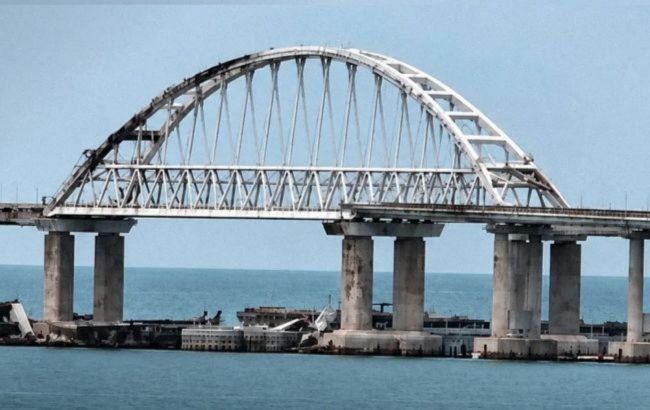 Defense Ministry makes a compelling case that the Crimean Bridge was not the reason behind Russia's attacks on Ukrainian bridges (photo: mod.gov.ua)
Russian strikes on Ukrainian bridges and industrial facilities are not "revenge" for the Defense Forces' operation against the Crimean Bridge. They are part of a systematic campaign of terror that has been ongoing since the first days of the war, according to Ukraine's Ministry of Defense.
The ministry emphasizes that the Kremlin's "revenge" narrative contradicts the facts.
Even before the Defense Forces' operation against the Crimean Bridge, Russia had carried out 109 attacks on Ukrainian crossings, President Volodymyr Zelenskyy said during a meeting with British Defense Secretary Wes Streeting.
In particular, since October 1, 2026—a month and a half before the operation against the Crimean Bridge—Russian forces had attacked Kyiv's bridges across the Dnipro River 12 times, as previously reported by Ukrainian Defense Minister Yevhenii Khmara.
And on the night of November 20, Russian ballistic missiles damaged three bridges in the capital at once: the Podilsko-Voskresenskyi, Darnytskyi, and Pivdennyi bridges.
The Ministry of Defense notes that the logistics of delivering missiles and drones to Russian airfields operate continuously according to a predetermined plan, and Russia does not need individual pretexts or events to justify its attacks.
Civilian crossings and major industrial facilities remain among Russia's targets. These include a metallurgical plant in Kryvyi Rih, which employs thousands of civilians.
"The Kremlin's 'revenge' narrative is merely a convenient smokescreen for planned terror. The real purpose of this myth is to shift the blame for the aggression onto those defending themselves," the ministry emphasized.
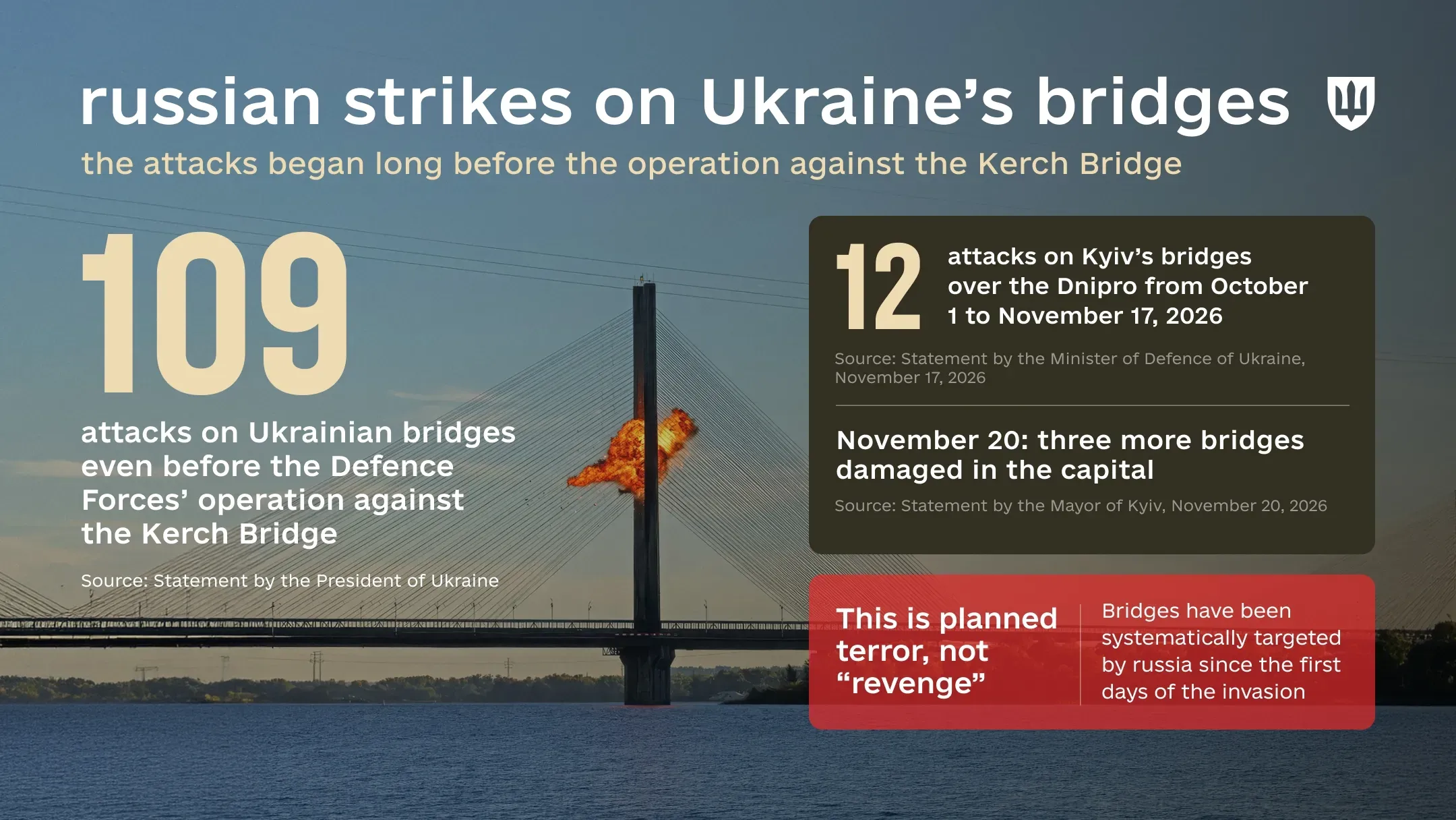
Ministry of Defense of Ukraine compellingly dismantles Russia's narrative about revenge for the Crimean Bridge (infographics: mod.gov.ua)
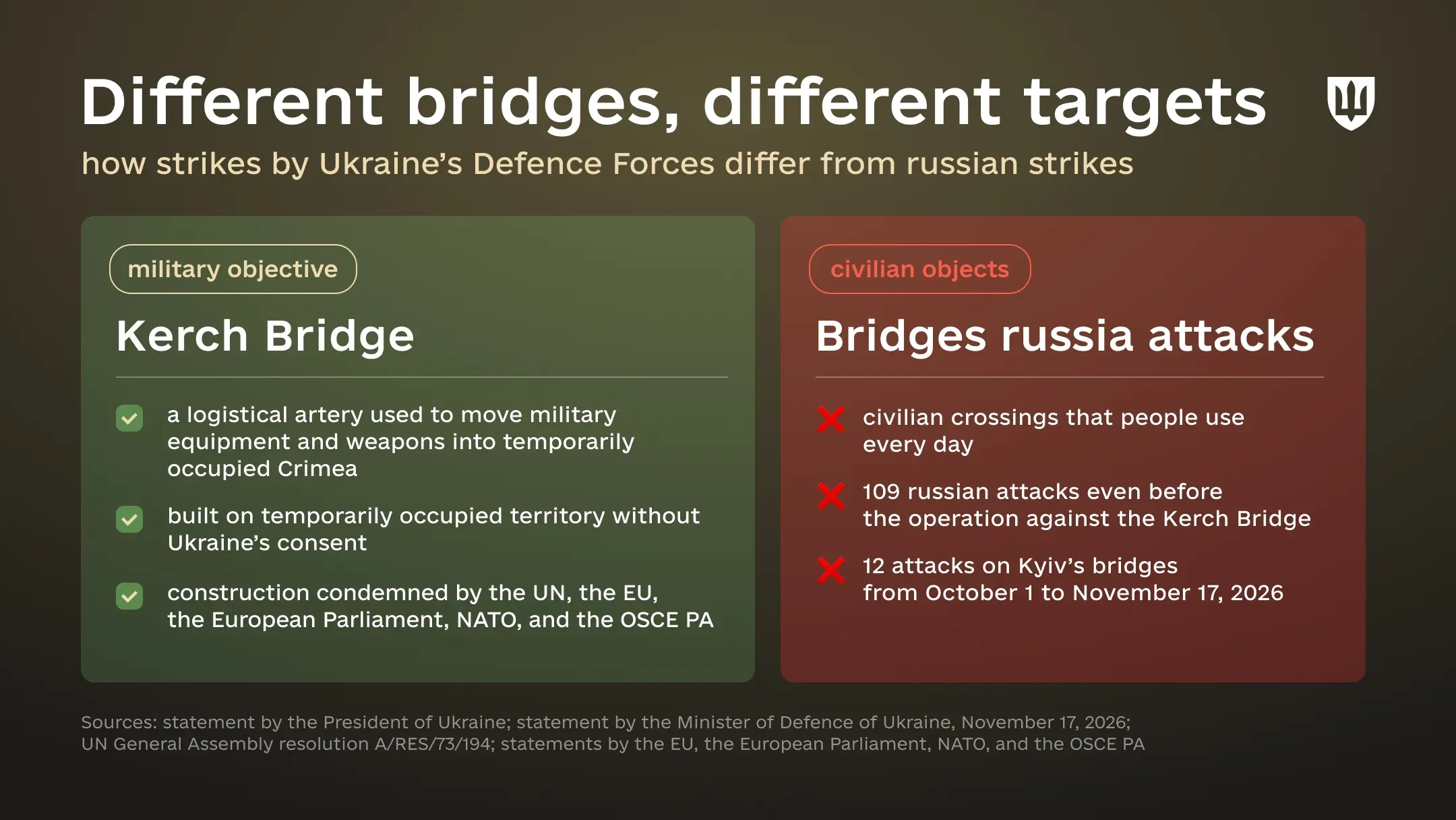
Ministry of Defense of Ukraine compellingly dismantles Russia's narrative about revenge for the Crimean Bridge (infographics: mod.gov.ua)
The ministry also emphasized the fundamental difference between military targets and civilian infrastructure.
Russian President Vladimir Putin's claim that the bridge is an "exclusively peaceful facility" is refuted by extensive evidence, including footage released by Russia's own Defense Ministry and Zvezda TV channel in February 2022, showing tanks, infantry fighting vehicles, and artillery being transported along the bridge's railway line.
British intelligence also confirmed the crossing's key role in supplying heavy equipment to the southern front. According to Ukraine's Security Service (SBU), before the successful Ukrainian strikes, 42 to 46 trains carrying weapons and ammunition crossed the bridge every day.
Because Ukrainian forces control the land corridor, the Crimean Bridge remains the only supply route for Russian forces in Crimea and on the left bank of the Kherson region.
Under Article 52(2) of Additional Protocol I to the Geneva Conventions, an object used to transport troops and ammunition constitutes a legitimate military target.
The European External Action Service's EUvsDisinfo project has also classified Russian claims about the bridge's civilian status as disinformation.
Moreover, Russia illegally built the crossing in temporarily occupied territory, a move condemned by the UN General Assembly, the EU, the European Parliament, NATO, and the OSCE Parliamentary Assembly.
By striking such targets, Ukraine is exercising its inherent right to self-defense under Article 51 of the UN Charter.
"Only air defense and the destruction of enemy military logistics and launch platforms stop Russian missiles and drones," the Defense Ministry concluded.
Crimean Bridge operation
On November 16 and 17, 2026, the Crimean Bridge, which connects occupied Crimea with Russia, came under two massive attacks by Ukraine's Defense Forces within 48 hours.
The first strike occurred on the morning of November 16.
Satellite images showing the aftermath of the attack later emerged online, revealing extensive structural damage. In particular, one of the bridge's arches appeared bent out of shape.
In the early hours of November 17, Ukraine launched another devastating strike.
As a result, one of the arches and a section of the road collapsed into the water, completely blocking Russian shipping through the Kerch Strait and cutting off the Russians' access to the Sea of Azov.