Crimean Bridge hit hard: How Ukraine's strikes disrupted Russian logistics and blocked Sea of Azov access


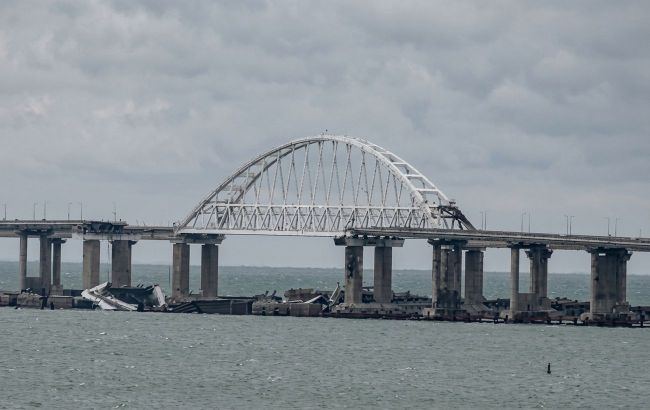 Photo: One of the arches of the Crimean Bridge, along with a section of the roadway, fell into the water (Russian media)
The Crimean Bridge, which connects the occupied peninsula to Russia, came under two massive Ukrainian attacks in the past two days. As a result of overnight strikes on November 17, an arch and a section of the road bridge collapsed into the water, blocking enemy shipping in the Kerch Strait.
More about the operation, Moscow's response, and the consequences for Russian logistics and its fleet in the RBC-Ukraine report below.
Timeline of the double strike
The attack on the crossing continued for two consecutive days:
- On the night of November 16, drones struck the bridge. As a result of the hits, the 227-meter arch supporting the roadway visibly shifted sideways by approximately 15 degrees, while the road surface was damaged in at least two places.
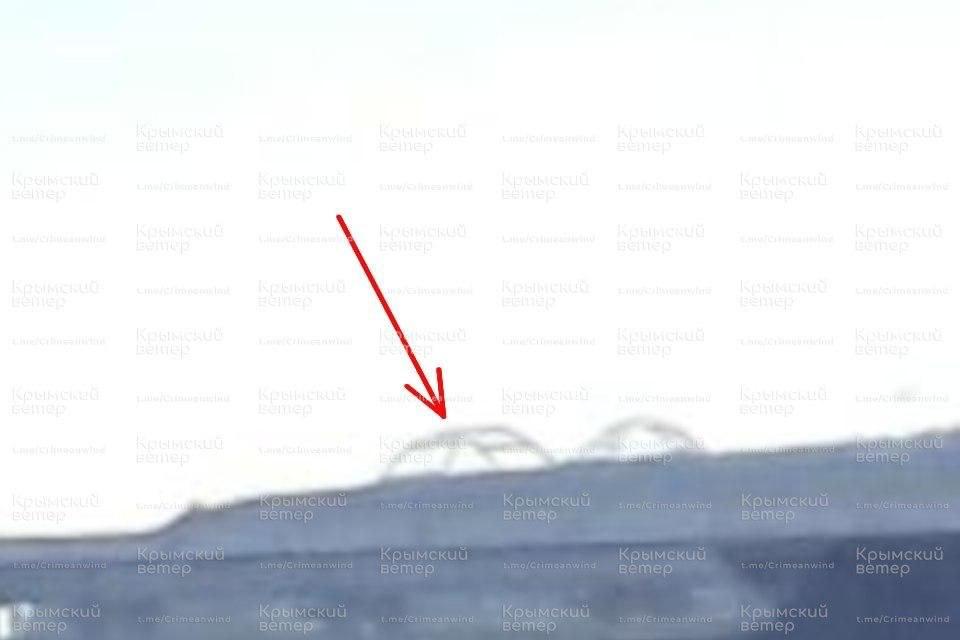
Photo: Crimean Bridge after drone attack (Crimean Wind)
- On the night of November 17, Ukraine's Defense Forces launched a second, combined attack using drones and missiles. The arch that had been tilted the previous day and a section of the roadway could no longer withstand the damage and collapsed into the water. The railway track remains standing but was also damaged.
Russia closes Crimean Bridge to all traffic after part of structure collapses pic.twitter.com/TVBO1ciJZU
— RBC-Ukraine (@NewsUkraineRBC) November 17, 2026
Russia's Transport Ministry confirmed the attack and announced a temporary suspension of traffic on both the road and railway sections of the crossing. Sergey Aksyonov, the Russian-installed head of Crimea, urged local residents to avoid traveling toward the bridge.
By noon, railway traffic across the Crimean Bridge had been restored.
What weapons were used to strike the Crimean Bridge
President Volodymyr Zelenskyy confirmed that the attack was the culmination of a multi-stage joint operation by the Security Service of Ukraine (SBU) and Ukraine's General Staff, which had been in preparation for several weeks. According to him, this was the seventh stage of the operation, during which Ukrainian forces first systematically took out Russian air defense systems, radars, and electronic warfare equipment protecting the approaches to the target.
Moment Flamingo missiles hit Crimean Bridge arch caught on camera pic.twitter.com/NCXoHRJgpz
— RBC-Ukraine (@NewsUkraineRBC) November 17, 2026
Drones and missiles, including Dovbush, Vendetta, Da Vinci, Sichen, MICH 2000, Ruta, Palianytsia, An-197, FP-1, FP-5 Flamingo, and R-360 Neptune, were used to eliminate the enemy's defenses. During the key strike on November 17, Ukrainian-made weapons were deployed:
-
Palianytsia drones struck the road section of the bridge;
-
Neptune missiles, Ruta drones, and FP-5 Flamingo missiles struck the railway section.
"Using Flamingo, our warriors carried out a precision-guided strike – and the communications uplink worked flawlessly until the very last seconds," Zelenskyy said, calling the operation a response to Russia's daily attacks on Ukrainian cities and bridges.
Grateful to the Security Service of Ukraine, all units of Ukraine’s Defense Forces involved, Ukraine’s Minister of Defense, the Commander-in-Chief of the Armed Forces of Ukraine and the General Staff, and all our weapons manufacturers for an unprecedented operation in response to… pic.twitter.com/pgUxGrE61K
— Volodymyr Zelenskyy / Володимир Зеленський (@ZelenskyyUa) November 17, 2026
Ukraine's General Staff added that following the destruction of the bridges at Chongar and in Henichesk, the number of land routes to Crimea available to Russian occupation forces is shrinking, and every hour the Kerch Bridge remains out of service deprives Russian forces in the south of essential supplies. The bridge had been the main artery carrying fuel, ammunition, equipment, and personnel to the peninsula and farther into southern Ukraine.
"Powerful explosions rang out over the strait. The arch and a span of the bridge’s road section have collapsed. The roadway is out of action: no vehicle can cross it. The railway section is still standing, but now with a damaged arch," Ukraine's General Staff confirmed.
The SBU also reported the attack. According to agency spokesperson Artem Dekhtiarenko, the Security Service carried out some of the strikes on the bridge independently.
Kremlin's reaction
Russian state propaganda TV channels ignored the bridge's collapse in their morning news broadcasts, reporting only that Russia had allegedly "repelled" the largest overnight attack.
The Kremlin said the government had already briefed Vladimir Putin on the situation. However, the Russian leader flew to China on a visit that morning, where he plans to meet with Donald Trump and Xi Jinping, and made no public comment on the incident.
Instead, Kremlin spokesperson Dmitry Peskov spoke out, promising that "the Crimean Bridge will be restored" and would supposedly be "even better than before."
Sea of Azov cut off: military expert's assessment
Retired Ukrainian Navy Captain 1st Rank and military expert Andriy Ryzhenko told RBC-Ukraine that the current damage to the crossing was of moderate severity. In his view, rebuilding the destroyed road span and arch will take more than a year.
At the same time, the expert said the main strategic impact lies in the blockade of shipping. A metal structure weighing 6,000 tons and standing about 45 meters tall fell directly into the navigable channel of the Kerch Strait.
"Most likely, for safety reasons, they will simply dismantle it using underwater explosions and dispose of it, then build a new one. But during that period, the Kerch Strait will be blocked. This will most likely last at least weeks, possibly months. There will be no shipping here for Russian or occupied Ukrainian ports," Ryzhenko explained.
In addition, the consequences of the attack on the Crimean Bridge create a critical problem for Russia's Black Sea Fleet, which will be unable to receive reinforcements for its naval forces, for example, from the Caspian Flotilla or the Sea of Azov. And that could last for several months.
Can the Crimean Bridge be completely destroyed
According to Ryzhenko, losing this route will deprive Russian occupation forces of between a quarter and a third of their military logistics capacity.
The Russians currently move most of their cargo south along the land corridor through the Sea of Azov region, via the M-14 highway, which Russia calls Novorossiya. The route runs from Rostov-on-Don through Mariupol, Berdiansk, and Melitopol to Henichesk/Dzhankoi. However, this route is also within range of Ukrainian Defense Forces' weapons.
Denys Shtilerman, co-founder of the defense technology company Fire Point, said in April 2026 that Ukraine cannot completely destroy the Crimean Bridge but can regularly destroy its spans.
In Ryzhenko's view, destroying the massive reinforced concrete supports would require significantly more explosives than damaging the bridge's metal structures. Depending on the method used, destroying the bridge could require anywhere from one ton to hundreds of tons of explosives, he estimated.
At the same time, the expert said it is not necessary to destroy all the bridge's supports to shut it down. The latest attack demonstrated that damaging critical structural components can render the crossing inoperable without completely destroying the entire structure.
Ryzhenko noted that the Russians had built a dense barrier around the Crimean Bridge's reinforced concrete supports at sea level, preventing naval drones from approaching.
And while destroying the massive concrete supports would require tens or even hundreds of tons of explosives, Ukrainian forces chose a much more effective way to disable the bridge: first, they used small drones made of composite materials, which are difficult for Russian air defense systems such as the S-400 to detect. They then precisely struck critical connection points in the metal structure, causing it to collapse under its own weight.