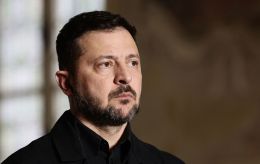
Ukraine reveals Kremlin goals behind fake attack on Putin's residence

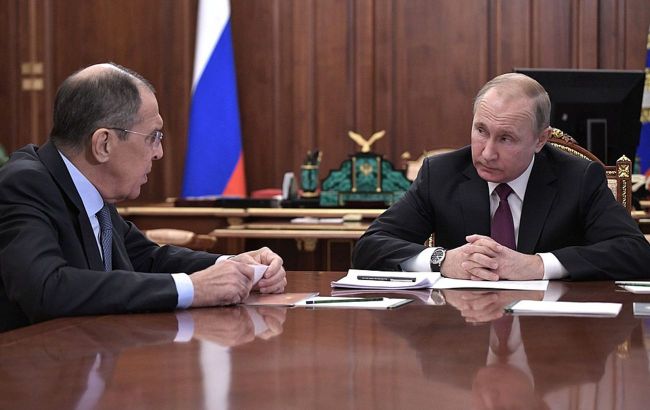 Vladimir Putin and Sergey Lavrov (photo: Getty Images)
Russian leader Vladimir Putin and his propagandists became so careless that the fake claim about an alleged attack on his residence was staged in a highly crude way, said Andriy Kovalenko, head of the Center for Countering Disinformation under the Ukraine National Security and Defense Council.
"Apart from high-level statements, two days later, they simply placed a drone on the snow and provided no other evidence. This may indicate several objectives pursued by Russia," Kovalenko said.
According to him, the first goal of such fake claims is to create grounds for delaying negotiations on ending the war and to shift Russia's own positions within US President Donald Trump's peace plan.
Putin's primary objective, in Kovalenko's view, is to drag the war out until May, avoid new US sanctions, and withdraw from parts of Trump's plan that require action from Moscow.
The second goal was an attempt to drive a wedge between Trump and the Ukrainian authorities. Putin's remarks about an attack on his residence, delivered personally to Trump, were intended to shift responsibility for prolonging the war onto Ukraine and provoke irritation from the US president. However, this did not happen.
"Putin is trying to avoid a situation in which the United States, Europe, and Ukraine work together and consistently coordinate their positions. He wants to decide the fate of Europe and Ukraine without their participation, directly with the United States. But this is not working and will not work," the head of the Center for Countering Disinformation emphasized.
Statements following the alleged attack on Putin's residence
On December 29, following a meeting between the presidents of Ukraine and the United States in Florida, Russian Foreign Minister Sergey Lavrov accused Ukraine of allegedly launching 91 drones at Putin's residence in Valdai and threatened a retaliatory strike.
Ukrainian President Volodymyr Zelenskyy called these statements yet another Russian lie and warned that Russia could be preparing strikes on Kyiv.
The Kremlin later stated that following the alleged attack, Russia would review several agreements and decisions discussed during talks with the United States.
US President Donald Trump, commenting on the incident on December 29, said that now is not the right time for this and promised to check whether the attack had actually taken place.
Later, analysts from the Institute for the Study of War refuted Lavrov's claims, emphasizing that there is no evidence of any attack: residents of Valdai did not hear air defense systems operating at night.
The European Union stated that information about Ukraine allegedly attacking Putin's residence was a deliberate distraction.
On January 2, Ukraine's Foreign Intelligence Service warned that the Kremlin is preparing a large-scale provocation with civilian casualties as part of an ongoing special operation aimed at derailing peace negotiations mediated by the United States.
More details on the alleged attack on Putin's residence, Ukraine's response, the Ukrainian Foreign Ministry's position, and inconsistencies in statements by Russian authorities can be found in the RBC-Ukraine report.