Trust fading: Allies increasingly see United States as unreliable partner, Politico poll shows

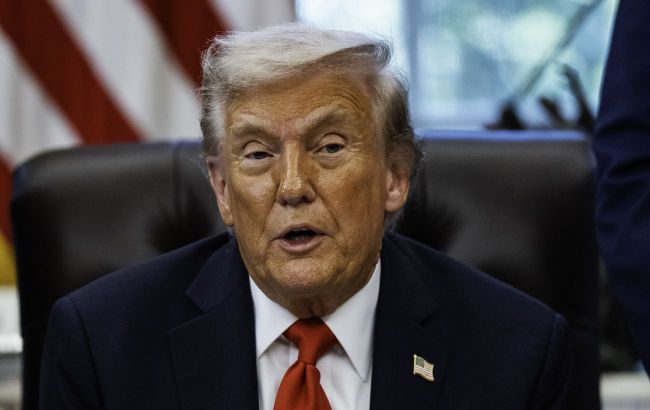 US President Donald Trump (photo: Getty Images)
In Germany, France, the United Kingdom and Canada, growing number of citizens no longer consider United States a reliable ally and doubt that it protects democracy or shares their values, Politico reports.
Research conducted by the London-based polling company Public First showed that in all countries where the survey was conducted, far more people described the United States as an unreliable ally than a reliable one.
In particular, this answer was given by half of the surveyed adults in Germany and 57% in Canada. In France, the share of people who called the United States unreliable was twice as high as that of those who called it reliable.
The highest authority of the United States was in Britain, but only by comparison: 35% of Britons said the United States is a reliable ally, while 39% consider it unreliable.
According to survey data, American military power is increasingly viewed as an uncertain asset.
The majority of adults in France and Germany said they do not believe enemies would be afraid to attack them because of their relations with the United States. In Britain, in just one year share of people who still consider the United States an effective deterrent against hostile attacks sharply declined by 10%.
In Britain, France, and Germany, negative perceptions of the United States outweigh positive ones on key indicators, including whether it protects democracy, shares their values, and acts as a reliable ally, according to survey results.
The survey also shows that a growing share of respondents in countries do not believe the United States shares their values or protects democracy, which is a long-standing American principle.
In France, only 17% of respondents agreed with the statement "the US shares our values," while 49% disagreed.
In Germany, 50% of respondents said the United States does not share their values, while only 18% said Washington "protects democracy."
According to Public First head of research Seb Wride, just a year ago, Europeans viewed the United States as "an unreliable ally but a critical one," which still deterred enemies despite some unpredictability. Now, he noted, more and more citizens do not believe in the very idea of transatlantic deterrence within NATO.
Deterioration of attitudes is linked to policies of President Donald Trump and several diplomatic conflicts — from trade disputes to statements about the possible annexation of Greenland. Additional tension was caused by last year's speech of Vice President JD Vance at the Munich Conference, which triggered a sharp reaction in Europe.
United States and NATO
Earlier, the United States intended to reduce the number of its personnel working in several key NATO headquarters.
At the end of 2025, Republican Thomas Massie, a member of the United States House of Representatives, introduced a bill providing for the withdrawal of the United States from NATO.
He stated that Alliance, in his opinion, lost relevance after the end of the Cold War, and the funds that the United States spends on its maintenance should be directed to strengthening its own security.
At the same time, Politico noted that NATO has no developed scenario in case Washington decides to leave the Alliance.
Meanwhile, United States Treasury Secretary Scott Bessent recently assured that the United States will remain a member of NATO. However, he did not directly answer what is more important for the national security of the United States — Greenland or NATO, calling it a "false choice."
In addition, the Pentagon recently released the new United States National Defense Strategy for 2026. Main focus is placed on domestic security, while support for allies in Europe becomes more limited.