New target for Israel and US: How Khamenei's son taking power could hasten Iran's regime collapse


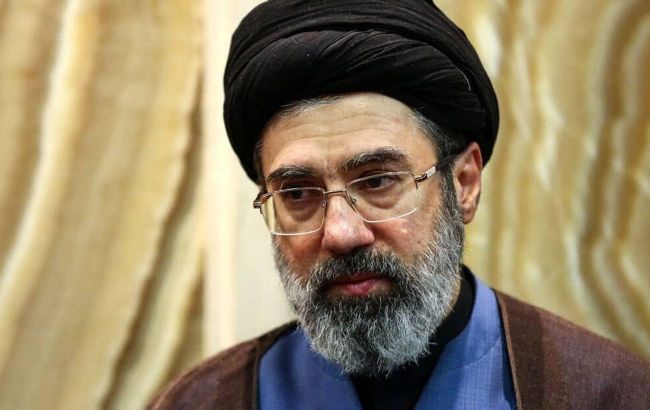 Photo: Iran’s new Supreme Leader Mojtaba Khamenei (Getty Images)
At the height of the war with Israel and the United States, Iran has effectively moved toward dynastic rule — the new Supreme Leader is Mojtaba Khamenei, the son of the late Ali Khamenei.
RBC-Ukraine explains why Mojtaba Khamenei’s appointment has sparked resistance within the country and what to expect from his leadership.
Key points:
- Shift in power balance: Mojtaba’s appointment strengthens security forces at the expense of other influence groups.
- Hardline course: The new leader is an ultraconservative who supports expanding regional proxy groups and suppressing domestic protests.
- Lack of status: Mojtaba does not hold the title of ayatollah, provoking resistance among Iran’s conservative clergy.
- Security pressure: The decision was made urgently under pressure from the Islamic Revolutionary Guard Corps (IRGC) to avoid chaos amid Israeli and US attacks.
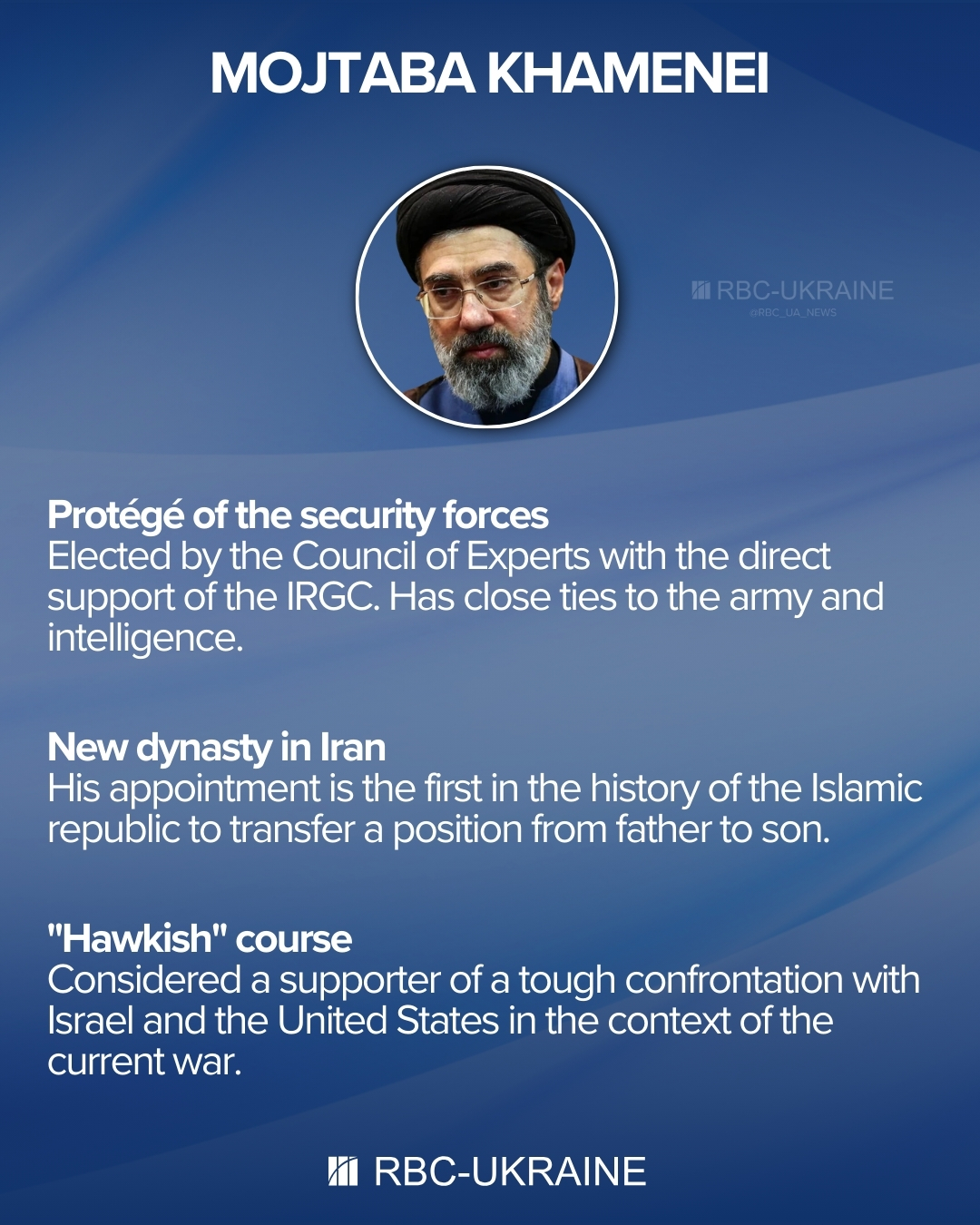
In the midst of the war, an even more radical leader, Mojtaba Khamenei, emerged in Iran (source: RBC-Ukraine infographic).
The selection of Iran’s new Supreme Leader, or rahbar, took place in emergency mode amid ongoing Israeli and US strikes. Security officials pushed for a rapid decision to prevent political destabilization after Khamenei’s death — a factor that helped advance Mojtaba’s candidacy.
Even an Israeli strike on the building where the selection process was reportedly underway failed to derail the procedure.
“Under different circumstances, Mojtaba likely would not have broken through the conservative bloc wary of imperial-style succession, where a son replaces his father,” Ihor Semyvolos, director of the Center for Middle Eastern Studies, told RBC-Ukraine.
Previously, opposition to Mojtaba’s appointment came not only from relatively liberal members of Iran’s ruling elite but also from conservatives concerned about the return of dynastic rule — albeit through a formal selection process.
The current regime emerged after the 1979 revolution that overthrew the Pahlavi monarchy. According to Iran International, the IRGC exerted strong pressure on the Assembly during the vote.
Who is Mojtaba Khamenei?
Mojtaba Khamenei, born in 1969, is the second son of the late Supreme Leader Ali Khamenei and is relatively young for the position. He studied theology in Qom, one of Iran’s religious centers, and volunteered during the Iran-Iraq War (1980–1988).
He is married to the daughter of former parliament speaker Gholam-Ali Haddad-Adel, has three children, and maintains a low public profile.
Unlike his father, Mojtaba does not hold the title of ayatollah — a senior clerical rank granted to highly respected Shiite scholars with deep knowledge of Islamic law and theology.
However, due to family ties, he has held an unofficial yet highly influential role within Iran’s power structure. He previously worked in the Office of the Supreme Leader as a trusted aide and controlled access to his father, influencing key decisions.
His influence is closely tied to paramilitary structures such as the IRGC and the Basij militia. He reportedly coordinated the suppression of protests in Iran earlier this year.
Politically, Mojtaba is an ultraconservative advocating for “Islamic governance” over republican principles and opposing reforms. In foreign policy, he supports strengthening Iran’s regional influence through proxy groups such as Hezbollah and Hamas.
“He is deeply disliked — not only by the opposition but also by many clerics. Moreover, he lacks the necessary religious status to claim the top position. The system was effectively bent to make this happen,” Semyvolos noted.
Consequences of the new leadership
Mojtaba Khamenei’s appointment shifts Iran’s internal balance further toward security forces, weakening civilian institutions. His predecessor attempted to balance competing factions.
“This effectively means the IRGC now controls nearly everything. It’s unclear how much authority President Pezeshkian retains. Security has never been his domain; his role focused on domestic economic management, while political authority belonged to the Supreme Leader. The president will likely be sidelined further,” Semyvolos said.
As a result, the interests of more moderate elements of Iran’s establishment are being sidelined — not to mention ordinary citizens who have protested against the hardline policies Mojtaba represents.
However, for these trends to materialize fully, the new leader must survive ongoing Israeli and US strikes.
“For Israel, dysfunction within Iran’s leadership is strategically important. That could only be achieved through further targeting of senior officials. Mojtaba now finds himself at the center of that objective,” Semyvolos said.
The conservatives’ pursuit of short-term control may ultimately accelerate the regime’s transformation or collapse.
Quick Q&A
Who succeeded Ali Khamenei as Iran’s Supreme Leader?
Mojtaba Khamenei, the second son of the former leader, was appointed in an emergency process amid fears of instability during ongoing Israeli and US military pressure.
Does Mojtaba Khamenei hold the religious title of ayatollah?
No. Unlike his father, he does not possess the title of ayatollah, creating tension with conservative clerical circles.
How will his appointment affect Iran’s foreign policy?
He is expected to pursue a hardline approach, deepen ties with the IRGC, expand support for proxy groups such as Hamas and Hezbollah, and resist diplomatic engagement with the West.
Does this signal a return to monarchy in Iran?
Many critics argue that the appointment effectively restores dynastic rule, contradicting the anti-monarchical principles of the 1979 Islamic Revolution that overthrew the Pahlavi dynasty.