The universe could disappear in an instant: What physicists say about the threat

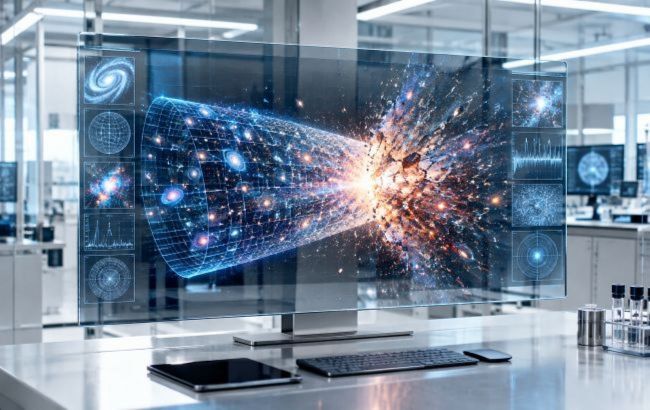 A single quantum glitch could destroy all of reality at the speed of light (photo: RBC-Ukraine)
The emptiness of space may not be the universe's lowest-energy state: physicists suggest space could transition to another state with an even lower energy level. If such a transition is possible, it could fundamentally change the laws of physics and destroy everything in the universe, according to New Scientist.
What is false vacuum, and why could it 'break down'?
Scientists explain this process using the example of an egg resting inside a deep bowl. It is in a stable position, although it could end up even lower—on the floor. To get there, the egg would have to overcome the rim of the bowl.
In physics, this state is called a false vacuum: it appears stable but could theoretically transition to a lower-energy state, known as the true vacuum.
The universe's transition into a lower-energy state is called vacuum decay.
It could occur through quantum tunneling, a phenomenon in which a particle crosses an energy barrier without receiving any additional energy.
As a result, a tiny bubble of a new vacuum could form in space, where the properties of matter and space would be completely different from those in our universe.
Read also: Earth could lose its oxygen a billion years sooner than expected
Why would such a bubble be dangerous?
What happens next would depend on this formation's internal properties.
If the bubble's surface tension were too strong and the energy difference too small, it would collapse immediately and disappear without consequences.
However, if it had enough energy, the microscopic bubble would begin expanding rapidly in all directions at the speed of light, consuming matter and destroying every quantum field in its path.
According to computer simulations, reality inside such a formation would completely collapse, and space as we know it would cease to exist.
The most frightening aspect is that the bubble would travel at the speed of light. This means we would not even have time to notice the approaching catastrophe or feel afraid—destruction would come instantaneously.
Don't miss: How 150 lines of code tricked AI into discovering alien life
How scientists try to determine the actual level of risk
It is impossible to test this theory directly in a laboratory, so physicists are trying to assess the universe's stability through precise measurements and calculations. In particular, they are studying the Higgs boson's mass and other fundamental properties of matter.
Available data suggest that our universe may be in an unstable state, but measurement uncertainties currently prevent scientists from reaching a definitive conclusion.
Another area of research involves searching for possible traces of tiny bubbles of a new vacuum that could theoretically form during black hole collisions. One hypothesis says such bubbles could enter black holes before they have time to expand.
In the future, scientists hope to find indirect evidence of this process, particularly through radiation associated with the evaporation of primordial black holes.
At the same time, physicists emphasize that there is no reason to worry about this hypothetical scenario—even if it is possible at all, humanity would have no way to influence it.
More interesting stories: