Scientists puzzled by impossible pair of black holes discovered in early universe

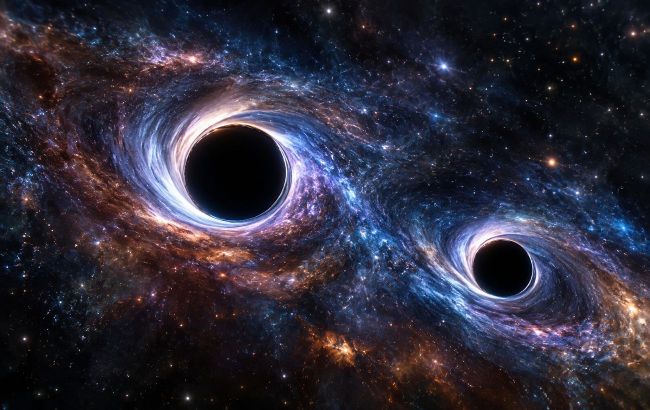 Scientists discover a unique quasar system (collage: RBC-Ukraine)
Astronomers have detected a pair of extremely massive quasars that existed shortly after the birth of the Universe. Their appearance so early in cosmic history contradicts current understanding of cosmic evolution, according to a study published in The Astrophysical Journal Letters (2026).
An international team of researchers led by Silvia Honorato from NSF NOIRLab has made a unique discovery — scientists have identified the oldest and most compact pair of quasars in the history of observations.
The object, designated J1602+4228AB and given the Hawaiian nickname Nāpōwawāʻenakaulua, is located in the cosmic dawn era — just 900 million years after the Big Bang.
What makes this discovery unique and mysterious?
Scientists explain that in the first billion years of the Universe's existence, active galaxies formed the first supermassive black holes at their centers. However, the Nāpōwawāʻenakaulua pair has stunned researchers with its scale:
- The objects are separated by a distance of only 18,100 light-years (about one-fifth the diameter of the Milky Way);
- The masses of the black holes are 1.5 billion and 400 million solar masses, respectively.
As the researchers note, there is currently no definitive theoretical explanation for how a single giant black hole could have accumulated such mass so early, let alone a pair of such objects in close proximity.

Astronomers have discovered the oldest pair of quasars (source: International Gemini Observatory/NOIRLab/NSF/AURA)
Read more: Universe may have formed inside another cosmos, new study suggests
How was the discovery made?
The quasar pair was detected as part of the Aether program using the JWST spectrograph, which surveyed over 200 quasars.
To distinguish two objects located incredibly close to one another, the team utilized the ground-based Gemini North telescope, situated on Mauna Kea in Hawaii.
Thanks to ideal weather conditions and exceptional sky clarity, scientists were able to confirm their nature in just two nights of observation.
According to researchers, Nāpōwawāʻenakaulua formed in a region of the early Universe that was exceptionally rich in matter. Galaxy interactions in this area could have simultaneously accelerated both star formation and black hole growth.
This is precisely why this quasar pair offers scientists a rare opportunity to study how galaxies formed and how the early Universe evolved.