Universe may have formed inside another cosmos, new study suggests

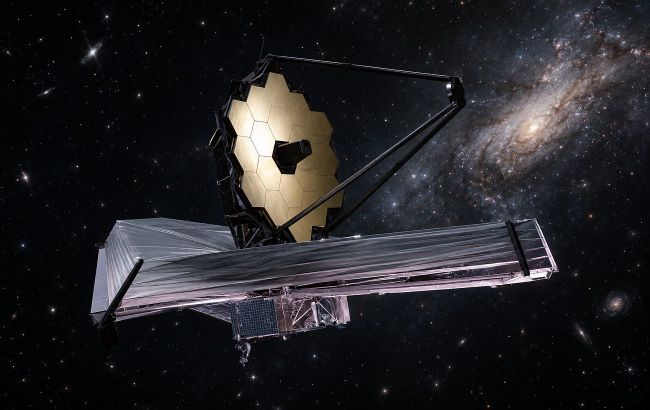 Our Universe may have been born in a black hole – JWST (collage: RBC-Ukraine)
The Universe may have originated inside a black hole in another, larger cosmos - a hypothesis suggested by new scientific data. This theory could become a significant argument in favor of an alternative explanation for the origin of the Universe, according to a study published in the peer-reviewed Journal of Experimental and Theoretical Physics.
What is the galactic anomaly?
Scientists explained that if the Universe had formed completely chaotically, as predicted by the standard Big Bang model, approximately half of the galaxies would rotate clockwise and the other half counterclockwise.
However, actual observations indicate the opposite.
An analysis of galaxy rotation performed using the James Webb Space Telescope (JWST), led by Professor Lior Shamir of Kansas State University, confirmed a clear asymmetry.
Among the studied objects, only one-third of the galaxies rotate clockwise relative to Earth, while two-thirds demonstrate counterclockwise rotation.
This discovery confirms a 2011 study published by physicist Michael Longo, based on an examination of over 15,000 spiral galaxies.
The presence of a clearly defined direction of rotation indicates that space had a common axis and its own rotation from the very beginning.
Read more: Scientists discover cosmic object 100 billion times brighter than star
Chiralities and the Einstein-Cartan theory
Scientists explain the detected anomaly using the Einstein-Cartan theory of gravity.
This extension of general relativity accounts for the rotation of spacetime and the interaction of elementary particles at the micro level.
In the ultra-dense conditions that existed at the beginning of the creation of the cosmos, the torsion of spacetime geometry can counteract gravity, eliminating the need for "infinite density."
As physicist Nikodem Popławski from the University of New Haven explains, according to this theory, every black hole creates a new, closed daughter Universe within itself.
Popławski explains that ordinary black holes in that case become Einstein-Rosen bridges, or wormholes, which connect the new cosmos with its parent one. He adds that if the parent black hole had been rotating, the newborn Universe would fully inherit its axis as the preferred direction of motion for its galaxies.
Don't miss: 15 NASA missions that changed our understanding of the universe
Is travel to another universe possible?
The theory provides grounds to assume the existence of so-called "baby universes" within our own cosmos.
The researchers note that a person could potentially enter such a “daughter universe” through a supermassive black hole, where tidal forces would not tear matter apart into atoms, as they would in smaller objects.
They add that returning to the parent Universe or sending a signal to it is impossible.
Due to strong gravity and the time dilation effect, the daughter universe becomes a completely autonomous spacetime branch with its own timeline, and matter within it moves in only one direction.
Astrophysicists hope to confirm the existence of such structures through highly precise measurements of the electron's structure in special magnetic traps.