Scientists discover cosmic object 100 billion times brighter than star

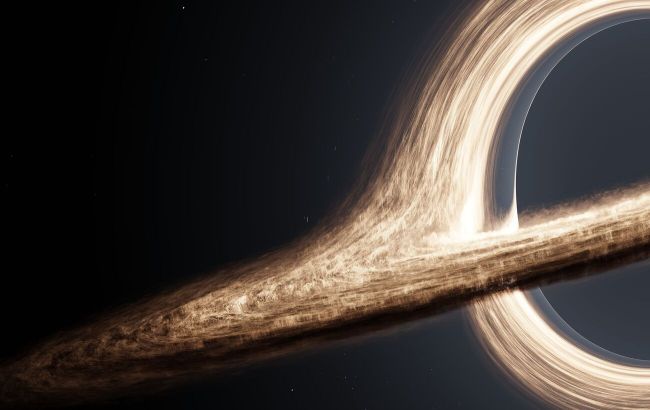 A black hole-star discovered in space (photo: Pexels)
An international team of astronomers, using the James Webb Space Telescope, has discovered a fundamentally new type of cosmic object — a black hole-star. The object, originating from the early universe, has been named MoM-BH*-1, according to Gizmodo.
Unique characteristics of MoM-BH*-1
From the outside, the cosmic object resembles a giant star the size of an entire Solar System, yet it emits approximately 100 billion times more energy than any known star.
According to lead study author Rohan Naidu from the University of Hawaii, the object is shrouded in such dense gas clouds that it effectively emits light as though undergoing stellar phenomena.
Scientists note that MoM-BH*-1 simultaneously exhibits key properties of both black holes and stars, and completely outshines its host galaxy.
The object's light sharply drops off below a certain wavelength — a phenomenon known as the Balmer jump. Unlike typical red objects where the hue is due to dust, MoM-BH*-1's spectrum indicates the presence of a large cloud of ionized gas.
The researchers believe that similar objects may represent the initial stage in the birth of supermassive black holes.
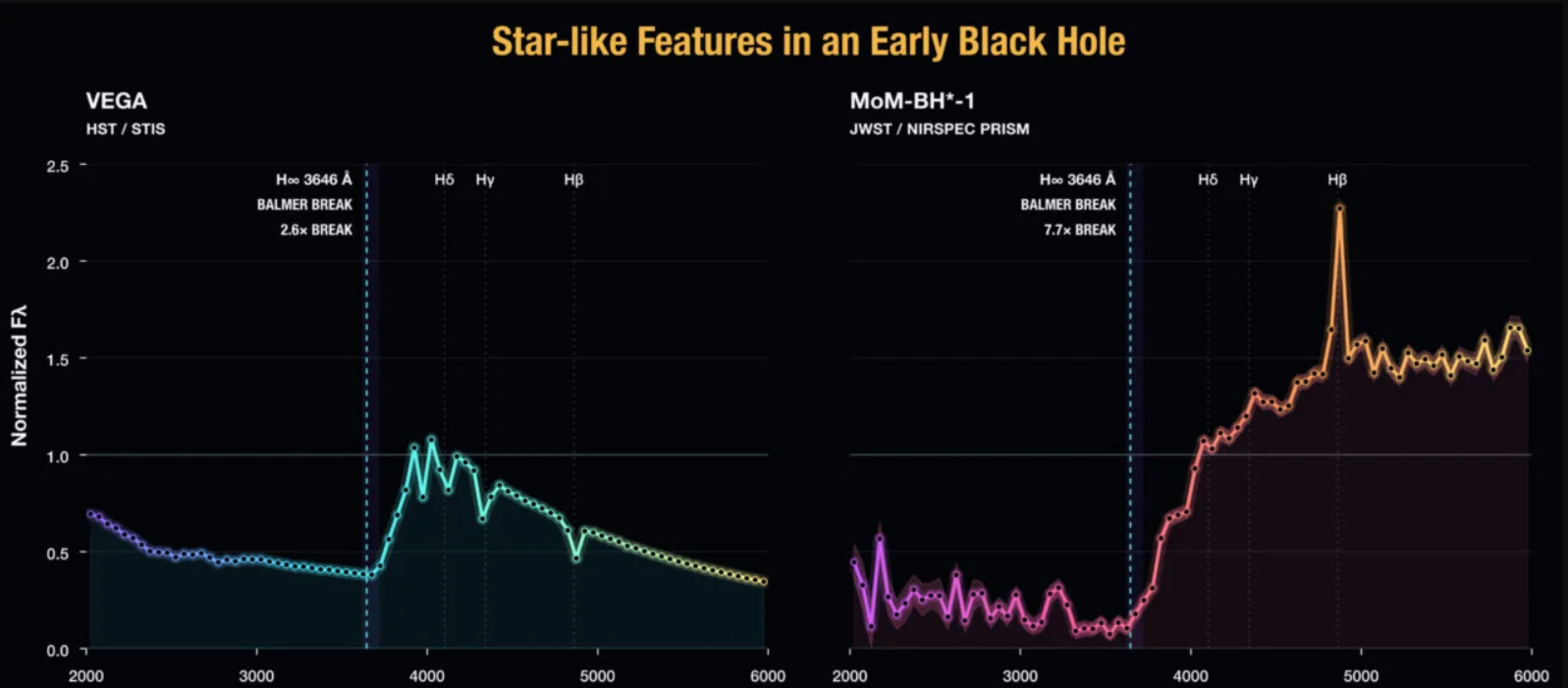
Graph illustrating the 'Balmer breaks' — a phenomenon that occurs when the outer layers of a star absorb light below a characteristic wavelength. Observations of the star Vega and MoM-BH*-1 (source: NASA, ESA, CSA, JWST; visualization: Rohan Naidu)
Unraveling the mystery of the "Little Red Dots"
Astrophysicists note that the discovery helps explain the nature of the so-called "Little Red Dots" in the early universe — compact objects with high redshift that had previously puzzled scientists.
If their color is due to gas rather than dust, it explains why early supermassive black holes have significantly larger masses than classical models predicted.
Scientists have already booked additional observation time on the James Webb Space Telescope. Starting in December, the team will begin a detailed analysis of the physics of these objects to determine their exact mass and the characteristics of their "stellar" atmosphere.