Russia increasingly uses Starlink on drones to bypass Ukraine's air defenses, Spiegel reports

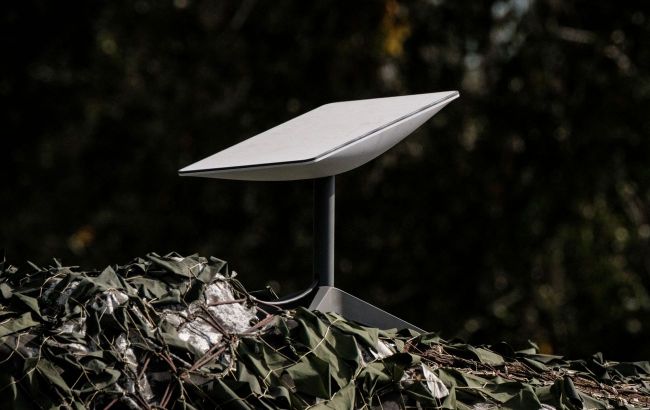 Illustrative photo: Russia uses Starlink terminals on drones (Getty Images)
Russia is increasingly trying to bypass Ukraine’s air defense systems by installing Starlink terminals on its Shahed and Molniya strike drones, Spiegel reports.
The outlet noted that reports of Starlink being used on Russian drones first emerged in 2024, but there are now signs that Russia is scaling up its use of terminals produced by the US company.
"These devices are being installed, among other things, during strikes on Ukraine’s civilian infrastructure on long-range Shahed-type (Geran) drones, as well as on Molniya-type tactical strike drones with a range of up to 50 kilometers," Ukraine’s Defense Intelligence (HUR) said in comments to Spiegel.
Why Russia is using Starlink
Thomas Withington, a military analyst at the London-based Royal United Services Institute (RUSI) specializing in electronic warfare and military communications, said Russia is using Starlink to equip strike drones with independent navigation, making them independent of global navigation satellite systems (GNSS).
GNSS is a collective term for satellite navigation systems such as GPS, Galileo, and Russia’s GLONASS.
According to Withington, GNSS signals are vulnerable to jamming, while Starlink channels are difficult to disrupt because they use narrow-beam, highly focused signals and high frequencies. In particular, a Starlink terminal mounted on a drone continuously transmits its location to a Starlink satellite.
He added that this allows the drone operator to see the drone’s position, as it is transmitted via the Starlink channel that connects the drone to the operator. The operator can use this channel to send commands to the drone, adjusting its course and ensuring it reaches the target, according to Withington.
Russian drones also frequently use standard mobile phone SIM cards to form a communications network within a drone swarm.
Withington explained that this allows the drones to continuously exchange information about their status, the tactical situation, and potential threats, such as counter-drone measures.
On January 14, the Institute for the Study of War (ISW) reported that Russian forces were equipping their Molniya-2 drones with Starlink satellite systems.