Russia attacks Kyiv from different directions: What is complexity of air defense work

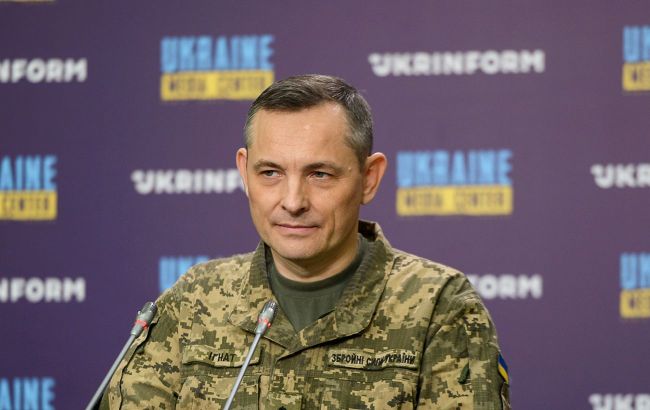 Photo: Yurii Ihnat, Head of Communications for the Ukrainian Air Force Command (Getty Images)
On the night of January 9, Russian troops attacked Kyiv with drones and missiles from different directions. It is difficult to shoot down so many targets at once, says Yurii Ihnat, head of the Communications Department of the Ukrainian Air Force Command.
Russia struck Kyiv simultaneously with drones and missiles from different directions. A combined massive attack on a single region creates problems. It is extremely difficult to shoot down such a large number of missiles at the same time.
"Decisions must be made by both military command and the servicemen themselves, who are serving either on anti-aircraft missile systems, interceptor drones, or mobile fire groups. Everyone is working, and the air defense system is working as an echeloned system. But shooting down such a large number of missiles in one location at the same time is extremely difficult with a high success rate," Ihnat explains.
He notes that today, out of 13 ballistic missiles, Ukrainian air defense forces shot down 8. This is also a high interception rate. However, fewer Kalibrs were shot down,10 out of 22.
"The main problem today is the shortage of missiles, anti-aircraft missiles, specifically for the anti-aircraft missile systems that were used today. It is clear that the enemy is increasing its attacks," the spokesperson stresses.
According to him, to repel an attack in a certain region, for example, in Kyiv or the Kyiv region, anti-aircraft missiles are needed for ground-based systems to shoot down ballistic and cruise missiles.
"This is because aviation cannot operate where ground-based air defense systems are operating. That is why the issue of missiles will always be relevant for us. And we will always need them, which we constantly emphasize to our partners, as the head of state says," Ihnat explains.
Russian attack on Kyiv on January 9
On the night of January 9, Russia launched a combined strike on critical infrastructure in Ukraine with strike drones and sea- and land-based missiles.
The main target of the strike was the Kyiv region.
In Kyiv, dozens of people were reported injured and 4 killed. In addition, houses were damaged, and several fires broke out. Among the killed is a medical worker who arrived to help the victims. His colleagues were also injured.
During the Russian attack in Kyiv, power outages were reported. Later, Kyiv Mayor Vitali Klitschko said that due to damage to critical infrastructure, the city was experiencing power and water outages.
According to the Kyiv City Military Administration, as of this morning, there is no heating in the Desnianskyi and Pecherskyi districts, as well as in parts of the Holosiivskyi, Darnytskyi, Dniprovskyi, Obolonskyi, Podilskyi, Solomianskyi, and Shevchenkivskyi districts.
In addition, a series of loud explosions were heard in Lviv on the night of January 9. There were reports online about a strike by a Russian Oreshnik ballistic missile. The West Air Command confirmed that the missile flew along a ballistic trajectory at a speed of about 13,000 km per hour.