Putin's support hits new low as Russians face internet restrictions

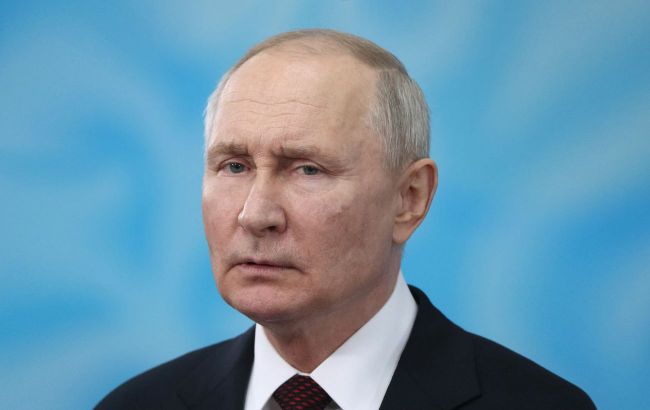 Photo: Russian President Vladimir Putin (Getty Images)
Russian President Vladimir Putin’s approval ratings are continuing to decline sharply amid attempts to block Telegram and ongoing internet disruptions across the country. Even Kremlin-backed polls are now acknowledging the trend, according to Nexta Live.
Russia’s state-run pro-Kremlin polling center VCIOM (Russian Public Opinion Research Center) admitted that Putin’s approval rating dropped from 79% in 2024 to 66.7% in April 2026. The decline has accelerated in recent months, particularly amid internet restrictions.
Since the beginning of 2026, Putin’s approval rating has fallen by 9%, marking the largest decline since 2022, when Russia launched its full-scale invasion of Ukraine.
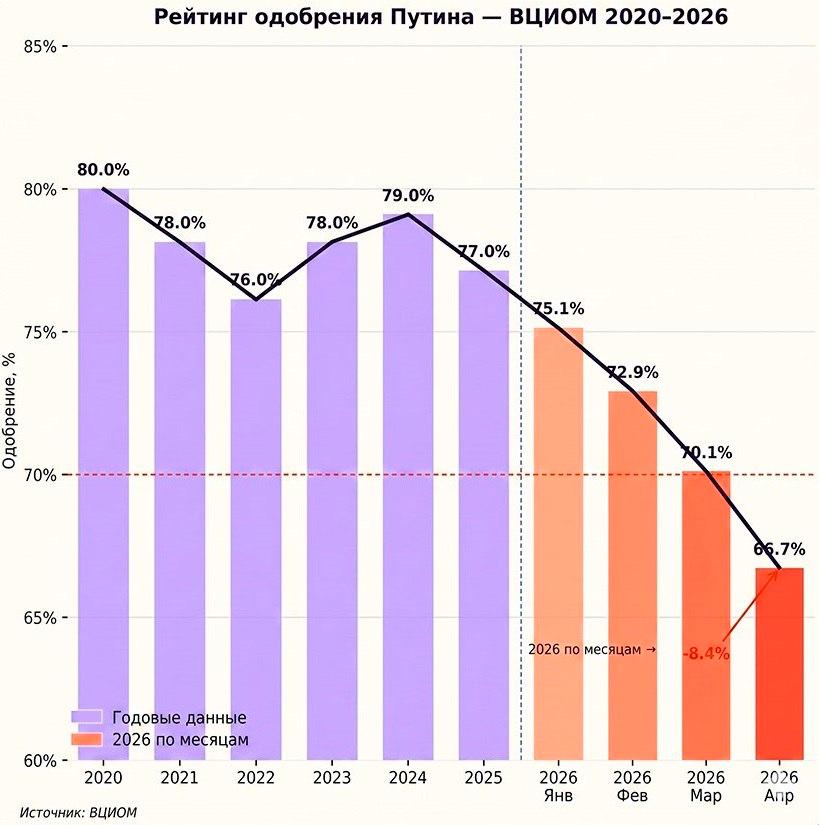
Photo: Putin’s approval rating from 2020 to 2026 (VCIOM)
According to Bloomberg, the sharp drop is primarily linked to the blocking of the Telegram messaging app. Internet disruptions and growing public frustration have forced the Kremlin to reconsider its approach to restrictions.
The Kremlin saw the negative economic and political impact of an idea promoted by an FSB-linked faction to block the internet and Telegram. Attempts to force Russians to switch to a so-called "national messenger," Max, have had the opposite effect.
Internet outages have particularly angered residents of Moscow, who are not accustomed to such restrictions. As Putin’s ratings began to fall, the Kremlin, which is trying to maintain the illusion of broad public support ahead of State Duma elections, has been forced to change its tactics.
Ukraine’s Foreign Intelligence Service also reported on March 31 that public trust in the Russian government and key state institutions is steadily declining. An increasing number of Russians view the situation in the country negatively, while support for the Kremlin’s course is weakening.
Telegram blocking and internet restrictions in Russia
As a reminder, Russia began blocking Telegram earlier than expected. The move was initially planned for early April, starting April 1, but in reality, restrictions began in late March.
This even sparked protests for a "free internet" in Russia. They took place on March 29 in most major cities and ended with detentions. Between 3 and 12 people were detained, while most demonstrators were simply dispersed.
Telegram, which Russian authorities are attempting to block, has introduced a special update with an enhanced anti-censorship protocol. In theory, this allows the app to function even in regions where it is blocked.