PL-17 missile: China's latest threat to US air power

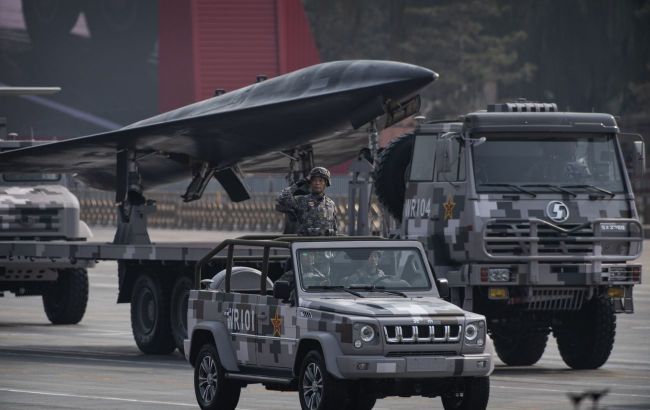 Illustrative photo: China showed off a giant rocket (GettyImages)
China unexpectedly revealed a new long-range missile, the PL-17, with a range of up to 500 km. The published photo has raised concerns in the US, as this weapon could dramatically shift the balance of power in the air, according to Defense Express.
The publication notes that US analysts have taken note of China’s unusual openness—detailed images of the missile are essentially not concealed, despite Beijing’s usual secrecy regarding new weapons.
Missile known for nearly 10 years
The PL-17 is not entirely new. The first clear images of the missile appeared back in 2016, when a Shenyang J-16 fighter carried two previously unknown missiles. Official photos of the PL-17 were only released in 2023.
According to experts, the missile has effectively existed for about ten years and may have become mass-produced and integrated onto multiple platforms during that time.
Range of up to 500 km and massive size
Available data indicates that the PL-17 has a launch range of 300–500 kilometers. This range is achieved through a dual-pulse engine, which explains the missile’s considerable size.
The PL-17 is approximately six meters long, nearly two meters longer than the American AIM-120 or its Chinese counterpart, the PL-15.
Guidance at long distances
The Chinese missile has its own radar homing head, but at maximum range, this alone is insufficient. To effectively hit a target, the PL-17 requires constant updates on the point of intercept.
Such information is primarily provided by long-range airborne radar aircraft (AWACS), which are a key component of the missile’s operational concept.
Not for fighters: the real target is strategic aviation
Analysts note that the PL-17 is unlikely to be optimal for destroying maneuverable fighters at maximum range. Its main purpose is targeting AWACS, aerial refueling tankers, and other large airborne platforms.
Experts pay particular attention to its potential to strike refueling aircraft, without which US combat aviation loses a significant portion of its operational effectiveness.
Threat to the entire US aviation concept
Defense Express emphasizes that targeting aerial tankers could severely limit the US ability to conduct long-range aviation operations, multi-hour patrols, and rapid concentration of forces in the sky.
In such a scenario, much of US aviation would be forced to operate from a limited number of advanced airbases within the range of Chinese missiles.
"Although the US already possesses similar long-range missiles - AIM-174B, converted into SM-6 air combat missiles with an expected range of 500+ km—there are questions about the number of these systems. In addition, Chinese air forces in the Pacific theater benefit from a short and strong continental logistics backbone, which no missile can compensate for," the article states.
Chinese fighters
Recently, China was observed testing a new unknown aircraft that, based on its characteristics and appearance, may belong to the sixth-generation fighter class. In released videos, it flies in tandem with the Chengdu J-20, a fifth-generation fighter considered among the most advanced in the People’s Liberation Army Air Force.
Later, China launched another promising next-generation combat aircraft, designated the J-36.
Previously, RBC-Ukraine also reported that, according to Pentagon estimates, Beijing has significantly accelerated the modernization of its armed forces and is actively expanding its nuclear potential.
Additionally, earlier reports indicated that the Chinese stealth fighter Shenyang J-35 likely made its first takeoff using an electromagnetic catapult (EMALS) from the new aircraft carrier Fujian.