Nuclear fusion reactors could move into space: Why humans might need them

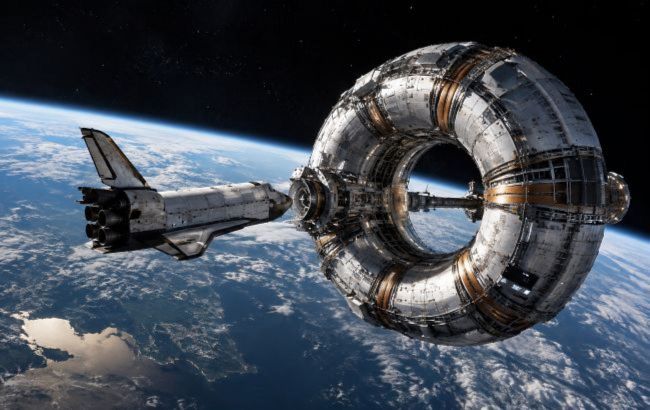 Nuclear fusion in space could be key to building settlements beyond Earth (collage: RBC-Ukraine)
Nuclear fusion could become a clean energy source, but scientists have so far been unable to build efficient reactors on Earth. Researchers propose placing them in orbit to power future space missions and settlements, according to a study published in the ResearchGate academic repository.
How could space tokamaks be better than Earth-based reactors?
One proposed option is to place large, donut-shaped fusion reactors called tokamaks in geostationary orbit.
Another idea involves using satellites equipped with powerful lasers to direct beams at special targets and trigger a fusion reaction.
Physicist Young K. Bae of Spacefaring Research acknowledges that these projects are still largely theoretical.
At the same time, the scientist identifies several advantages of space-based reactors over their Earth-based counterparts:
Microgravity. It significantly reduces the mechanical stress on a tokamak's structure.
Absence of atmospheric pressure. This makes it possible to build much smaller and lighter vacuum chambers.
Cooling in outer space. Excess heat from the reactor could be dissipated using special panels that radiate it directly into space at around 726 degrees Celsius.
In the study, Bae proposed a preliminary design for a 1-gigawatt tokamak. Such an installation could supply electricity to approximately one million homes.
It could also power large industrial facilities, orbital data centers, and deep-space bases.
Read also: Scientists claim universe is twice as old, rendering dark matter unnecessary
Why do space missions need new energy sources?
Currently, most spacecraft get their energy from solar panels. However, the farther a mission travels from the Sun, the less efficient its solar panels become.
To ensure a stable power supply on the Moon, the United States and China plan to use nuclear fission reactors. However, these installations raise concerns because of the risks associated with radioactive materials.
Bae believes that controlled nuclear fusion could become the foundation for a sustained human presence beyond Earth. His study focuses primarily on reactors that use magnetic fields to contain superheated plasma.
However, the scientist also explored another option: triggering a fusion reaction in outer space using powerful lasers.
Read also: The universe could disappear in an instant: What physicists say about the threat