Scientists claim universe is twice as old, rendering dark matter unnecessary

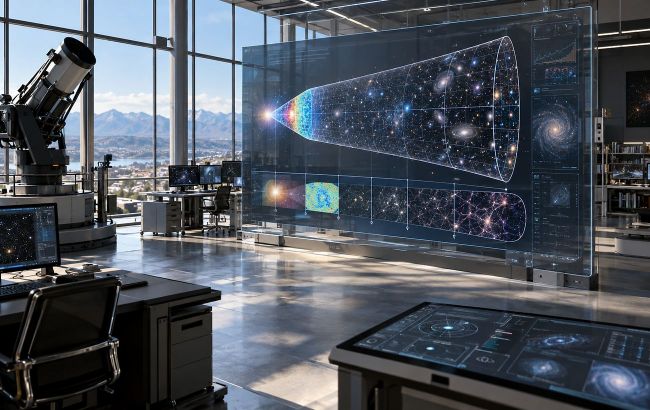 Scientists state that the Universe may be nearly 27 billion years old (image: RBC-Ukraine)
Researchers from the University of Ottawa have presented a new cosmological model according to which the age of the Universe is 26.7 billion years. The theory does not require the existence of dark matter or dark energy, according to a scientific study published in the journal Monthly Notices of the Royal Astronomical Society.
New model without dark matter: what do scientists propose?
For decades, scientists have searched for evidence of dark matter and dark energy, yet neither has been directly detected.
The standard cosmological model, known as ΛCDM, is also beginning to be questioned due to the discovery of extremely massive galaxies in the early Universe.
A team of researchers from the University of Ottawa, consisting of Rajendra Gupta and Nikolaos Samaras, tested an alternative concept called CCC+TL (covarying coupling constants plus tired light).
Instead of invisible components, the model suggests that the effects attributed to dark matter and energy are caused by the evolution of fundamental constants that govern the interaction of forces and particles.
Successful tests and consistency with observations
The authors of the study modified Einstein's and Friedmann's equations, developing new mathematical tools to test the theory.
The results showed high consistency with key astronomical data.
How exactly?
- Predictions regarding the abundance of hydrogen, helium, and other light elements formed after the Big Bang matched those of the standard model.
- Data from cosmic chronometers confirmed calculations of the Universe's expansion rate.
- Analysis of the SPARC database for 175 galaxies demonstrated the model's ability to reproduce rotation curves without invoking dark matter.
Additionally, analysis of the Bullet Cluster collision showed that the additional gravitational effect in the new model follows the galaxies themselves, rather than the hot X-ray gas. Scientists believe this is significant evidence supporting the concept.
Why are early galaxies no longer a mystery?
The new concept resolves one of the biggest problems in modern astrophysics—the appearance of huge, mature galaxies at extremely early stages of cosmic development.
In the standard model, the age of the Universe during the cosmic dawn was estimated at approximately 300 million years, which is too little time for such objects to form.
According to CCC+TL model calculations, at that same redshift moment, the age of the Universe was about 4.6 billion years. This extra time allowed galaxies to grow approximately 12 times larger in size and mass than predicted by standard theory.
The next stage of testing this theory will be the GLIMPSE program involving the James Webb Space Telescope. It will search for galaxies with record-high redshifts.
If such objects are discovered in the early Universe period when, according to the standard model, there was insufficient time for their formation, it would become a strong argument in favor of the alternative theory.