No education, no career: How the Soviet Union shut Jews out and fueled hatred


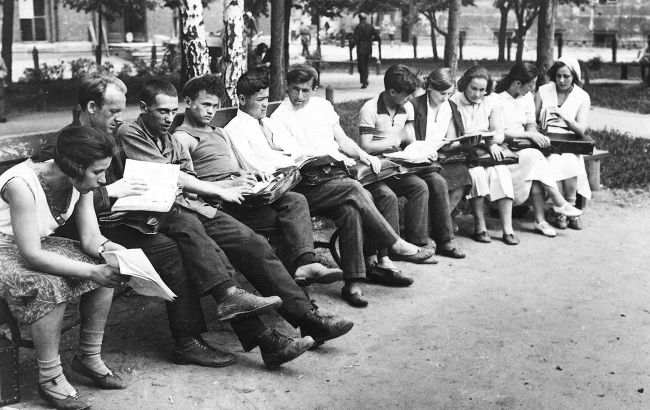 The Soviet regime cultivated hostility between different peoples (illustrative photo: Getty Images)
During the Soviet era, the Holocaust was concealed behind the phrase "peaceful Soviet citizens" to erase the identity of the victims. At the same time, Jews were turned into both an internal and an external enemy, says historian Vitalii Nakhmanovych in an interview with RBC-Ukraine.
How many Jews were killed during the Holocaust
The expert stressed that the Holocaust is not a "foreign" story, but part of Ukraine's own history.
"When victims are not divided into ours and others, and all are remembered, society itself becomes stronger," he said.
According to Nakhmanovych, "the Holocaust claimed the lives of more than six million Jews in Europe, including at least one and a half million in Ukraine."
In Babyn Yar in Kyiv alone, "more than 33,000 people were killed in just two days in September 1941."
"The Soviet Union tried to appropriate and erase the memory of the tragedy, but failed. Today, remembrance of the past serves as a warning: forgetting the lessons of history is dangerous for all generations," the historian emphasized.
What is known about persecution of Jews in the USSR
Nakhmanovych explained that officially (though not publicly declared), the Soviet Union had "national percentage quotas" during that period:
- for education;
- for employment;
- for holding certain positions.
As an example, he recalled a story told by the well-known Soviet poet Rasul Gamzatov in his memoirs, about how he came to Moscow to apply to the Literary Institute.
He submitted his documents and was asked, "What is your nationality?" He replied, "I am an Avar." "Is an Avar an Abkhaz?" "No, an Avar is an Avar." "Sorry," they told him, "but there is no quota for your nationality," the historian recounted.
According to him, the same situation applied to Jews.
"Jews were the most urbanized nation in the Soviet Union. Their aspiration for higher education, like that of any urban population, was high, but people encountered this problem," the scholar acknowledged.
Nakhmanovych also shared the story of his own mother, who graduated from the Kyiv Polytechnic Institute's evening program (because she was not admitted to the daytime program) and worked at a design institute for the light industry.
"Once, a colleague of hers, a Ukrainian woman, asked, "Is it true that only Jews are hired at this institute?" My mother replied, "You're mistaken; it's simply the only institute where Jews are hired at all," he said.
In addition, Jews were barred from certain jobs altogether.
"For example, in Kyiv, there were very few design institutes that were allowed to employ Jews. Most likely, all of them were considered of strategic importance, and the authorities feared agents of world Zionism," the expert noted.
Why hostility between people was cultivated
In conclusion, the historian stressed that "the Soviet regime needed to cultivate hostility between different peoples."
"Therefore, tragedies were silenced, while myths were spread — for example, about Jews who fought in Tashkent and Ukrainians as punishers and Nazi collaborators," Nakhmanovych explained.
The main goal, he said, was "to ensure that Ukrainians and Jews could never unite in opposition to Soviet power."