Moon appeared in just 5 hours? Scientists reveal shocking new theory

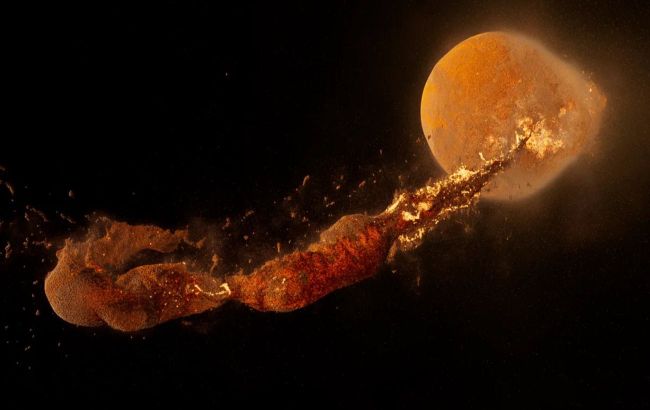 The Moon may have formed in just a few hours (photo: NASA)
New computer simulations by astrophysicists have shown that the Moon may have formed in just five hours after Earth collided with the protoplanet Theia, according to scientific journal IOP Science.
According to the widely accepted hypothesis, the Moon formed after a hypothetical object called Theia — a Mars-sized protoplanet — collided with the early Earth.
It was believed that some of its remnants went on to form the Moon, while others ended up deep inside the Earth.
For a long time, scientists believed that the energy released by the impact was so immense that Theia’s specific geological properties did not matter to the final scenario. However, new simulations completely challenge this assumption.
The impact of temperature and material strength
New computer models have shown that if Theia was a hot but solid body, like Earth, the catastrophe unfolded very differently than it would have if Theia had been colder.
Hotter objects are less rigid than colder ones, meaning that moon-formation scenarios proved to be extremely sensitive to temperature.
According to the study’s author, Dr. Adin Denton of the Southwest Research Institute in Texas, the proto-Moon’s initial geology is crucial.
“When Earth and the Moon are simulated as bodies with specific geological properties, it completely changes the mechanics of how they form after the collision — a detail that was previously considered unimportant,” the scientist explained.
Key findings from the simulations
Slow scenario: at high temperatures for both Earth and Theia, the impact could have destroyed Theia and created a massive disk of debris around Earth, from which the Moon gradually formed over a long period of time.
Fast scenario: when the same internal temperature was used for both bodies, a fully formed and intact Moon separated from the collision debris and emerged in just five hours.
Previous research: the concept of rapid formation was already proposed in a 2022 study, but the new research is the first to show that material strength and the temperature at the time of the collision have a tremendous impact on how events unfold.
Solving ancient mysteries
Today, the Moon has a number of physical and chemical properties that do not fit the traditional view of its prolonged formation from a circumplanetary disk.
The more flexible scenario proposed in the new study helps resolve these contradictions and explain the existing anomalies.
Scientists note that modern models have evolved and now take material strength into account — a parameter previously used only when studying collisions between small asteroids or the formation of the Pluto–Charon system.
As the new calculations have shown, this factor turned out to be no less important for the Moon.