Latvia builds anti-tank defenses along border with Russia

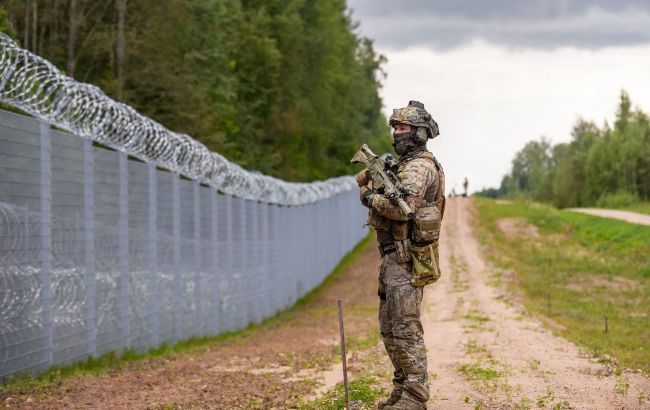 Latvia installs dragon's teeth and anti-tank trenches along the border with Russia (photo: Getty Images)
Latvia's National Armed Forces have begun installing the so-called dragon's teeth barriers and anti-tank trenches along the entire border with Russia, LSM reports.
It is noted that this land was previously expropriated for national defense purposes, as the construction of the Baltic Defense Line infrastructure is planned directly along the border, including areas where private property is located.
The barriers are arranged in three rows, about 10 meters wide, and are intended to prevent military equipment from crossing the border.
Each of the dragon's teeth weighs about one and a half tons. Military officials noted that the gaps between them are small, so military vehicles cannot pass through.
The production and delivery of the barriers to deployment sites began in 2024, but their physical installation on state and municipal land began in 2025.
Land expropriation became one of the biggest challenges, since part of the infrastructure is being built on private property, but the Law on the Establishment of Anti-Mobility Infrastructure significantly accelerated the process.
"Until the Law on the Establishment of Anti-Mobility Infrastructure was adopted, we faced restrictions. We could not come in and begin deploying these mobility barriers on private land. At this point, that has been resolved," said Colonel Andris Rieksts, the officer in charge of the Baltic Defence Line project.
According to the publication, owners will receive fair compensation for the expropriation of land needed for the construction of the infrastructure, which will be determined by a special commission with the help of a certified real estate appraiser.
The goal of the defense line is not only to deter a potential enemy, but also, if necessary, to stop and destroy them while they are still at the border.
"If something does happen, we need to be able to destroy them here, because we see that in Ukraine – once we give up land, it's practically impossible to get it back," Riksts said.
He stressed that in modern warfare, not only defense against drone and missile attacks is important, but also control over territory.
"They won't be able to conquer us with drones. In Ukraine, we see that there are hundreds of drone and missile attacks every day, but as long as the land is held and no one physically comes and drives people out of their homes, that land is ours," the officer added.
In addition to the dragon's teeth, the construction of anti-tank trenches is also planned in the future.
The total length of Latvia's border with Russia and Belarus is about 450 km. This year, Latvian troops plan to build more than 8 km of anti-mobility infrastructure.
Threat to Europe from Russia
Fears are growing in Europe that Russia could expand the war beyond Ukraine.
Several European national security officials have warned that within the next 12 months, Russia may try to test NATO unity by attacking one of the Baltic states, Swedish or Danish islands in the Baltic Sea, or alliance territory in the Arctic.
In addition, recent threats by US President Donald Trump to withdraw from NATO and his moves to reduce American troops stationed in Europe are increasing the threat.
Polish Prime Minister Donald Tusk recently warned that Russia could attack one of the NATO countries within months rather than years. He is also unsure whether the United States would defend Europe in such a scenario.
Meanwhile, Germany adopted the first military strategy in its history, officially naming Russia as the main security threat in Europe.
Defense Minister Boris Pistorius said that Moscow is preparing for a confrontation with NATO and is already waging a hybrid war against the West.
At the same time, the Center for Countering Disinformation under Ukraine's National Security and Defense Council believes that Russia's hybrid provocations — aircraft entering the airspace of Baltic countries and statements about Western plans to seize Kaliningrad — are part of an information campaign aimed at spreading panic.
According to the Center for Countering Disinformation, Russia will not have the resources for a full-scale war in the Baltic states until 2028.