Inca treasure and Dracula's fortress: Hidden Carpathian castles with incredible legends

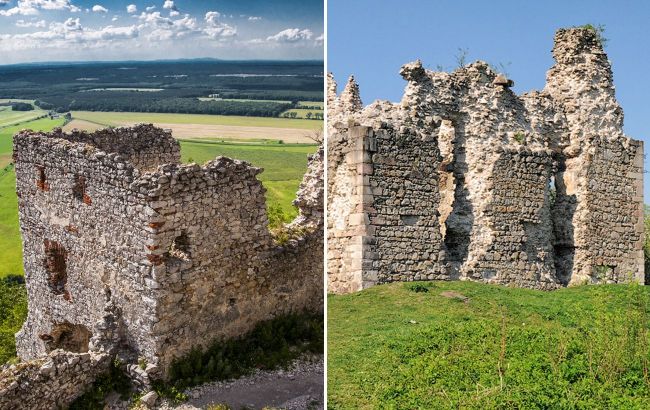 Hidden historic castles in the Carpathians few people know about (collage: RBC-Ukraine)
The Carpathian Mountains are often associated only with breathtaking landscapes, alpine meadows, and ski resorts. But for centuries, these mountains served as a natural frontier between powerful empires, leading to the construction of dozens of remarkable fortresses and castles, many of which remain overlooked today.
RBC-Ukraine highlights some of the most fascinating castles and fortresses hidden across the Carpathian range from Ukraine to Romania, Slovakia, and Poland, offering a unique blend of history, mystery, and spectacular scenery.
Nyalab Castle (Ukraine)
While thousands of visitors flock to Palanok Castle in Mukachevo or Uzhhorod Castle every year, the impressive ruins of Nyalab Castle near the village of Korolevo in Ukraine's Zakarpattia region remain largely forgotten.
Perched on a volcanic hill overlooking the Tysa River, the fortress once belonged to the Hungarian royal family before becoming the residence of the noble Perényi family.
The site is significant not only for its military history. In the 14th century, the famous Korolevo Gospel, an important monument of early Ukrainian literature, was created here. According to local legends, the castle's extensive underground tunnels stretched all the way to the river.
The fortress was destroyed in the 17th century on the orders of the Austrian emperor. Today, visitors can explore the surviving walls and central tower, which offer sweeping views of the Zakarpattia Carpathians.
Poenari Fortress (Romania)
Most travelers searching for Vlad the Impaler's legacy head to Bran Castle, although the Wallachian ruler rarely, if ever, stayed there. His true mountain stronghold was Poenari Fortress, hidden deep within Romania's Southern Carpathians near the famous Transfăgărășan Highway.
Built atop a cliff above the Argeș River canyon, reaching the fortress requires climbing nearly 1,500 concrete steps through dense forest.
Originally constructed in the 13th century, the fortress was heavily reinforced during Vlad's reign and became one of his most important military strongholds. Its isolated location and imposing medieval ruins create an authentic Gothic atmosphere unlike the tourist crowds at Bran Castle.
Slovenská Ľupča Castle (Slovakia)
Near Banská Bystrica, Slovenská Ľupča Castle rises above the surrounding landscape from a steep hill. Although remarkably well preserved, it remains absent from most international travel guides.
The castle was built in the 13th century after the Mongol invasion to protect an important trade route crossing the Tatra mountain passes. It also served as a customs station and royal residence, where Hungarian monarchs often stayed during hunting trips.
One of the castle's greatest treasures is an ancient linden tree, believed to have been planted by King Matthias Corvinus in the 15th century. Visitors can also explore deep stone cellars and a well carved more than 60 meters into solid rock.
Niedzica Castle (Poland)
Located on the shores of Lake Czorsztyn near the Slovak border, Niedzica Castle is one of southern Poland's hidden gems. Despite its picturesque setting, relatively few international tourists venture here.
Originally built in the early 14th century as a Hungarian frontier fortress, Niedzica is surrounded by one of Europe's most unusual legends.
According to the story, one of the castle's owners returned from South America in the late 18th century with a wife descended from the Inca rulers. It is said they hid part of the legendary Inca treasure and a mysterious quipu—the ancient Inca knot-record system—within the castle's underground chambers.
In the mid-20th century, a lead capsule containing Peruvian documents was indeed discovered at the site, but the mystery of the lost Inca gold remains unsolved.