Ship castles and underground bunkers: Ukraine's 10 architectural marvels you need to see

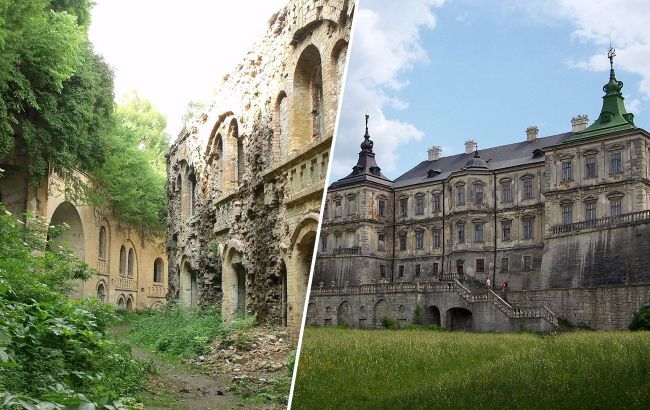 Ukraine's most unusual castles that tour guides rarely mention (Collage by RBC-Ukraine)
Most tour guides have been taking tourists along the same route for years: Kamianets-Podilskyi, Khotyn, and Palanok in Zakarpattia. But the true architectural oddities and mystique are hidden in remote villages, where ancient walls are overgrown with shrubs or serve as fences for residents.
RBC-Ukraine presents the 10 strangest castles and fortresses in Ukraine, including both well-known architectural anomalies and completely forgotten structures that will surprise you.
Mykulyntsi Castle
Most European castles have either been turned into museums or lie in ruins. But this 16th-century defensive stronghold in the Ternopil region is the only one of its kind in Ukraine.
It is a truly living castle, as ordinary people have been living for several generations inside its centuries-old defensive walls, in the renovated rooms of the flanking towers.
Whether you’re buying a ticket or simply strolling through the courtyard of this medieval bastion, it’s quite common to encounter residents going about their daily chores, tending their vegetable gardens, or hanging laundry on clotheslines right beneath the arrowslits.
Novomalyn Castle
These little-known ruins on the banks of the Zbytenka River were once the Malynski Palace. The most remarkable feature of this site is the remains of a pentagonal chapel in the pseudo-Gothic style.
Its interior was once entirely adorned with intricate stucco work imitating the intertwining of forest vines and foliage. Even now, in its semi-ruined state, the castle impresses with its delicate, openwork architecture in the midst of the forest wilderness.
_1.jpg) Novomalyn Castle (photo: wikimedia.org)
Novomalyn Castle (photo: wikimedia.org)
Sydoriv Castle
If you look at this structure from above or from a certain angle in the valley, it seems as though a huge warship is racing at breakneck speed across the green fields of Podillia.
The castle was built in the 17th century from local limestone and has a unique elongated triangular shape. Its length is nearly seven times its width.
This architectural eccentricity can be explained by the plateau’s topography, but the visual effect of a stone ship with a sharp, pointed bow makes it one of the country’s most whimsical outposts.
Schönborn Palace
The Beregvar hunting castle in Zakarpattia amazes not so much with its defensive logic as with the astronomical fanaticism of its creators.
The late 19th-century building was constructed according to the precise principles of the astronomical year. The castle has exactly 365 windows (like the days of the year, with one bricked up in case of a leap year), 52 rooms (the number of weeks), 12 entrances (the months of the year), and 4 towers at the corners, symbolizing the seasons.
Even the artificial pond in the luxurious park surrounding the palace once had a curious shape—it precisely replicated the contours of a map of the Austro-Hungarian Empire of that time.
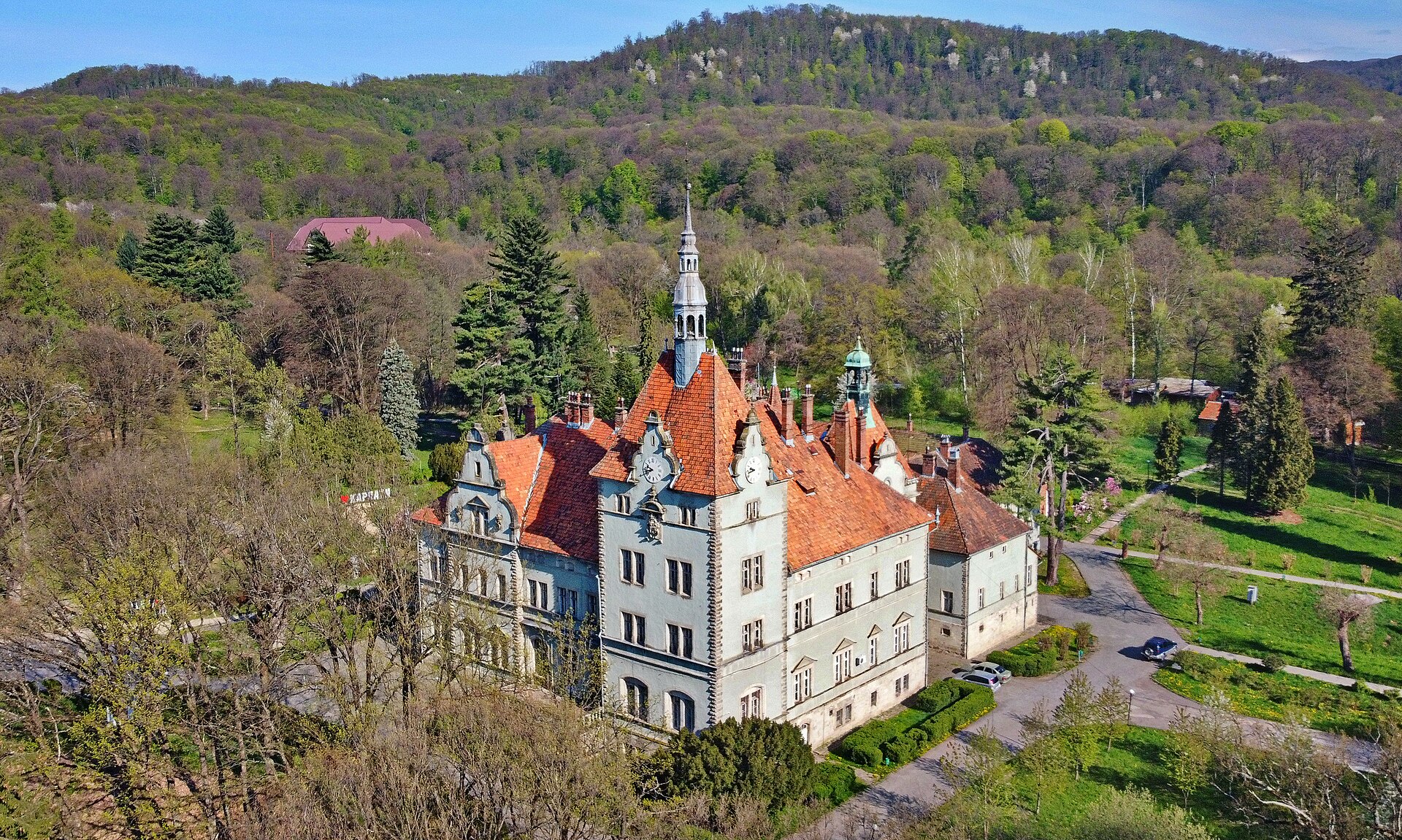 Schönborn Palace (photo: wikimedia.org)
Kudryntsi Castle
The castle was built in the early 17th century atop the steep Strilka Mountain overlooking the Zbruch River. Its main feature is that one of its three walls rests entirely on the edge of a rocky precipice, which served as a natural defense.
Because of this, the castle appears to be an extension of the cliff itself. Beneath the fortress lies an abandoned labyrinthine cave, to which, according to legend, a secret passage leads from the palace cellars.
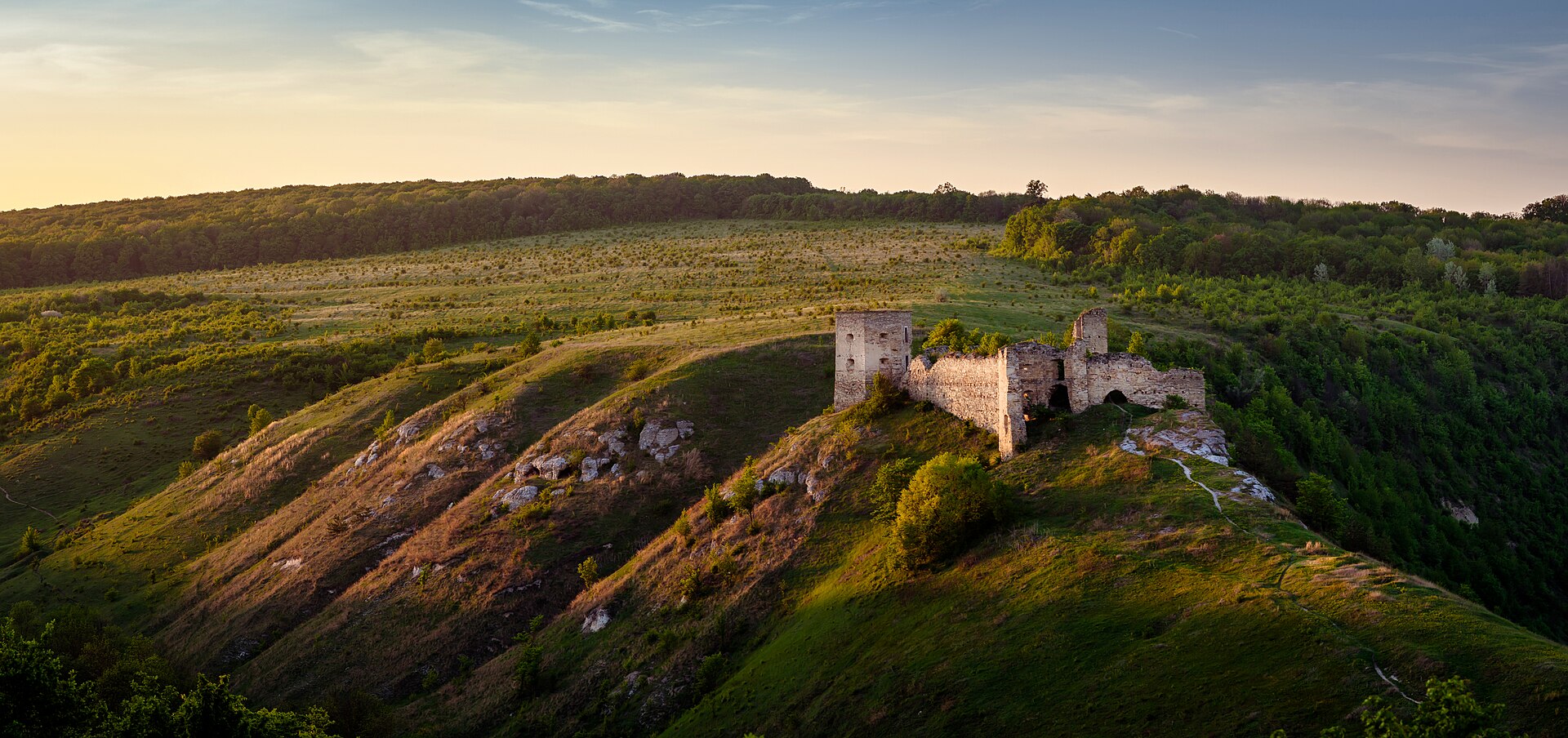 Kudryntsi Castle (photo: wikimedia.org)
Tarakaniv fortress
It’s hard to call this place a classic castle, but in terms of its scale and mystery, this late 19th-century military outpost surpasses many medieval citadels.
The main peculiarity of this fort in the Rivne region is that it’s almost impossible to see from a distance—it’s hidden deep inside a hill underground, camouflaged by vegetation and fortification ditches.
To reach the heart of the fort, you must walk through a dark, 100-meter-long tunnel. A mixture of bricks, crumbling concrete, and corridors leading nowhere creates an atmosphere of a mystical post-apocalyptic world.
_06_1.jpg) Tarakaniv fortress (photo: wikimedia.org)
Tarakaniv fortress (photo: wikimedia.org)
Pidhirtsi Castle
This castle in the Lviv region is considered one of the most beautiful examples of the palazzo in fortezza style, where the elegance of the Italian Renaissance is combined with bastion fortifications
However, its strange fame is linked to the afterlife. Pidhirtsi is considered perhaps the most famous haunted castle in Ukraine.
According to legend, one of its former owners, Count Zhevuskyi, walled up his young wife alive within the palace walls out of mad jealousy.
Since then, paranormal investigators and numerous tourists have claimed to see the misty silhouette of a woman in white (The White Lady) in the cellars and park alleys.
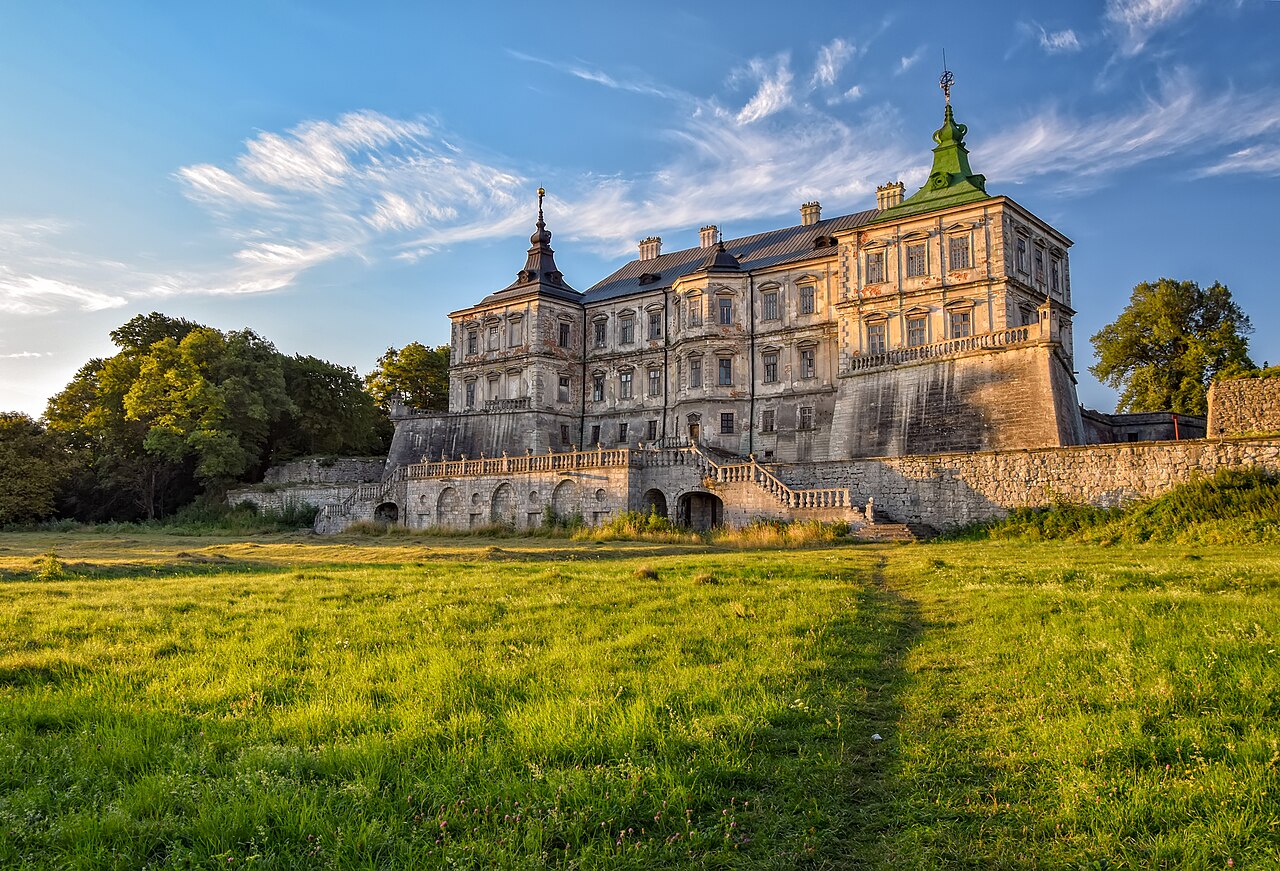 Pidhirtsi Castle (photo: wikimedia.org)
Chervonohorod Castle
A ghost castle is located deep within a massive crater-canyon in the middle of the lost city of Chervonohorod. Its two massive towers with Gothic battlements look incredibly surreal against the backdrop of the wild landscape.
The fact that the ground around the castle has a rich red color due to the unique composition of the local sandstone adds a special charm, and nearby roars Ukraine’s tallest lowland waterfall—the Dzhurinskyi.
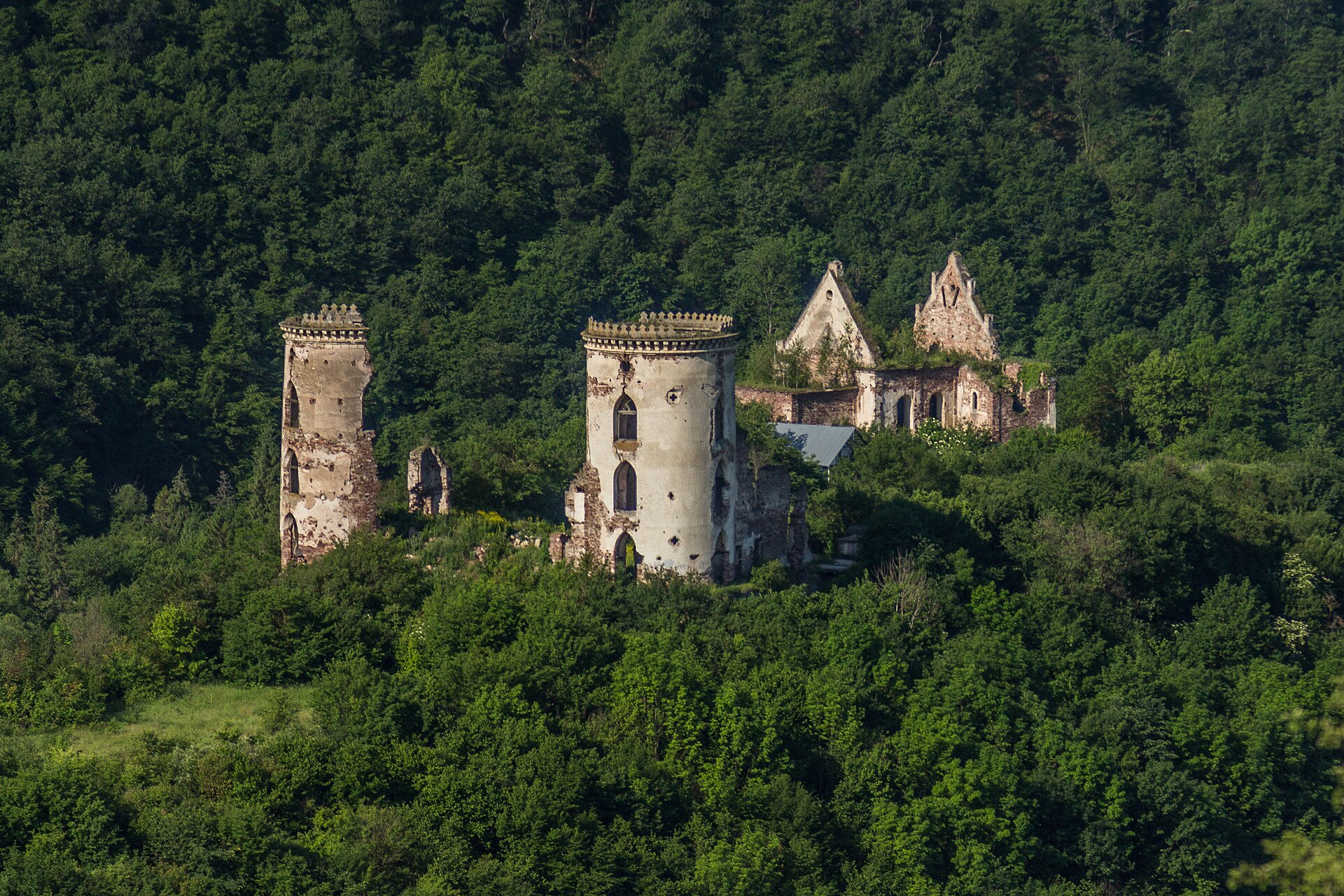 Chervonohorod Castle (photo: wikimedia.org)
Saint Miklós Castle
Unlike the opulent neighboring palaces, this 15th-century castle appears from the outside to be an austere, gloomy, and almost unadorned stone cube. It is a fortress-like castle.
Its main surprise lies inside—walls over a meter thick conceal an entire system of secret passages. You can enter a room on the first floor and, through a hidden door in the wall, emerge in the middle of a hall on the second floor.
Skala-Podilska Castle
This fortress is situated on a high rocky promontory and is protected on three sides by cliffs and a river. The most remarkable part of the ruins is the powder tower, which is perhaps the best-preserved structure.
It has an unusual oval shape and literally rises from a jagged rock. The defensive walls, built of dark local slate, add a special atmosphere, giving the castle a very gloomy and Gothic appearance.
Ostroh Castle in the village of Mezhyrich
This is a unique example of a defensive monastery-castle, defended not only by monks but also by a full-fledged military garrison.
Massive defensive walls with towers featuring artillery embrasures surround the enormous Trinity Church.
The most remarkable feature of the complex is a huge ancient open-air furnace in the middle of the courtyard. It was once used to boil pitch for sieges and to keep the guards warm during winter assaults.
_1_1.jpg) Ostroh Castle (photo: wikimedia.org)
Ostroh Castle (photo: wikimedia.org)