Humanoid combat robots enter battlefield trials in Ukraine

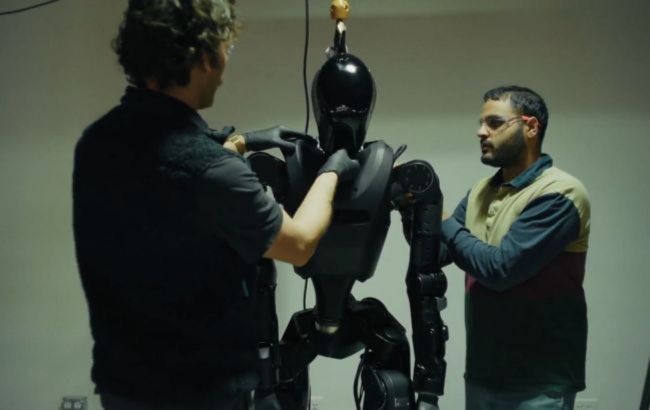 Phantom robot (photo: video screenshot)
American startup Foundation Future Industries, which is linked to Donald Trump, is testing its combat humanoid robots in Ukraine. The systems are being trialed directly on the front lines of the war launched by Russia, CNBC reports.
Company, its ties to Ukraine
The outlet says Foundation is based in San Francisco and specializes in robotics. It is also linked to the family of US President Donald Trump.
The media notes that the startup envisions a fundamentally different use for humanoid robots. While many companies are developing them for tasks such as folding laundry or serving coffee, Foundation sees their application in warfare and other high-risk, potentially life-threatening professions.
In particular, the company is developing autonomous dual-use humanoid robots intended for both heavy industry and military applications.
Early prototypes are being tested in Ukraine for potential battlefield use, with trials conducted in real combat conditions in the war launched by Russia against Ukraine.
In an interview with CNBC, CEO Sankaet Pathak said the company is built on the belief that humanoid robotics should focus on solving humanity's most critical challenges rather than performing household tasks and services.
The startup has set ambitious goals: Pathak plans to scale production to thousands of units this year and begin frontline testing with US troops within the next 18 months.
Trials in Ukraine: What we know
Earlier this year, Foundation gained broader international recognition by sending two of its Phantom MK-1 robots to Ukraine for a pilot demonstration. According to the company, this marked the first known deployment of humanoid robots in a combat zone.
The extended trials, supported by the US government and conducted in cooperation with Ukrainian officials, have focused on logistics tasks in high-risk areas.
Ukraine has become a natural testing ground, as the war has turned the country into a large-scale real-world laboratory for robotics and artificial intelligence under combat conditions. Ground robots are already used for frontline resupply missions, while autonomous and AI-enabled drones carry out precision strikes and reconnaissance.
Pathak says the MK-1 trials in Ukraine have already demonstrated the robot's potential for logistics missions that often put soldiers at risk.
However, the company acknowledges limitations: the MK-1 systems are far from super-soldiers, carrying only about 20 kg of payload. They also lack waterproofing and sufficient battery life for large-scale deployment.
Foundation plans to send an upgraded version, Phantom 2, to Ukraine this year. The CEO says the new model will feature superhuman capabilities and double the payload capacity of the Phantom 1.
Why US conducts these trials
Foundation expects the results of its Ukraine trials to inform future cooperation with the US military.
The startup has already received $24 million in government contracts for research into applications in inspection, logistics, and weapons handling across the Army, Navy, and Air Force.
According to Pathak, discussions with government officials have shifted from research toward scaling deployment. He aims for Foundation's technology to be used by the US armed forces — and, if necessary, on active battlefields — within the next 12–18 months.
Trump's role
CNBC reports that this effort involves Eric Trump, the second son of Donald Trump, who recently joined the company as chief strategy advisor.
A Foundation representative told the outlet that Eric Trump was an investor in the firm before becoming an advisor, and that both sides share a vision of bringing manufacturing back to the United States.
Robots in Ukraine
Recall that in April, CNN reported that Ukraine is increasingly using robotic technology on the battlefield. Ground drones and unmanned systems have already enabled Ukrainian forces to storm positions and capture prisoners without a single shot being fired by infantry.
Also, the Ukrainian company DevDroid regularly updates its combat robots, enabling rapid adaptation to battlefield conditions. According to Business Insider, NATO has taken a strong interest in this advantage.