Europe describes relations with US as dysfunctional family — The Guardian

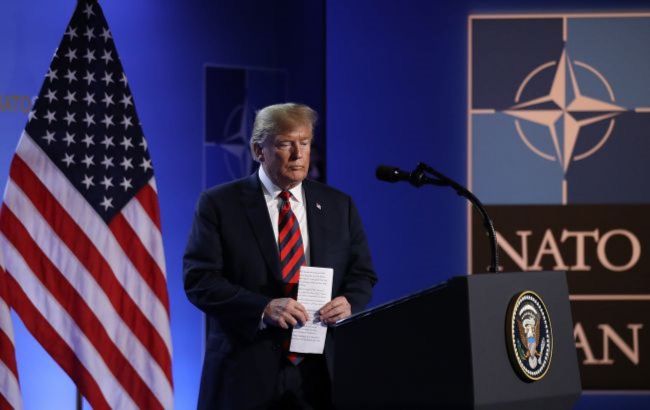 US President Donald Trump (photo: Getty Images)
Countries in Eastern Europe are increasingly worried about how the United States might respond to a potential Russian attack ahead of the NATO summit in Ankara, with Poland and the Baltic states preparing for a scenario in which US forces may not join the defense, The Guardian reports.
According to the report, since Donald Trump returned to the White House, capitals in Eastern Europe have increasingly discussed a nightmare scenario: what would happen if Russia attacked and the United States did not join the fight.
The Guardian writes that at a mid-May meeting in Tallinn, US Deputy Secretary of State Thomas DiNanno was directly asked whether American troops would fight in the event of a Russian invasion of the Baltic states.
The official reportedly "shifted uncomfortably in his chair," and his answer was unclear—there was no "yes."
Publicly, regional politicians avoid such topics. "We shouldn't pour fuel on the fire," ministers from several eastern NATO countries reportedly repeated.
Dysfunctional family metaphor
Former Lithuanian Defense Minister Dovilė Šakalienė compared Europe–US relations to a "dysfunctional family where divorce is not an option." Another official described the situation more bluntly:
"What do you do when your beloved father figure suddenly starts drinking and behaving in a way that is utterly incomprehensible? It's hard to know how to act," the official said.
According to The Guardian, the first warning signs appeared in February 2025, less than a month into Trump's second term, when US Defense Secretary Pete Hegseth said in Brussels that European security would no longer be Washington's priority.
Summit in The Hague, Rutte as mediator
The report says the June 2025 NATO summit in The Hague took place amid "apocalyptic predictions" that Trump might use it to undermine the alliance.
The summit was ultimately considered successful, largely due to NATO Secretary General Mark Rutte, who "made it his personal mission to keep Trump happy."
At the same summit, member states committed to increasing defense spending to 5% of GDP by 2035—a level that Poland and the Baltic states have already come close to, but which was previously considered unthinkable for many Western European countries. According to the report, Rutte made it clear that this was a personal achievement of Trump.
Rutte's privately referring to Trump as "daddy" in the corridors was reportedly seen by NATO officials as "distasteful but tolerable." "It's cringe, but most European leaders are fine with it as long as he delivers Trump," one source told the outlet.
Former Estonian President Kersti Kaljulaid told The Guardian that Trump's pressure on Europeans has produced results, whereas previous administrations achieved little.
"Barack Obama and Joe Biden asked politely for Europeans to spend more and it got us nowhere. It is only by being impolite and insistent that you can get Europe to change," she said.
Drones, Greenland, White House unpredictability
The report says the main problem is that "a firm promise today can be undone by a Truth Social post tomorrow." For example, after a Russian drone incident, Trump initially posted "Here we go!", but later suggested it might have been a mistake rather than a deliberate attack.
Polish Foreign Minister Radosław Sikorski strongly rejected this interpretation, saying, "You can believe that one or two veer off target, but 19 mistakes in one night, over seven hours, sorry, I don't believe it."
The article also notes renewed tensions after Trump's earlier threats regarding Greenland, a Danish territory and NATO member.
Some capitals even asked whether Article 5 would apply in such a scenario.
Sikorski warned that some reduction in US troops in Europe now appears inevitable, predicting a shift toward a NATO Mark 3 model where Europe bears most of the burden while the United States becomes "a cavalry-over-the-hill kind of ally."
Analyst from the European Council on Foreign Relations, Jana Puglierin, concluded: "Nobody knows the real status of the relationship until we 'open the box' – until NATO is tested militarily. But by then, it might be too late for the Europeans."
Notably, Pentagon chief Pete Hegseth outlined a scenario for changes in the US military presence in Europe ahead of the NATO summit in Ankara.
Against this backdrop, concern is growing in Poland and the Baltic states over the risk of Russian provocations against NATO's eastern flank.