Economic squeeze on Russia alongside support for Ukraine could force Putin to seek peace — ISW

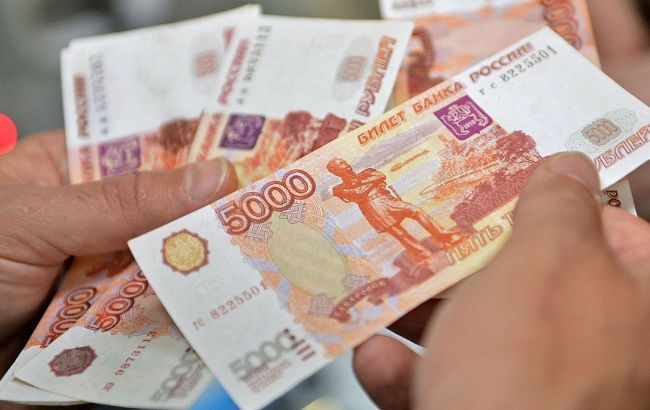 Illustrative photo: Russians face inflation and tax increases (Getty Images)
Increased economic pressure on Russia, coupled with support for Ukraine's efforts on the battlefield, may force Russian President Vladimir Putin to seek peace, as he is already forced to shift the main burden of financing the war onto the people, according to the Institute for the Study of War (ISW).
When financing budget expenditures, the Kremlin gives priority to the Russian defense-industrial base (DIB). According to a statement by Russian First Deputy Prime Minister Denis Manturov on January 12, 2026, investments in the military industry grew by 23% in the first nine months of 2025.
An additional 5 trillion rubles, or $64 billion, was invested in the military industry, which ensured a 3% growth in the military-industrial complex. Currently, the DIC provides jobs for 3.8 million people in Russia, including 800,000 jobs created after February 2022.
The institute notes that the Kremlin is trying to find funding for the military industry amid Western sanctions and restrictions. Thus, the main creditor for the military-industrial complex is the Russian government's Industry Development Fund.
Funding is also provided through off-budget subsidies and coercion of Russian banks to provide preferential loans to the military-industrial complex. To facilitate financing, the Central Bank of Russia, contrary to logic, lowered the key interest rate four times in 2025.
Price of priorities
The Russian people are paying for Putin's priorities because banks are passing on all the consequences of credit pressure to them. The civilian sector is also suffering because there is a labor shortage and a crisis in average wages in Russia.
High salaries in the military-industrial complex have caused inflation and price spikes. At the same time, the civilian sector is unable to compete with the military-industrial complex. For this reason, several large civilian manufacturers in Russia introduced a four-day working week in the second half of 2025 and announced job cuts.
Ordinary Russians are also unable to buy homes, as mortgage rates in 2025 were estimated at a minimum of 20%. Adding to all these problems, in November 2025, the dictator signed a law raising the value-added tax (VAT) from 20% to 22%.
The federal tax, which is levied on most Russian goods and services in the domestic market, has increased by 2%, which could have serious consequences for the Russian economy. In this way, Putin is forcing the Russian people to bear the brunt of the Kremlin's costly war in Ukraine.
"ISW continues to assess that increased Western economic pressure on Russia, along with helping Ukraine maintain and even increase pressure on the battlefield, remains critical to changing Putin’s calculus and forcing Putin to face more serious tradeoffs between continuing to pursue his maximalist war aims and sacrificing the quality of life of the Russian people," the ISW concludes.
According to Ukrainian foreign intelligence, Russian regions are entering the new year with an increasingly deep sense of hopelessness, and the financial burden is rapidly concentrating in areas that until recently formed the backbone of the economy.
The Ukrainian Foreign Intelligence Service also reported that the Russian economy has fallen into a trap of bad loans that could collapse it. Even the Russian government acknowledges the problem — in fact, the Kremlin has already confirmed the high probability of a banking crisis and a crisis of non-payments in the corporate sector.
In total, since the beginning of 2022, the aggression against Ukraine has cost Russian taxpayers $550 billion. According to some estimates, Russia's total war costs since 2021 have increased almost fourfold.