Russia's regions sink into financial crisis - Intelligence names hardest-hit areas

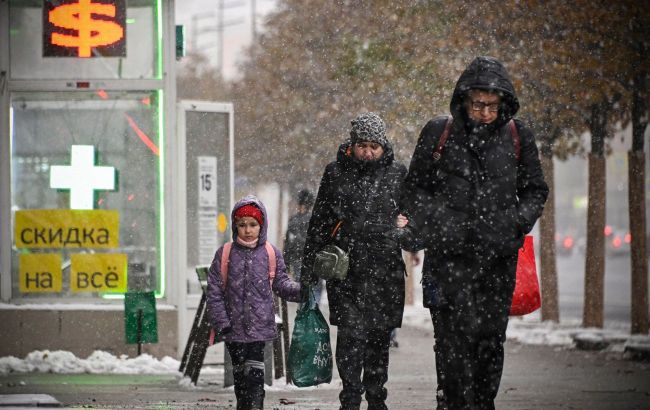 Photo: Russia's regions hit by financial crisis (Getty Images)
Russia's regions are entering the new year with an increasingly deep sense of hopelessness, while the financial burden is rapidly concentrating in areas that until recently formed the backbone of the economy, according to the press service of Ukraine's Foreign Intelligence Service.
According to intelligence data, the combination of sanctions, the loss of external markets, and the deterioration of the global economic environment has exposed the structural weakness of Russia's regional budgets, which are no longer able to meet even basic obligations.
The worst situation is unfolding in traditionally depressed regions — Kalmykia, Mari El, and the Pskov region.
For decades, their survival model was built on federal transfers, but these flows are now shrinking, while access to credit is rapidly narrowing. Chronic debt, a lack of investor interest, and declining subsidies are creating the conditions for a full-scale budget crisis with no visible way out.
Against this backdrop, problems in industrial regions only deepen the overall picture. Coal-mining areas, particularly the Kemerovo region, are expected to become among the main "negatives" for Russia's budget this year.
Falling global coal prices, sanctions pressure, and the final loss of the European market are leading to a projected 4.1% decline in gross regional product (GRP) and a budget deficit of about 44 billion rubles.
Khakassia has found itself in a similar trap: unprofitable mines combined with dependence on non-ferrous metal prices and limited hydropower capacity, where the state-owned RusHydro is squeezed between tariff regulation and lobbying by metallurgical companies.
Metallurgical regions are also losing their footing. In the Irkutsk region, falling prices for aluminum and coal are driving a projected budget deficit of around 40 billion rubles, while a prolonged crisis at Rusal enterprises leaves local authorities with little room for optimism.
In the Vologda region, the situation is further aggravated by a conflict between Governor Georgy Filimonov and Severstal owner Alexey Mordashov — to the extent that economists have effectively abandoned updating GRP forecasts since 2024.
Regions with "specific risks" are becoming an additional burden on the federal budget.
Thus, the Astrakhan region expects a 2.1% decline in GRP, with the prospect of continued negative dynamics through 2028 due to the depletion of oil and gas fields and a lack of resources to launch new ones.
The Kursk and Belgorod regions, which previously benefited from cross-border trade with Ukraine, have turned into frontline territories fully dependent on subsidies.
The Foreign Intelligence Service noted that the overall logic for regions is becoming increasingly harsh: relying on the center is no longer an option.
"The federal budget, constrained in resources, is focused on the war against Ukraine. Domestic demand is not growing, and there is no increase in money among the population or investors. For Russian regions, this means one thing — survival without support and without prospects," the intelligence service stressed.
Economic collapse in Russia
Earlier, Ukraine's Foreign Intelligence Service reported that Russia’s economy has fallen into a trap of non-performing loans that could bring it down. The problem is acknowledged even by the Russian government — in effect, the Kremlin has already confirmed a high risk of a banking crisis and a wave of corporate payment defaults.
The key factor is hidden growth in bad debt. Even taking restructured loans into account, the real volume of problematic debt has already exceeded 11%, reaching approximately $131 billion.
According to intelligence data, since early 2022 Russia's aggression against Ukraine has cost Russian taxpayers $550 billion.
Overall, Russia's spending on the war since 2021 has nearly quadrupled.
The Foreign Intelligence Service notes that Russia's financial and institutional system is increasingly sinking into a mode of managed chaos. Banks are concealing ownership structures, civil servants are being exempted from asset declarations, and entrepreneurs are barely keeping their businesses afloat.
In addition, Russia's economy is suffering not only from sanctions and the war in Ukraine. Permafrost in regions critical to the Russian economy is beginning to melt, threatening key infrastructure.
Moreover, Russia is facing a large-scale collapse of public utilities caused by decades of infrastructure degradation and the redirection of state funds toward the war against Ukraine.