Problem loans could collapse Russia's economy, Ukrainian intelligence says

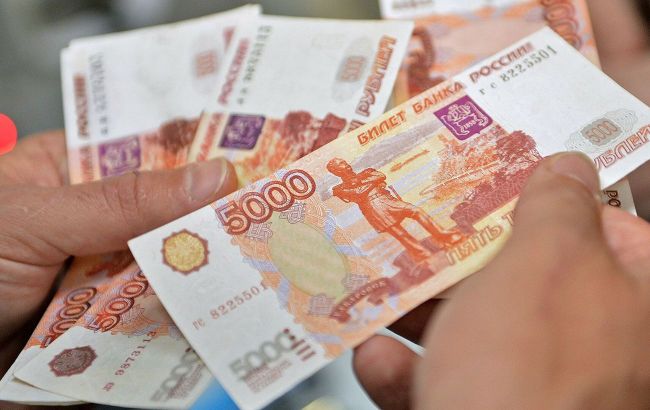 Illustrative photo: Russian economy has fallen into a trap of problematic loans (Russian media)
Russia’s economy has fallen into a trap of problem loans that could ultimately trigger a collapse. The issue is being acknowledged even by the Russian government itself — in effect, the Kremlin has already confirmed a high risk of a banking crisis and a wave of corporate payment defaults, according to Ukraine’s Foreign Intelligence Service.
The key factor is the hidden growth of non-performing debt. Even after accounting for restructured loans, the real volume of troubled debt has already exceeded 11%, reaching approximately $131 billion.
For reference, a level of 2%–4% is considered safe for banking system stability, while 5% signals elevated risk. A non-performing loan ratio of 10% or higher is widely regarded as pre-crisis or crisis-level. As a result, a full-scale crisis could emerge as early as the third or fourth quarter of 2026 due to debt accumulation.
At the same time, the cost of servicing debt is rising sharply. In 2024, Russian companies paid banks $145 billion in loan interest alone — an 83% increase compared to 2023. In 2025, companies have already paid $95 billion in interest.
"As of the end of the third quarter of 2025, one in four companies with loans had missed payments. The number of legal entities with overdue debt rose to 165,000 — up by 41,000 since the start of 2025 and by 100,000 compared to 2022," the intelligence service said.
Core sectors of the economy have proven the most vulnerable. In 2025, mining and metallurgy companies, oil and gas firms, as well as state-owned transport corporations required loan restructuring. This includes Russian Railways, which reported a net loss for the first time in five years.
"Defense-sector lending remains a separate source of systemic risk. In 2022–2024, defense enterprises received loans totaling around $202 billion. These obligations are concentrated within the banking system, lack transparency, and could rapidly turn into non-performing assets," the intelligence service added.
Taken together, these factors are further undermining Russia's economy. In Russia’s current model, debt burdens and credit backed by indirect state support have almost entirely displaced genuine sources of economic growth.
"Without large-scale recapitalization of the banking system or a mechanism to shift corporate bad debts onto the federal budget, a crisis scenario appears almost inevitable, involving mass corporate defaults and a subsequent explosive rise in non-performing assets at banks," the intelligence service concluded.
According to intelligence estimates, Russia's aggression against Ukraine has cost Russian taxpayers $550 billion since early 2022. The Kremlin is financing the war at the expense of its population, with overall war spending having nearly quadrupled since 2021.
Ukraine’s Foreign Intelligence Service also believes that Russia’s financial and institutional system is sinking deeper into a state of managed chaos. Banks are concealing ownership structures, civil servants are being exempted from declarations, and entrepreneurs are barely keeping their businesses afloat.
Meanwhile, the Russian central bank has introduced cryptocurrency regulations that focus more on control than development. While the model formally recognizes cryptocurrencies, it effectively places them under strict state supervision.