Not just sanctions: Melting permafrost threatens Russia's economy

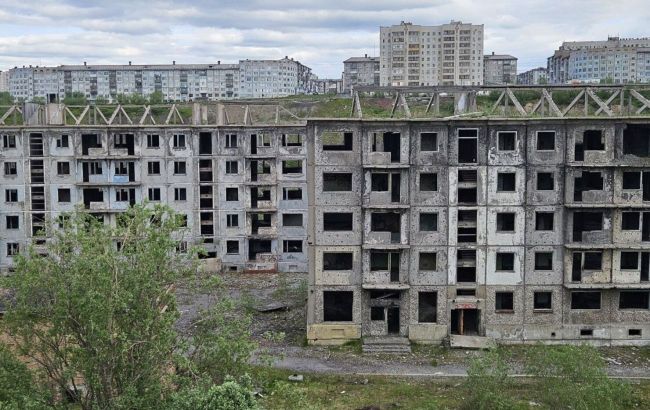 Illustrative photo: Vorkuta, where 80% of infrastructure is deformed (Russian media)
Russia's economy is suffering not only from sanctions and the war in Ukraine. Permafrost in regions critical to Russia's economy is starting to thaw, posing a threat to vital infrastructure, according to Ukraine's Foreign Intelligence Service.
Permafrost is ground formed during the Ice Age, with a temperature below zero and containing ice. It also includes a seasonal thaw layer on the surface that melts during the warm season.
Most of Eurasia's permafrost is located in Russia, covering 65% of its territory. Cities within the permafrost zone include Vorkuta, Norilsk, Yakutsk, and Magadan. Over the past 30 years, the depth of the seasonal thaw has nearly doubled - from 45 to 70 centimeters.
"This is happening in regions critical for the country's economy, where the main oil, gas, and mineral extraction centers are located," the Ukrainian intelligence service notes.
Russia's Arctic permafrost regions generate 10% of Russian GDP and 20% of exports. They produce 18% of oil, 90% of natural gas, 90% of nickel and cobalt, 60% of copper, and 100% of diamonds.
Soviet engineers designed infrastructure assuming the permafrost would remain permanent, and Russian engineers continued this approach. Almost all residential buildings in permafrost regions were constructed between 1960 and 1999.
However, relying solely on permafrost for construction has proven shortsighted. It has caused annual deformation and destruction of structures. According to Ukraine’s Foreign Intelligence Service, up to 10% of buildings in Yakutsk and Norilsk are deformed, 22% in Tiksi, 35% in Dikson, 55% in Magadan, and over 80% in Vorkuta.
"At the same time, 1,260 km of main gas pipelines and thousands of kilometers of roads are at risk. By 2050, the population in permafrost regions will decline by 61% compared to 2017, reaching 1.7 million people," the intelligence service added.
Previously, Ukraine's Foreign Intelligence Service reported that Russia is facing a serious economic crisis. During the first eight months of this year, Russian company profits fell by 8.3%.
The service also noted that Kazakhstan introduced new export control rules for a year, specifically targeting shipments to Russia, aiming to prevent sanctions evasion.