Did Russia buy or steal Banderol technology? Expert weighs in


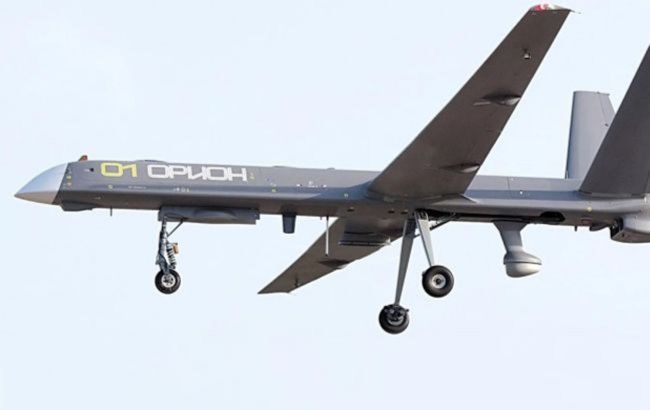 Banderol carrier — Orion drone (photo: War and Sanctions portal)
Russia's Bandерol and Dan-T should be classified as small cruise missiles rather than Shahed drones. Russia may have purchased or stolen the technology used to develop them, and China is not necessarily the source, said Ivan Kyrychevskyi, a service member of the 413th Raid Unmanned Systems Regiment and a weapons expert at Defense Express.
Spec details available
Kyrychevskyi explained that Russia's defense industry considers the Geran-2 and Garpiya-1A to be different products, but Ukraine views them as essentially the same gasoline-powered Shahed drone. According to him, units produced at the Alabuga facility are designated Geran-2, while those manufactured at the Kupol Izhevsk Electromechanical Plant are designated Garpiya-1A. He added that Russia exports Garpiya-1A to Africa and supplies it to units of Russia's Africa Corps.
His assessment says the Banderol and Dan-T should be classified as small cruise missiles with a launch weight of 260 kilograms, including a 130-kilogram warhead. The expert noted that they have no aerodynamic flight issues and that their high-energy fuel allows them to travel up to 500 kilometers. He added that the Banderol can even be mounted on a Mi-28 helicopter.
For comparison, the expert cited the LMUR missile, which Russia previously developed for the Mi-28. It has a launch weight of about 105 kilograms, including a 15-kilogram warhead. In Kyrychevskyi's view, developing a small cruise missile that flies reliably and carries a warhead that accounts for half its launch weight is difficult. He suggested that Russia may have purchased the technology or borrowed ideas from Ukrainian designs, but declined to speculate about the specific source.
Kyrychevskyi also recalled leaks concerning the so-called Izdelie (Product) 715 and 720—missiles displayed at the Raduga Design Bureau plant during visits by Russia's military and political leadership around 2023–2024.
Interception methods, partners' actions
Expert Kyrychevskyi noted that when the means to shoot down such weapons are available, their technical characteristics matter less. He stressed that intercepting every target with 100% effectiveness is impossible. Drawing on the experience of Ukraine's partners, he said comparable effectiveness is achievable, but at costs orders of magnitude higher.
He also recalled that Defense Minister Yevhenii Khmara had publicly stated that Ukraine would need 10,000 engines of a single type per month next year. According to Kyrychevskyi, this poses a challenge for Ukraine's military technology sector. He noted that the United States had been working on small jet engines since 2023, including developing methods to 3D-print rocket engines.
Among American counterparts to the Banderol, he named the Rusty Dagger, which was expected to be supplied to Ukraine, and Anduril's Barracuda family of missiles.
Notably, Russian forces used about 350 Banderol and Dan-T weapons over the course of a month, Yurii Ihnat, Head of Communications of the Ukrainian Air Force Command, told at RBC-Ukraine's "TSE BAZA" podcast.
According to him, that is about 10 times fewer than the jet-powered drones Russia uses to attack Ukraine. Ihnat explained that these weapons can be called missile-drones or loitering munitions and are launched from airborne platforms.