Deliberate terrorist act: Nearly year ago, Russia attacks sarcophagus at Chornobyl NPP

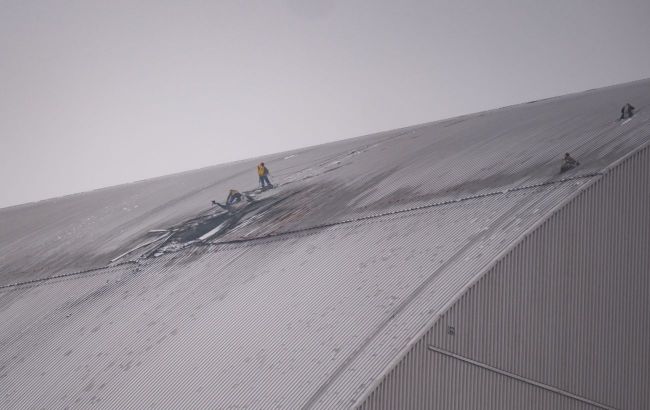 Photo: Russian drone attacked the NSC over Unit 4 of the Chornobyl NPP (Vitalii Nosach, RBC-Ukraine)
Russian forces carried out a deliberate strike on the Shelter facility at the Chornobyl Nuclear Power Plant (NPP). The plant is not involved in electricity generation, so in effect, Russia committed a terrorist act, according to a statement by Head of the State Nuclear Regulatory Inspectorate of Ukraine Oleh Korikov.
Korikov recalled that the Chornobyl NPP has long since stopped generating electricity. Moreover, the Russian army struck a facility that protects against the consequences of the 1986 disaster — the New Safe Confinement (NSC). Therefore, this constitutes a terrorist act by Russia.
"This facility is designed to serve as a barrier to the spread of radiation to humans and the environment. The enemy UAV damaged the supporting structures and the membrane that ensures tightness. The consequences of such a terrorist act are the loss of two important functions: shelter and the possibility of dismantling the reactor," Korikov summarized.
What is known about the NSC
The New Safe Confinement (NSC) was built in 2016 over the Shelter object at the Chornobyl Nuclear Power Plant. It covers the ruins of Unit 4, isolates the remaining radioactive materials, and prevents the release of radiation into the environment.
The NSC is a massive arched steel structure designed to protect the old sarcophagus and enable the safe dismantling of debris. Its service life is estimated at more than 100 years; however, any damage can reduce its effectiveness — which is what happened following Russia’s attack.
Damage to the Chornobyl sarcophagus: What is known
On the night of February 14, 2025, a Russian strike UAV carrying a high-explosive warhead hit the protective structure over the destroyed Unit 4 of the Chornobyl Nuclear Power Plant — the New Safe Confinement (NSC) itself.
The Russian strike caused serious damage to the external protective covering and started a fire. As a result of this terrorist act, the sarcophagus lost its primary functions, according to the International Atomic Energy Agency (IAEA).
Ukraine’s State Agency for the Exclusion Zone Management separately reported that the consequences of the attack could have been catastrophic if the drone had hit 15 meters away from the impact point.
Chornobyl NPP Director Serhii Tarakanov in December 2025 did not rule out the possibility that the Russian forces could strike the plant again. In such a case, the sarcophagus could collapse even without a direct hit on the protective structure.
Then, on the night of January 20, 2026, the Russian army carried out a terrorist attack on energy infrastructure nodes supplying electricity to facilities in the Chornobyl Exclusion Zone, causing a large-scale power outage. Energy supply in the exclusion zone was only restored the following morning.