Blackout game: Russia mass-edits books, erases war and LGBTQ+ content

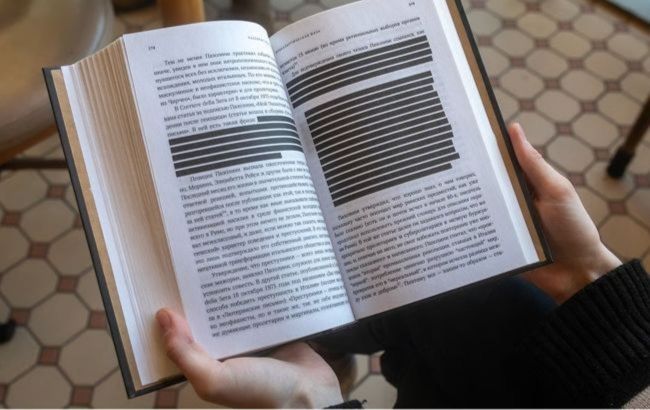 A book with text fragments blacked out during censorship review (photo: szru.gov.ua)
Publishing censorship in Russia has become so strict that readers increasingly receive books with blacked-out sections replacing parts of the text, according to the Foreign Intelligence Service of Ukraine.
The service said that censorship in the book industry of Russia has become systematic, covering the entire publishing process, from manuscripts to retail sales.
One of the symbols of this new policy is the so-called "blackout," meaning the physical redaction or concealment of parts of the text with black bars.
The intelligence agency notes that this practice is no longer hidden and is now openly presented to readers.
The reason is new legislative restrictions in Russia. Bans or strict moderation now apply to references to war, criticism of Russian aggression, LGBTQ+ topics, emigration, decolonization, as well as content related to drugs or suicide.
This results in thousands of books in Russia being reviewed, labeled, or removed from sale.
The Foreign Intelligence Service emphasized that censorship is applied regardless of when a work was written. Even classic works of world literature are affected during new translations or reprints.
Some Russian publishing houses have already begun using artificial intelligence to detect "undesirable" content.
These algorithms analyze texts and identify potentially risky fragments, but often mistakenly flag ordinary words or neutral contexts as violations.
As a result, even neutral scenes or individual words can be subject to censorship.
At the same time, the final decision on whether to edit or remove content is made by editors and lawyers, who face the threat of fines or criminal prosecution.
The Foreign Intelligence Service noted that historically, "blackout" was used as an artistic or protest technique, but in modern Russia, it has become a tool for concealing content.
Black lines become familiar and are perceived as part of the "rules of the game," the service said.
In this way, Kremlin censorship turns books from a source of knowledge into an instrument of ideological control, where even the absent text carries political meaning.
Previously, the Ukrainian Foreign Intelligence Service also noted increased censorship in Russia, not only in media but also in cultural and sports spheres. For example, stadiums have begun banning banners and symbols that allegedly contradict "traditional values" or "offend" certain social groups.
In addition, following legislative changes, even classical literature has fallen under new restrictions. Russian publishing companies have begun labeling works by Pushkin and Chekhov as 18+ due to references to drugs, while publishers increasingly resort to self-censorship due to the risk of fines and prosecution.