'Without USSR, WWII would never have begun': Ukrainian historian on real price of victory over Nazism


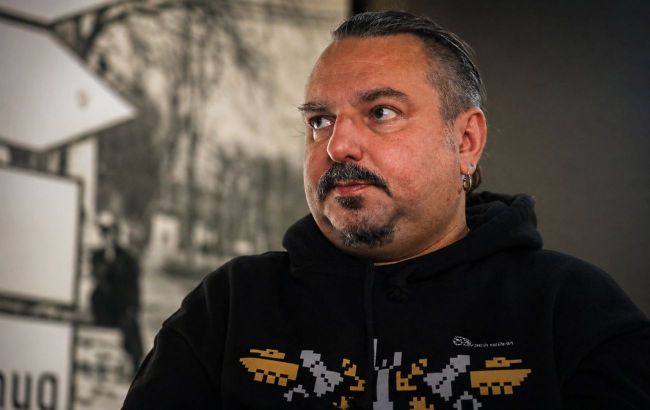 PhD in history Roman Kabachiy (photo: Vlad Nesterov/RBC-Ukraine)
World War II became for Ukraine a time of survival in battle between two dictatorships — the Soviet Union and Hitler's Germany. And both viewed Ukrainians primarily as expendable material for achieving their own imperial goals.
About the real price of victory over Nazism, crimes of unpunished communism, and the role of Ukrainians in World War II, PhD in History and head of sector at the National Museum of History of Ukraine in the Second World War, Roman Kabachiy, told Ukrainian media outlet RBC-Ukraine in an interview.
Key points:
-
Ukraine's contribution to victory: 7.5 million Ukrainians fought in the Red Army. Every second, one was killed, while half of those who survived returned wounded.
-
Preparation for attack, not defense: In the 1940s, Soviet schoolchildren were taught German language and given maps of Europe as part of preparations for a "liberation campaign" to the West.
-
Babyn Yar provocation: The explosion on Khreshchatyk street, organized by Soviet special services, became the pretext for Nazi mass shootings of Jews in Kyiv.
-
Ban on frontline truth: Soviet regime replaced real memories of soldiers about death and crimes against their own people with a "beautiful" image of victory.
-
Quasi-statehood: The separate flag of the Ukrainian Soviet Socialist Republic and membership in the United Nations were Stalin's "decorations" for the West to create an illusion of national freedoms.
-
Continuation of unpunished evil: Modern Russia's war against Ukraine is a consequence of the communist regime never facing a tribunal in 1945, similar to the Nuremberg Trials.
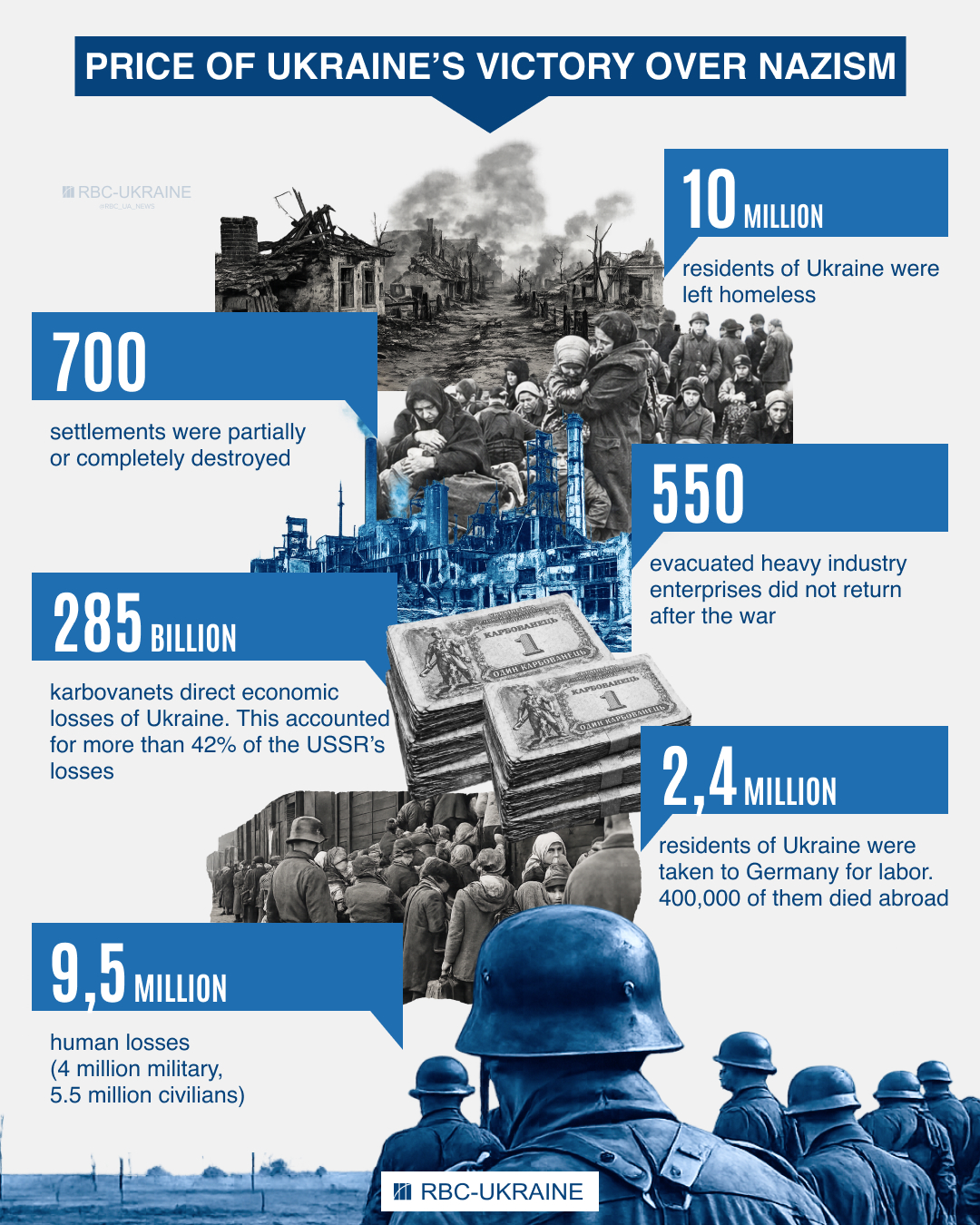 The price Ukraine paid for victory over Nazism (infographic by RBC-Ukraine)
Fight for victory: What role Ukraine and the Soviet Union really played in World War II
– First, the Soviet Union, and now Russia, effectively monopolized victory over Nazism. What was Ukraine's real role in this struggle?
– Ukraine was part of the Soviet Union, just like the people of Central Asia and the Caucasus, and a narrative about "shared victory" was cultivated primarily for the so-called Soviet people. Russians were given a leading role in this narrative — Stalin personally emphasized this after the war ended.
Since borders were closed, this ideology was difficult to project to the West, so it operated exclusively within the country to make the Soviet/Russian people believe in their own exceptionalism.
Ukraine's contribution was enormous. 7.5 million Ukrainians fought in the Red Army. Half of them were killed, and half of those who survived returned wounded.
However, it benefits Putin to say that Russians alone defeated Nazis, while diminishing the role of other Soviet peoples, especially Ukraine. In the West, this is poorly understood, and this must be countered with Ukrainian narratives.
In reality, victory over Nazism was shared. However, many prefer not to remember that without the USSR, World War II would not have started.
In 1939, the Soviet Union signed a non-aggression pact with Germany: it divided Poland, attempted to interfere in Finland, and seized Bukovina and Bessarabia from Romania. All this happened in full view of the Western world. But Hitler struck first, although the Soviet Union was preparing to attack Germany.
– So Stalin did not manage to launch a "preventive strike" against former allies?
– There is plenty of evidence for this: in Soviet schools, boys were taught how to assemble and disassemble weapons, and in 1940–1941, they were given manuals with maps of Germany and instructions on how to behave in European territory. They were taught the German language.
Preparation was not for defense. That is exactly why the Soviet Union suffered enormous losses. From the first days, Germans surrounded fuel bases and destroyed aviation.
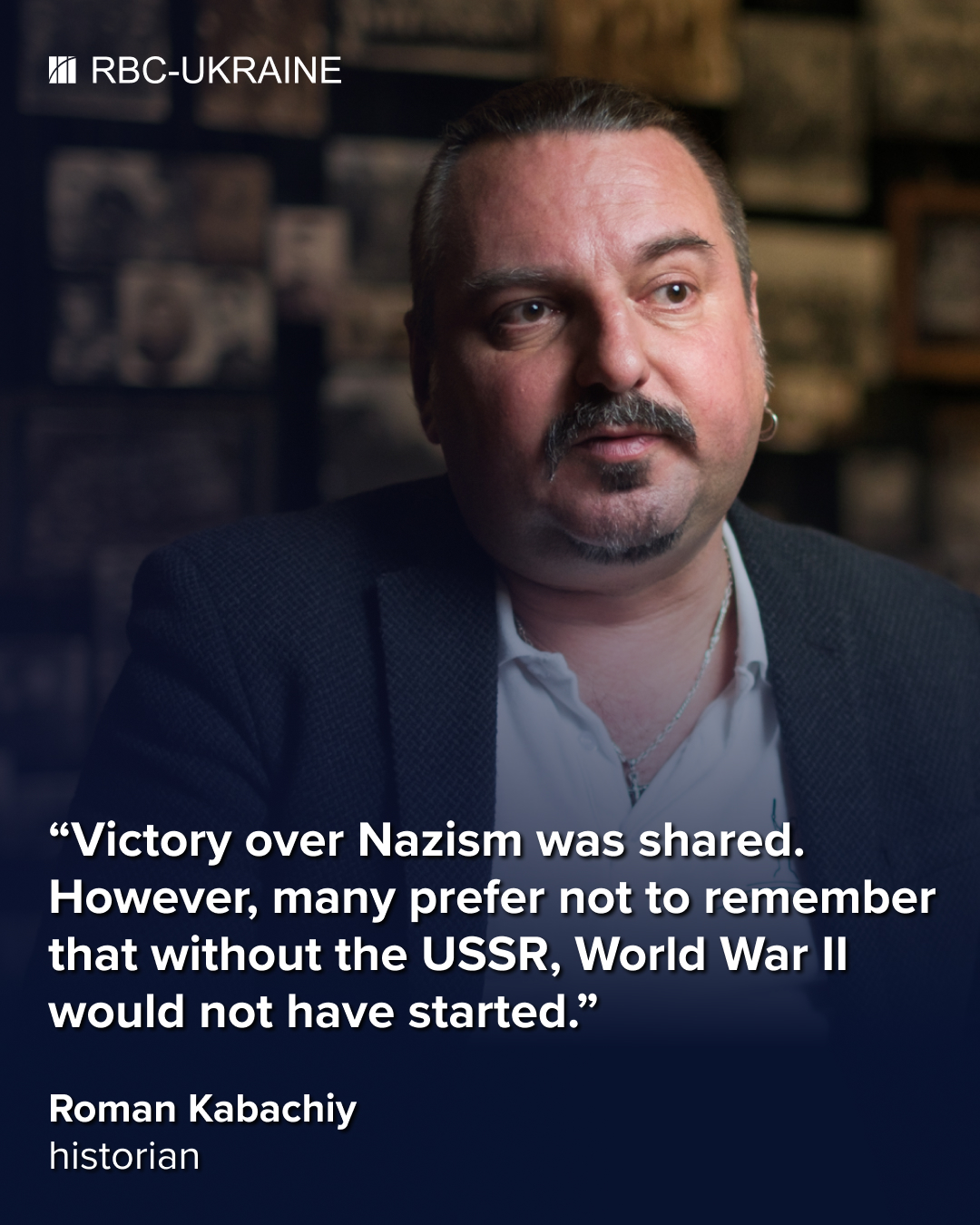 PhD in History and head of sector at the National Museum of History of Ukraine in the Second World War, Roman Kabachiy (photo: Vlad Nesterov/RBC-Ukraine)
– Would the Soviet Union have won the war without Western Lend-Lease aid?
– I would say not only without Lend-Lease, but also without the opening of the second front. By that moment, Hitler had already occupied continental Europe and was waging an air war against Britain. For him, the issue on this continent was already settled.
Stalin demanded that Western allies open a second front. The condition for this was that once the war in Europe ended, the Soviet Union would enter the war against Japan.
That is why in May 1945, nobody disbanded the Red Army — soldiers were sent to the Far East. The United States ended the war with Japan by dropping atomic bombs on Hiroshima and Nagasaki. In fact, the Soviet Union sent Ukrainian Kuzma Derevyanko to sign Japan's act of surrender because he knew the Japanese language.
– The Soviet Union was not only the country claiming victory. Recently, Donald Trump claimed a decisive role belonged to the United States. Is this another example of "pulling a blanket over oneself" in world history?
– Front in Eastern Europe was a distant world for the United States, so they focused on closer theaters of war. In general, everyone in the West saw their own war: the British were convinced they achieved victory themselves, while Americans attributed success to themselves.
Price of ideology and scorched-earth tactics: How the Soviet Union destroyed its own people
– The Soviet Union often used scorched-earth tactics even on its own territories. Why did Soviet authorities actually blow up Khreshchatyk Street in 1941?
– The Soviet Union had several months to mine everything because the Germans reached Kyiv only in September. Later, Kyiv Jews were blamed for the explosion of Khreshchatyk, and Babyn Yar became a direct consequence of this provocation.
Historically, the Soviet army used the tactic of terrifying the population while retreating and dragging people away with them so that not even mobilization resources would remain for the enemy.
Senior Sergeant Adam Zghursky, whose diary is preserved in our museum, died 10 days before victory. In his notes, he was surprised by how Soviet troops tried to take everything away. They even issued directives to burn grain in fields. Of course, peasants did not want to do this because they needed something to live on afterward.
In Toretsk, the Red Army destroyed water pumping stations, leaving the population without water in the steppes of the Donetsk region. Then the Germans arrived and repaired them, so in the eyes of Ukrainians, they sometimes acquired a positive image. Through scorched-earth tactics, the Soviet Union actually turned people against itself.
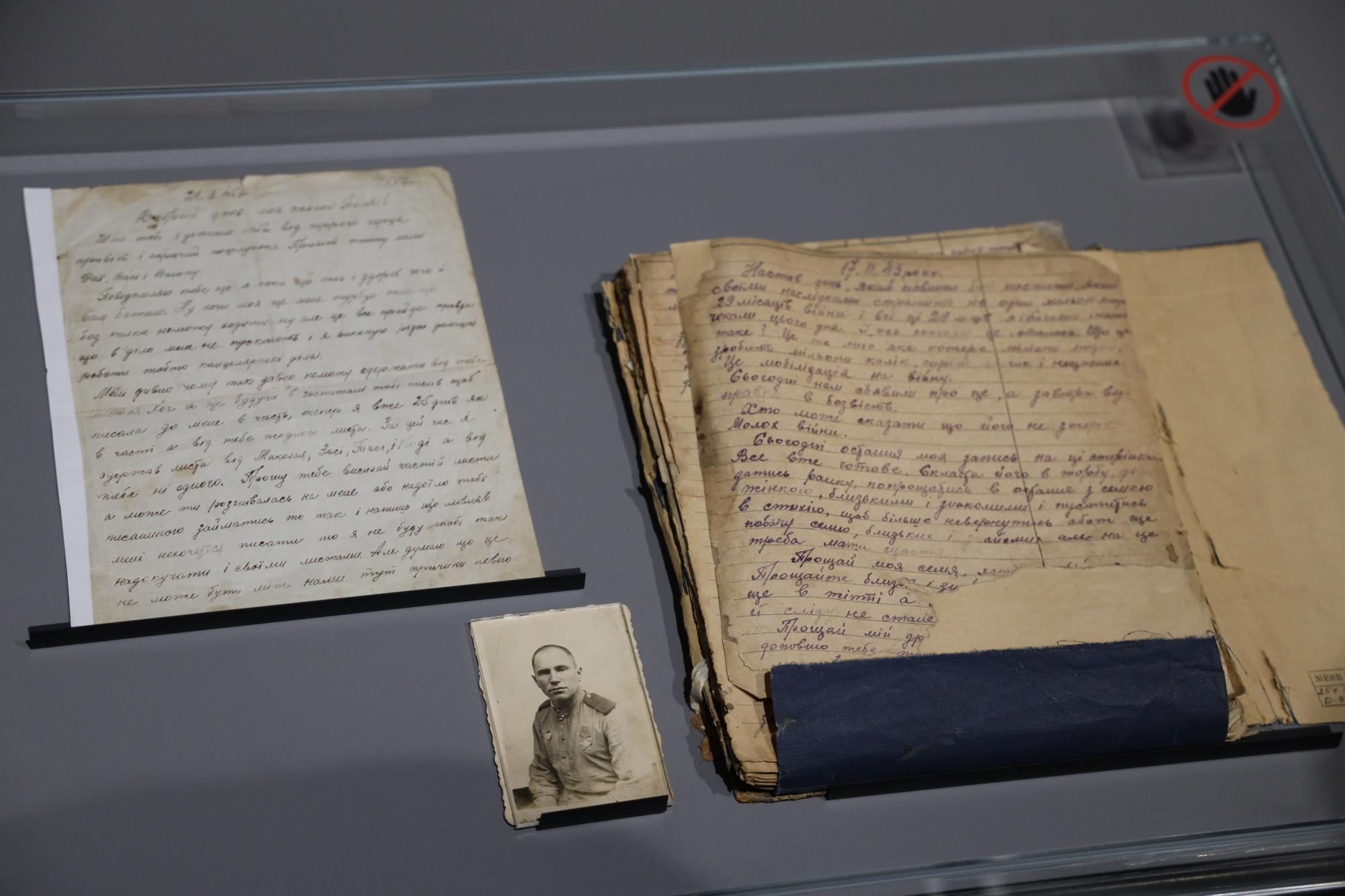 Diary of Adam Zghursky is preserved at the National Museum of History of Ukraine in the Second World War (photo: Vlad Nesterov/RBC-Ukraine)
– So does part of the responsibility for the mass shootings of Jews during the Nazi occupation of Kyiv also lie with the Soviet Union?
– The Soviet Union did not tell the truth to its citizens. Jews were not informed about who the Nazis were. In Ukraine, people still remember the German-Austrian occupation, when the Central Rada (Ukrainian parliament during the 1917–1918 revolution) effectively invited Germans here. And at that time, Jews were not exterminated.
Bina Smekhova, head of the Society of Ukrainian Immigrants in Israel, told me that her father managed to evacuate her and her mother on the last barge. All her other relatives ended up in Babyn Yar. They did not expect executions, so they obediently went there. They genuinely believed they were being evacuated. During those two days, 30,000 Jews were shot.
In general, the Holocaust in Ukraine is called the Holocaust by bullets, while in other countries, death camps operated. It was a one-way ticket. People literally disappeared there. They were brought to camps, stripped naked, and led into gas chambers.
The truth about Nazi atrocities was already spreading, but because of the effect of sudden occupation, the Germans managed to exterminate many Jews in Ukraine. Besides Kyiv, mass shootings of 10,000 people took place in Ivano-Frankivsk and Kamianets-Podilskyi.
– Every fifth or sixth soldier in the Soviet army was Ukrainian. Was this an attempt to weaken the Ukrainian people by thinning out our ranks?
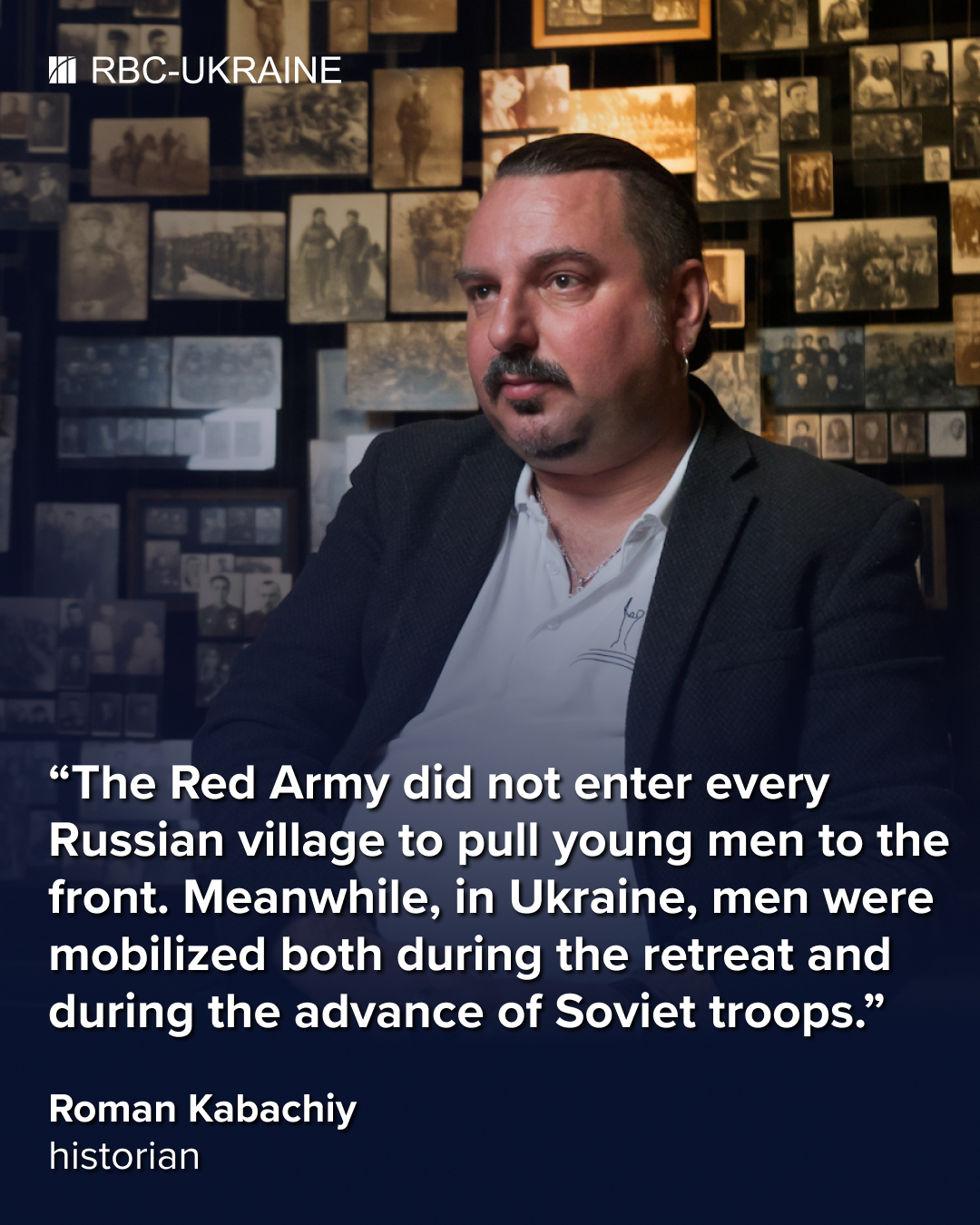
– I do not think so, because after Holodomor (man-made famine organized by Stalin's regime in 1932–1933), this issue no longer existed. However, we must understand that the Red Army did not enter every Russian village to pull young men to the front. Meanwhile, in Ukraine, men were mobilized both during the retreat and during the advance of Soviet troops
Young men were often not even given uniforms: they were sent into assaults in their own jackets, practically barehanded. That is how the term "black infantrymen" appeared.
My grandfather was mobilized in the Vinnytsia region together with fellow villagers and thrown into battle near the village where most of those young men were killed. My grandfather survived, went through Stalingrad and Berlin, and returned home. Wives of fallen soldiers cursed my grandmother because she still had her husband.
We preserve letters in which young men write how "they do not want to die, but apparently will have to." One young man married only in the summer of 1943, then the front arrived, and during the liberation of Kyiv in November, he was killed.
 7.5 million Ukrainians served in the Red Army (infographic by RBC-Ukraine)
– How widespread was the practice of blocking detachments, when soldiers were simply shot in the back by their own side?
– Penal battalions were a deliberate policy. Prisoners were offered a chance to "repay debt to motherland with blood." Such people were thrown into assault units. Today, prisoners are also fighting in the Russian army. The question is under what level of coercion.
– Are there similarities between the methods of Stalin and Hitler?
– They learned from each other. Before the beginning of World War II, Hitler had not yet carried out mass executions. Meanwhile, Stalin had already created the Gulag concentration camps, carried out mass purges of intelligentsia in 1937, and ethnic purges.
Poles of the Soviet Union became the first victims targeted on a national basis. In 1935, Polish national districts in Ukraine and Belarus were destroyed. Then came the Greek operation of the People's Commissariat for Internal Affairs (mass repression against ethnic Greeks in the Soviet Union in 1937–1938). Stalin showed that this could be done.
At the same time, he may have envied Hitler because half of Europe fell under the Führer's boot almost instantly. Soviet leadership never abandoned the idea of world revolution: after failures in Germany and Hungary at the turn of the 1920s, they continued preparing for a major war to spread the Bolshevik regime to the shores of the Atlantic Ocean. And World War II was seen as a chance to finally implement this plan.
Resistance and internal fronts: Ukrainian Insurgent Army, partisans, and choice without choice
– When people speak about victory over Nazism, the Ukrainian Insurgent Army is rarely mentioned. Why? After all, its fighters battled two regimes at the same time.
– I would even say three. Besides Germany and the Soviet Union, there was also the Home Army, which believed that the state of Poland should be restored on the territories that belonged to it before 1939.
The Ukrainian Insurgent Army fought for an independent Ukrainian state, not specifically against Nazism, although it also carried out actions against Nazis. Its fighters prepared for the possibility that after the return of Soviet forces, there would be a chance to create an independent Ukrainian state, as stated in proclamations of the Organization of Ukrainian Nationalists.
Poles thought similarly. They developed Operation Tempest, which was supposed to begin when the Red Army crossed Poland's prewar border. The belief that the Soviets would allow the restoration of the Polish state was naive, considering that officers of the Polish army had been executed in Katyn and other camps in 1940.
– How justified was the Soviet partisan movement, considering the reprisals against civilians that it provoked?
– The Soviet Union thought about the civilian population last. It was important for it to show that partisans existed and had support from people. Although after 20 years of Bolshevik rule, a generation with the corresponding ideology had already grown up, so in some territories, there really were partisans.
In Western Europe, Germans did not behave as brutally as they did toward Slavs, whom they considered untermenschen (subhumans) fit to complete no more than three years of education. So Germans themselves cultivated hatred toward themselves among Ukrainians.
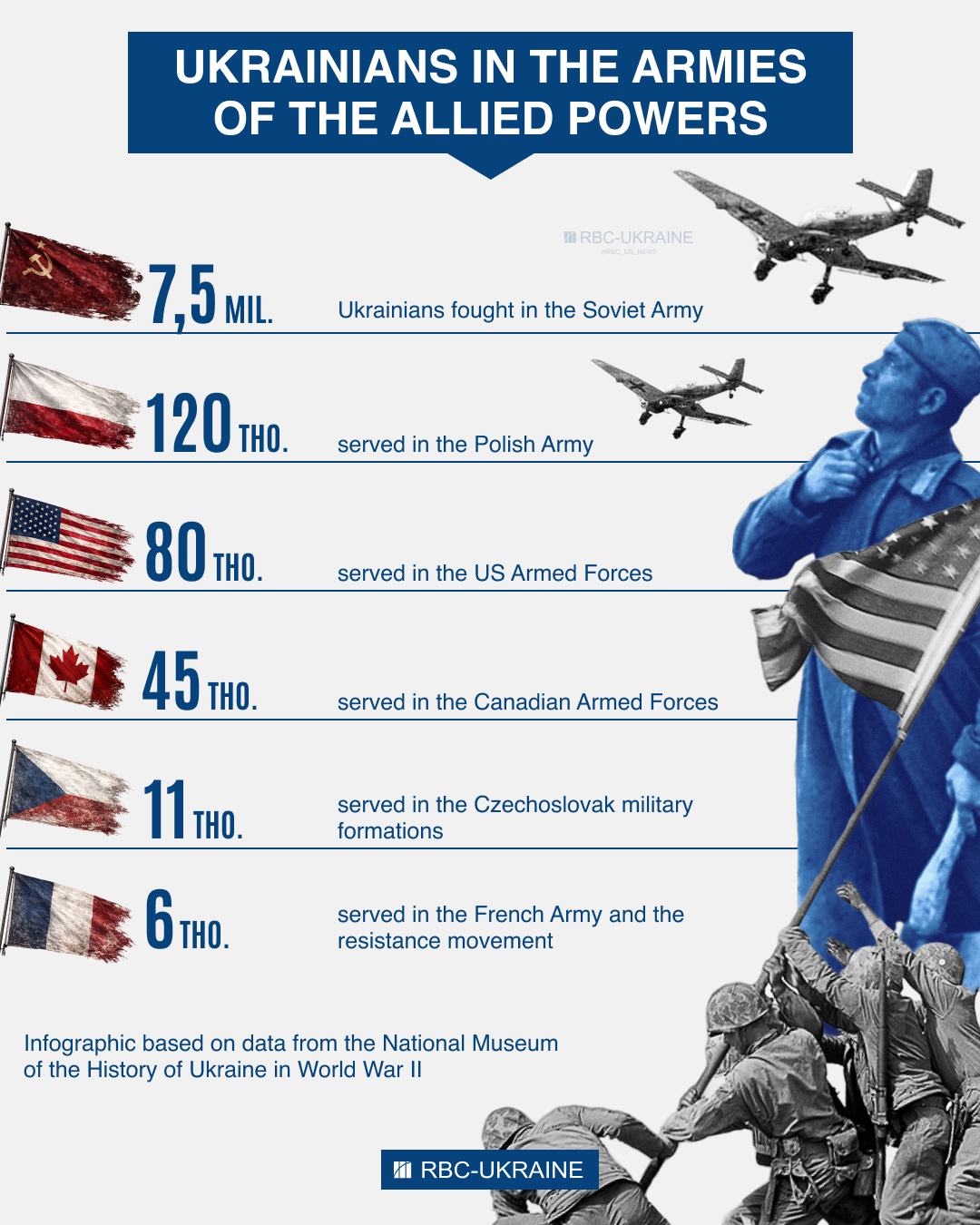 Ukrainians in the armies of the Anti-Hitler Coalition countries (infographic by RBC-Ukraine)
– We are used to thinking of 1945 as a year of peace, but for many Ukrainians hell continued. How did Operations Vistula and West become tactics for finishing off those who did not fit into the new order?
– These deportations had a different nature. If before 1939, a conditional democratic world for us began beyond the Zbruch River, then after the return of the Soviets, it moved beyond Berlin. That meant hopes for our independence became smaller. Although there were still hopes for a Third World War, and that Americans would come. That is why the struggle of the Ukrainian Insurgent Army continued into the 1950s.
Instead, Stalin delivered the final blow — postwar repressions, filtration camps for former Ostarbeiters (people taken by Nazis for forced labor), and deportations. Operation West was a classic postwar deportation of families who cooperated with the Organization of Ukrainian Nationalists to North Korea and Kazakhstan.
Operation Vistula and ethnic deportations were attempts to solve ethnic conflicts through the creation of monoethnic nations and the elimination of any movements that could threaten communism.
Polish-Ukrainian population exchange of 1944–1946 was carried out to get rid of the Polish minority in Galicia and Volhynia. It was also meant to make Western allies Roosevelt and Churchill understand that Poland would never return to these lands, because the Ukrainian Soviet Socialist Republic and the Belarusian Soviet Socialist Republic were now there. And so that Ukrainians would no longer remain west of the Bug and San rivers.
Accordingly, Ukrainians in Poland could no longer create a base for a struggle for independence, and Poles here could no longer organize any movements either.
Operation Vistula was an action by the Polish communist government aimed at dispersing Ukrainians to create a Polish ethnic nation. In the territory of Poland, Hitler exterminated Jews, Stalin deported Germans to Germany, but the last national minority considered dangerous for Poles remained — Ukrainians. As part of the operation, 150,000 Ukrainians were dispersed and subjected to assimilation.
Meanwhile, in the Soviet Union, this was done so that the Iron Curtain would stand along the Bug and San rivers. At that time, even place names reminding of national differences were destroyed. Unification followed.
– What kind of country did Ukraine emerge from the war as? Territorial, ethnic…
– Ukrainians are victorious losers. On one hand, we contributed to the victory over Nazism, but on the other hand, we did not gain independence.
We preserved a certain institutional framework and even strengthened it. The Ukrainian Soviet Socialist Republic became a member of the United Nations. It also received a separate flag — the so-called azure stripe was added to the Soviet flag. Before World War II, all flags of Soviet republics were identical and differed only in inscriptions.
According to Mykhailo Hrechukha, head of the Presidium of the Supreme Soviet of the Ukrainian Soviet Socialist Republic, the Soviet Union thus "threw bait to overseas uncles, pretending that national freedoms were remembered here."
Most ethnic Ukrainian lands — Volhynia, Galicia, Bukovina, Southern Bessarabia, and in 1954 Crimea — became part of the Ukrainian Soviet Socialist Republic. With these territories, we entered the borders of 1991.
The Ukrainian population of Zakarpattia (historical Ukrainian territories west of the Curzon Line) was forcibly deported to the Ukrainian Soviet Socialist Republic and western Poland. Meanwhile, in Belarus, Ukrainians were registered as Belarusians, erasing their national identity.
Historian Yaroslav Hrytsak says our main victory was that we survived at all between two systems.
– Russian propaganda often speculates on the idea that Stalin united the Ukrainian lands.
– We did not receive our own country back then. We had quasi-statehood. We had administrative borders, but there was only one state — the Soviet Union.
Stalin mocked the proclamation of independence of Carpathian Ukraine. He said, "This little mutt thinks it will one day unite all Ukraine around itself." But later repressions by the People's Commissariat for Internal Affairs against people connected to Carpathian Ukraine show that they feared this seed of independence.
.png) Roman Kabachiy: "Ukrainians are victorious losers. On one hand, we contributed to the victory over Nazism, but on the other hand, we did not gain independence" (photo: Vlad Nesterov)
Roman Kabachiy: "Ukrainians are victorious losers. On one hand, we contributed to the victory over Nazism, but on the other hand, we did not gain independence" (photo: Vlad Nesterov)
Memory and deoccupation of consciousness: From "cult of victory" to understanding the price of war
– Why did the Soviet Union cling so stubbornly to May 9, unlike the rest of the world that commemorates victory over Nazism on May 8?
– Germany's act of surrender was signed on May 8, but in Moscow, it was already May 9 by that moment. That is why the Soviet Union artificially attached itself to this date.
The key issue is a completely different approach to commemorating dates. In the free world, the focus was on honoring the memory of the victims. Meanwhile, in the Soviet Union, celebrations contained much more kitsch (a style characterized by excessive showiness, bad taste, and orientation toward mass appeal), especially after Brezhnev came to power.
Putin and Lukashenko grew up in this kitsch. And this is exactly how they view the celebration of May 9, which turns into a victory obsession. They imagined war and victory as something beautiful. Very few people actually knew what war really was. That is why the slogan "we can repeat it" is pure bragging.
In the Soviet Union, there was a complete ban on frontline truth. If someone described it in diaries or letters, they were imprisoned and brutally silenced. Russian historian Nikolai Nikulin, in his book Memories of War, clearly described what World War II really looked like from the perspective of an ordinary soldier.
In 1975, the author returned to the battlefield where, during the war, he had seen 20-year-old soldiers. He was shocked by the number of unburied skeletons still lying in fields. This image angered him so much that he began writing a book for the drawer. It was published only after the collapse of the Soviet Union.
Nikulin writes one simple thing — the first victim of war is the frontline truth. The war in the Soviet Union was criminal, first of all against its own soldiers, because they were sent to slaughter according to schedule. There was an even rule: a commander who sent soldiers into two or three assaults could leave the frontline and go to the rear for rest.
.png) National Museum of History of Ukraine in the Second World War (photo: Vlad Nesterov/Ukrainian media outlet RBC-Ukraine)
National Museum of History of Ukraine in the Second World War (photo: Vlad Nesterov/Ukrainian media outlet RBC-Ukraine)
– We still have nameless graves of World War II soldiers. Is it realistically possible today to establish these identities, or is this already lost history?
– In our museum, the sector for documentary accounting of military losses studies death notices, letters, and information about where the person declared missing in action was last seen.
I even have a family story myself. During the war, the brother of my maternal grandfather — Ivan Zolotashko — disappeared. Data from military enlistment offices was confusing, but museum researchers established that he was killed in 1942 in the Smolensk region and buried there. So today's work is more about establishing information about deaths rather than exhumations.
– Ukraine is decommunizing monuments that commemorate millions of Ukrainians who had no choice. What should memory policy toward "our own in foreign uniforms" look like?
– Today, symbols glorifying Soviet ideology are being dismantled. Meanwhile, monuments to the unknown soldier are mostly being moved to cemeteries so they no longer remain in open public spaces.
There should be a compromise between local communities and national memory policy. For example, in a village near Kyiv where my wife's mother bought a house, the memorial contains nearly 500 names of people who never returned from the front.
The question is, where do they exist outside this village? Do all settlements still have monuments where the names of soldiers can be read? Awareness of World War II losses in our country remains low.
– The Soviet Union created the "cult of victory," which Russia still uses today to justify war against Ukraine. Could a similar "victory obsession" threaten Ukraine in the future?
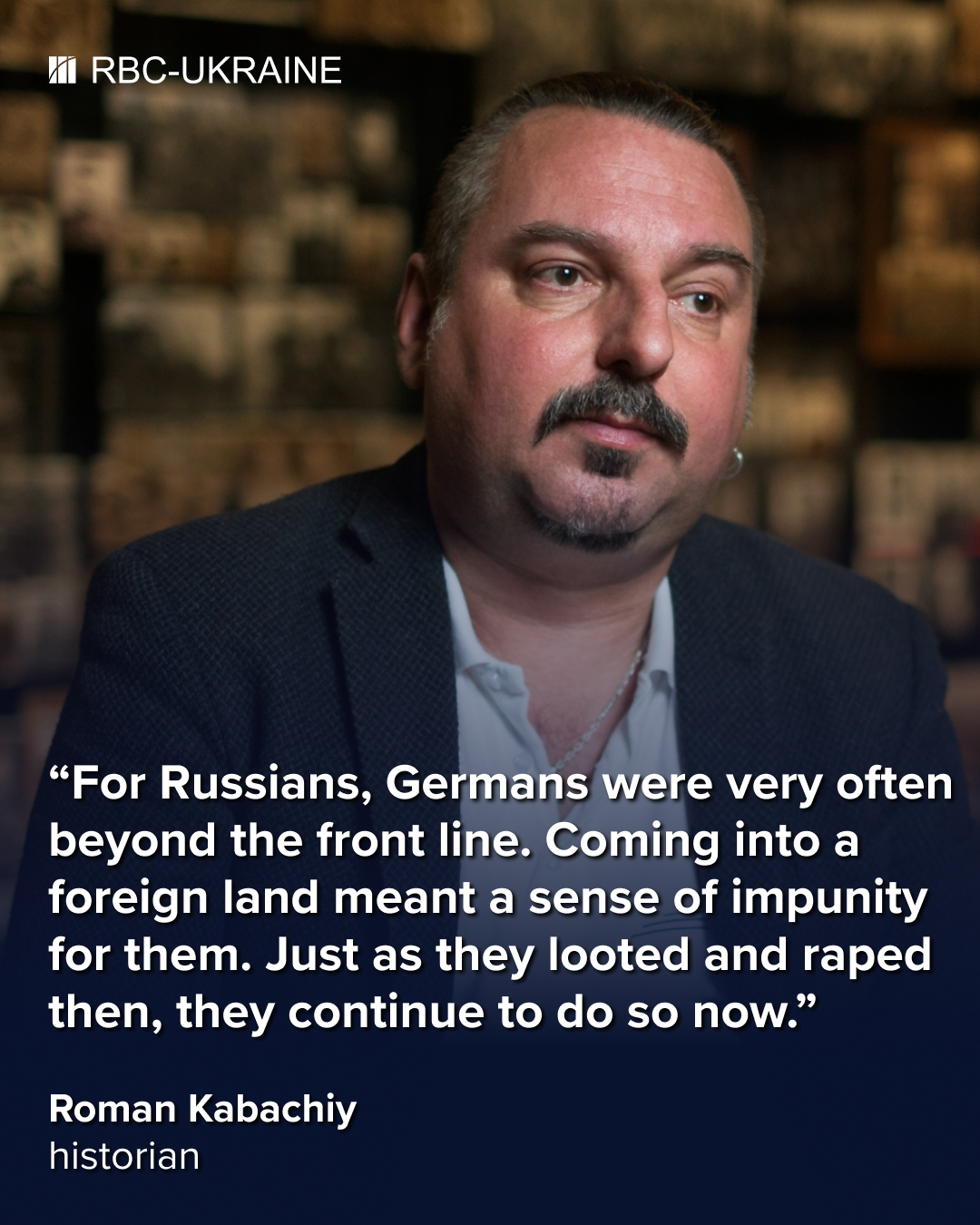
– Practically all Ukrainians during World War II experienced occupation. Every village in the Ukrainian Soviet Socialist Republic was occupied. Everyone saw Germans. For Russians, Germans were very often beyond the front line. They did not experience occupation on their own land.
Coming into a foreign land meant a sense of impunity for them. Just as they looted and raped then, they continue to do so now. For them, this is a war of brutality and expansion, not a defense of their own land, no matter what they say about "protecting Donbas." We feel this completely differently because we are defending ourselves. We have no threat of the cult of victory.
– What methods has the Russian army inherited from the Soviet army and now uses against Ukraine?
– First of all, during the occupation, they destroyed educated and intellectual people. Historian Artem Petryk, who survived the occupation of Kherson, writes that any educated person with critical thinking — journalists, historians, and others — is dangerous for a totalitarian regime.
And Putin's regime is totalitarian. They destroy priests, teachers, and people of culture and media. Because if you are a historian or journalist, then in their eyes, you are a propaganda figure.
Russia uses terminology from World War II for its propaganda to motivate soldiers to go to war against Ukraine. Our museum preserves four diaries of modern Russian occupiers found in liberated territories.
Despite the fact that these are very different people with different levels of education, every diary contains references to these Soviet clichés.
 Russians barely experienced occupation on their own territory during World War II (infographic by RBC-Ukraine)
– Nazism received its verdict at Nuremberg, while the Soviet Union remained among the victors. Is the current war a consequence of communism never being condemned in 1945?
– In some way, yes, because Soviet evil was never punished. Including the fact that the Soviet Union was a co-organizer of the outbreak of World War II.
Historian Olena Stiazhkina believes that World War II was a continuation of the First World War. And perhaps even the current war is an unresolved legacy of World War II.
Putin's attempt to present lawlessness as acceptable is a continuation of Stalin's policy. At the Yalta Conference, Churchill pushed for democratic elections in Poland. But West realized that wherever the Red Army had already set foot, they could do nothing there. And the same thing is happening now.
Yes, the Soviet Union was recognized as one of the victors. But nobody in the West asked at what price this was achieved. Nobody thought about what would happen to Soviet citizens handed over from American and British occupation zones into the hands of the People's Commissariat for Internal Affairs.
– Can we expect a modern Nuremberg for Russians because of the war against Ukraine?
– Evidence for the tribunal is being collected, but for now, we have only trials in absentia. Like in the case of the downing of a Boeing airliner in 2014. I think Russia must punish itself through deep defeat and self-destruction, because acknowledgment of guilt is not characteristic of this nation.