Drone diplomacy: How Ukraine is using weapon else to build new military alliances


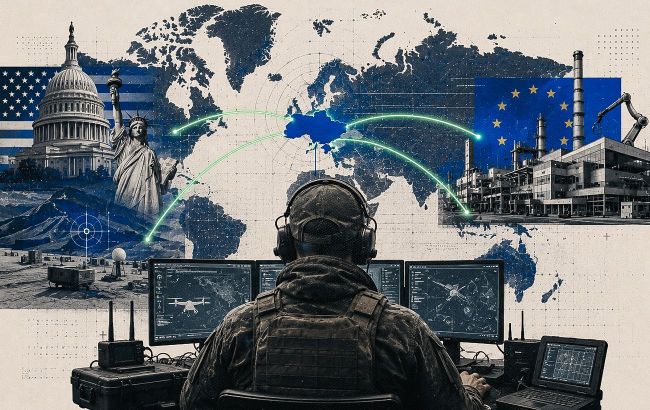 Photo: How Ukraine is launching weapons exports through Drone Deals and what it could bring (RBC-Ukraine collage)
In exchange for its own defense technologies, Kyiv wants to receive more from partners than just money. To maximize the benefits of exporting Ukrainian-made weapons, the government is preparing separate Drone Deals.
What makes these agreements unique, which countries have already signed them, who else may join, and what Ukraine ultimately stands to gain — read in the RBC-Ukraine's report.
Key points:
- Ukraine is preparing Drone Deals with 20 countries, exchanging drones for financing, technologies, or scarce raw materials.
- Kyiv proposed a Drone Deal to the US last year. Negotiations are still ongoing.
- While there is no final agreement, Ukrainian developers are entering the US market through other channels.
- Amid the war with Iran, Ukraine signed Drone Deals with four countries in the region.
- Lithuania became the first European country to legally formalize a Drone Deal, while six more states are preparing to sign.
Ukraine has officially opened weapons exports and aims to scale them through a new tool of “drone diplomacy” — the so-called Drone Deals, agreements focused on unmanned technologies.
The term first appeared in discussions with Washington, but Ukrainian authorities later began using it as a universal framework for cooperation with other key countries around the world.
In practice, the concept of a Drone Deal still remains rather vague. It combines direct arms supplies, complex political barter, and technology exchange. However, for the Ukrainian state, this direction has already become a priority.
On May 11, President Volodymyr Zelenskyy said around 20 countries are interested in the Drone Deal format.
Kyiv is developing a separate strategy for each region: in some cases exchanging drones for financing and technologies, and in others for political concessions or scarce raw materials.
Drone Deal with the US
Ukraine announced talks on a Drone Deal with the United States back in the fall of last year. Broadly speaking, the proposed agreement envisioned supplying Ukrainian drone systems for US needs in exchange for royalties, investments, and purchases of American weapons.
According to Zelenskyy, Ukraine proposed a five-year $50 billion deal to the United States involving the production of up to 10 million drones annually. Kyiv and Washington held several rounds of talks, but no final document has yet been signed.
According to a source familiar with the talks cited by Bloomberg, the US wants technology transfers and access to Ukrainian intellectual property rights. American officials also want to independently test Ukrainian products before moving forward.
Bloomberg reported that in early May, the US sent Ukraine a draft letter of intent requesting such trials.
According to CBS News, Ukraine and the US have so far prepared only a memorandum outlining the terms of a potential defense agreement. It concerns the export of Ukrainian defense technologies to the US and the creation of joint ventures with American companies.
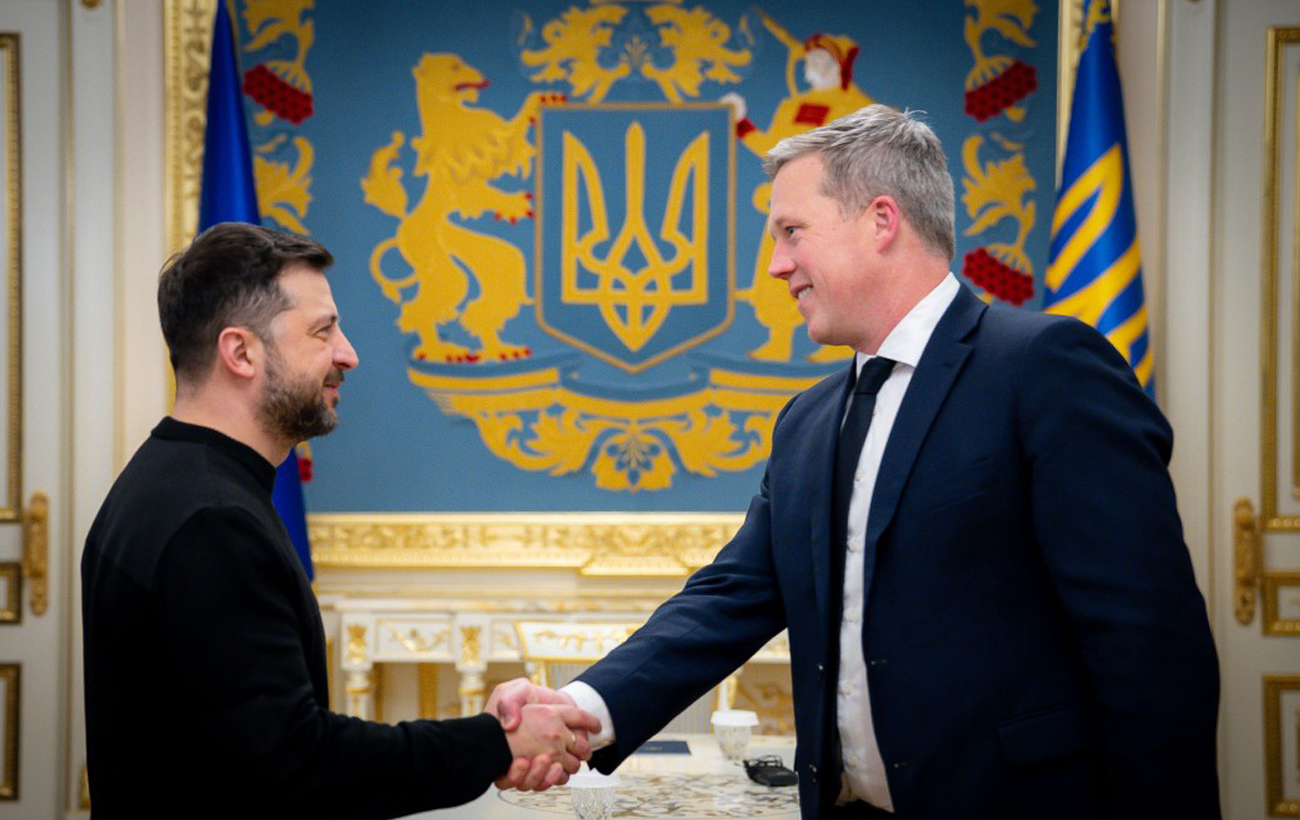
Photo: President Volodymyr Zelenskyy and US Army Secretary Daniel Driscoll in Kyiv during Drone Deal talks (president.gov.ua)
Cooperation without a deal
The delay stems from both political and technical reasons. The American procurement system is extremely conservative. Any foreign technology must undergo lengthy security certification.
“There is still no political framework for supplying Ukrainian weapons to the US. So I would be very cautious about describing this as an already open export direction. But at the practical level, cooperation is already moving forward,” RBC-Ukraine quoted Ihor Fedirko, CEO of Ukraine Defense Alliance as saying.
According to him, cooperation is developing mainly through direct company-to-company dialogue: technical consultations, demonstrations, preparation for testing, discussions of joint production, localization of components, and possible joint ventures.
One example is Ukrainian manufacturer General Chereshnya, which announced a strategic partnership with Wilcox Industries to create joint production of FPV drones and interceptor drones in the US.
Production is expected to be based at Wilcox facilities in New Hampshire, while the Ukrainian side contributes battlefield experience, engineering expertise, and technology.
Another important initiative is the American Drone Dominance program. The first stage already took place in the US, and many Ukrainian manufacturers participated.
According to Fedirko, some Ukrainian companies performed strongly and won, while others failed even to enter the competition because of the complexity of applications and participation requirements.
“As far as I know, the second stage of Drone Dominance is already underway. The third stage is expected in roughly five or six months, though there is no exact date yet. For us, this is an important signal: Ukrainian companies are already entering practical American defense processes, even if the political export framework is not finalized,” he added.
Valerii Yakovenko, co-founder of Drone.ua and a drone expert, emphasized that current work mainly involves preparatory cooperation efforts.
“Ukrainian companies are already present on the American market. They are seeking opportunities for cooperation. They are working within the legal frameworks of both the US and Ukraine. No one intends to export anything without approval,” Yakovenko said.
According to him, companies are opening local legal entities and building communication channels between local stakeholders and Ukrainian firms.
“Some companies are working in the field of commercial technologies without focusing on defense directions at all. But they are simply waiting for the right time when more can be done,” the expert noted.
Breakthrough thanks to Iran
For a long time, the Middle East was not a priority for Ukrainian arms exports. There were many reasons for this, from Russia’s traditionally strong position in the region to lingering perceptions of Ukraine.
Everything changed on February 28, when Israel and the US launched another war against Iran. In response, Tehran began attacking Washington’s allies — the Arab monarchies of the Persian Gulf. The US failed to guarantee the security of either those countries or even its own military bases there.
Iran attacked with the same Shahed drones that Russia uses against Ukraine. Kyiv now has the world’s most extensive experience defending skies against such threats. Contacts with Arab states began within days of the conflict’s outbreak, and the first Ukrainian specialists traveled to the region on March 10.
At the same time, Ukrainian arms manufacturers privately began receiving requests to sell anything capable of intercepting Iranian drones. However, the Ukrainian government initially did not authorize exports, prompting criticism that Ukraine was missing a unique opportunity while competitors could take over the market.
But Ukraine chose another strategy — first political agreements, then anti-drone exports.
According to RBC-Ukraine sources, the Ukrainian leadership seriously fears that advanced Ukrainian technologies and production capabilities could “leak” abroad without directly benefiting Ukraine itself.
Sources pointed to the example of other countries supplying military aid to Ukraine: major defense products cannot simply be purchased directly without political approval from the top.
“The Middle East in recent years, especially in security technologies, has not shown consistency in maintaining partnerships. So it is extremely difficult work to ensure Ukrainian technologies are not replaced by local alternatives and that we do not lose influence in the region,” Yakovenko said.
That is precisely what Drone Deals are designed for. Since most of these agreements involve defense industries, military technologies, and electronic warfare systems, even their official titles and specifications remain classified.
In practice, each deal contains entire packages of non-public contracts involving both governments and private sectors.

Photo: President Volodymyr Zelenskyy and Saudi Crown Prince Mohammed bin Salman during Drone Deal talks (president.gov.ua)
A focus on pragmatism
Ukraine signed its first Drone Deal with Qatar on March 28. Similar 10-year defense frameworks were later concluded with Saudi Arabia and the United Arab Emirates.
The latest stage of this expansion came during Zelenskyy’s April visit to Azerbaijan, where six agreements were signed under the Drone Deal concept. Beyond air defense and joint production, the package also covered civil law and energy cooperation.
Ukraine openly aims for broader “package agreements” within Drone Deals that would affect other sectors too.
Initially, Kyiv hoped to exchange anti-drone systems for scarce Patriot air defense ammunition — the only reliable defense against Russian ballistic missiles. However, Middle Eastern partners showed little enthusiasm because they themselves need protection from Iranian missiles. Still, agreements were reached in other areas.
“Ukraine is already guaranteed its first energy-related results from these deals — the necessary fuel volumes for the Ukrainian market are secured. Significant financial results will follow,” Zelenskyy said on May 11.
Drone Deals are also indirectly helping cooperation in other sectors thanks to the improved image of Ukraine. For example, pharmaceutical company Farmak gained access to the Saudi market in May, while MHP had its poultry export permit restored.
As for drones and electronic warfare systems, Ukrainian Bukovel-AD mobile electronic warfare complexes from Proximus and Piranha SF-3 anti-drone rifles from Piranha Tech are already being supplied to the Middle East.
Contracts also reportedly include Sting interceptor drones from Wild Hornets, as well as export versions of Magura and Sea Baby autonomous naval drones.
Drone Deals with Europe
Another strategic direction of Ukraine’s “drone diplomacy” is Europe. Unlike the Middle East, the structure of these agreements is built around creating an entire technological network.
As of late May, Lithuania became the only European country to formally sign and legalize a Drone Deal. At the same time, agreements with several other countries are expected soon.
Six more agreements are currently being drafted and negotiated. Relevant ministries, together with the Ukrainian side, are working on documents for the Netherlands, Germany, Norway, Finland, and Italy, while finalizing a framework with Latvia.
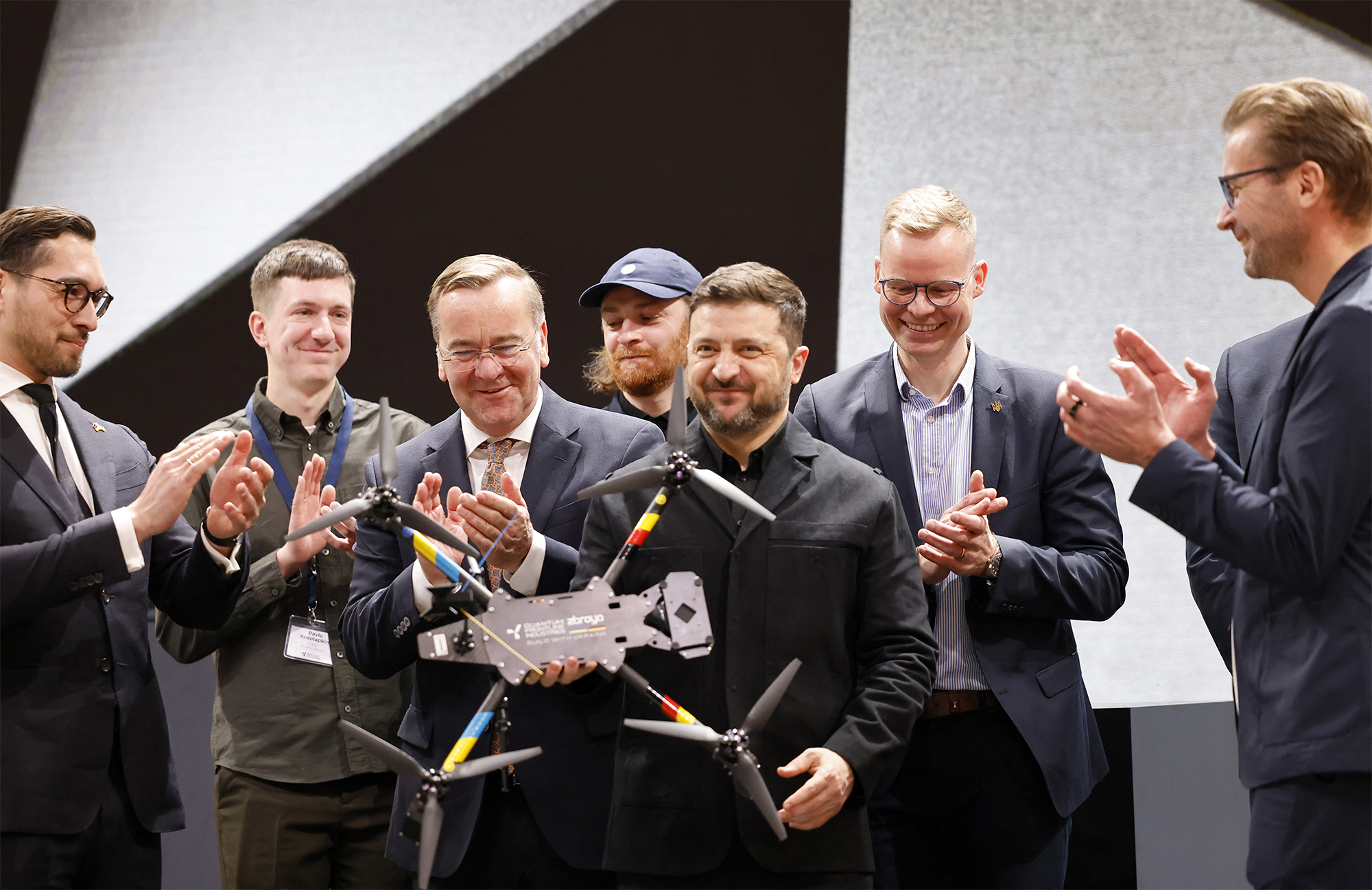
Photo: Volodymyr Zelenskyy and German Defense Minister Boris Pistorius visit a drone factory in Gilching near Munich (Getty Images)
In addition, during an April 20 interview, Zelenskyy mentioned France, the United Kingdom, and Sweden as promising candidates for future Drone Deals.
Romania stands somewhat apart. On May 13, Zelenskyy officially proposed to Romanian President Nicusor Dan joining the format. Following the talks, both leaders agreed that the Ukrainian and Romanian teams would work out all technical and legal details.
Overall, Europe’s approach differs somewhat. While European Drone Deals, like those in the Middle East, emphasize involving Ukrainian specialists in training allied militaries, European partners are reportedly more interested in joint ventures and production on their own territory than direct weapons imports from Ukraine.
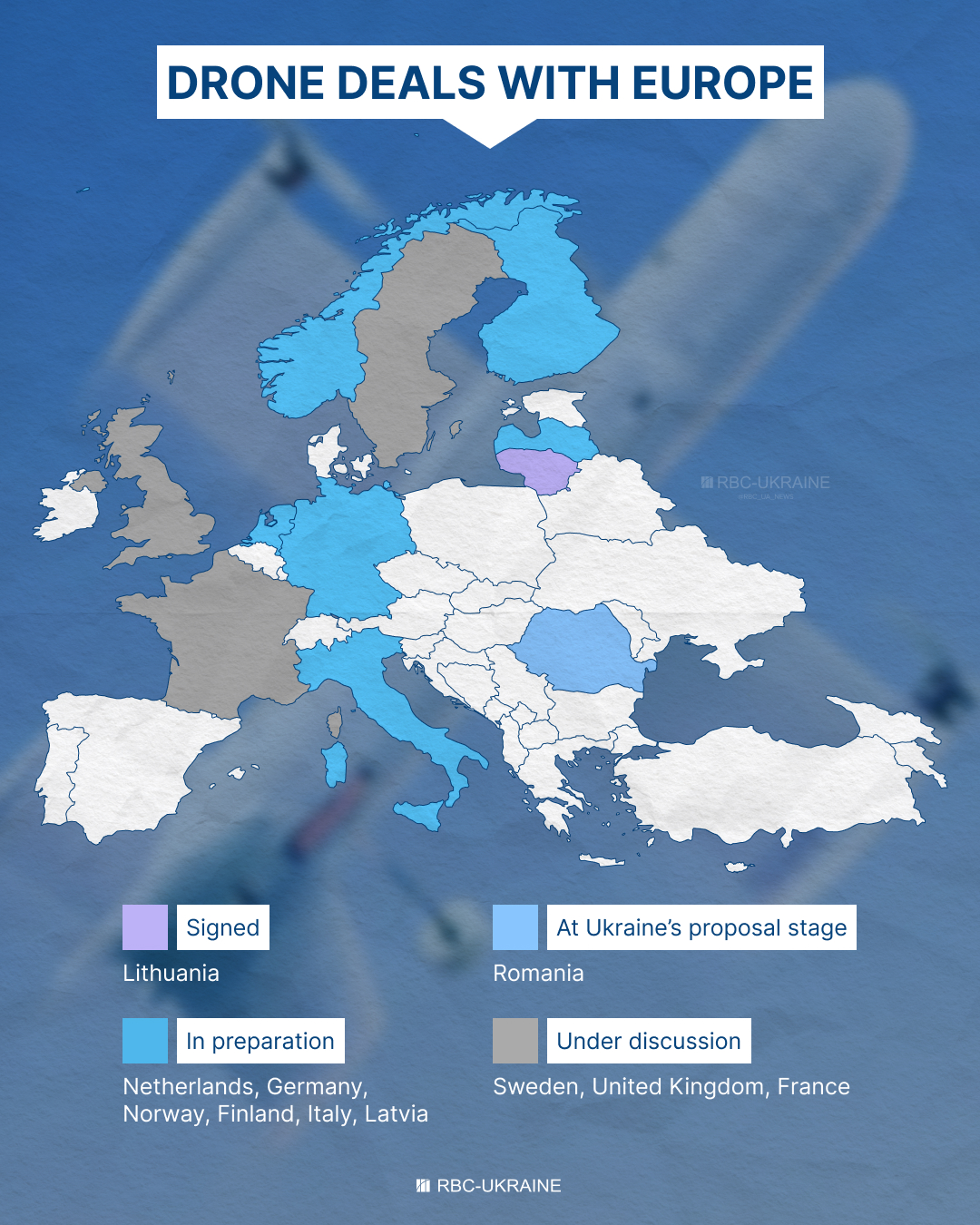
Photo: Europe deepens defense cooperation with Ukraine through Drone Deals (RBC-Ukraine collage)
Systemic cooperation
Ukraine and European countries have been working closely together in the defense sector for quite some time. At the European Union level, the key initiative is the SAFE program. It allows Ukrainian defense companies to join EU supply chains and participate in joint procurement programs.
“A process of integration is underway where Ukraine is no longer viewed as just a resource base, but as an equal partner — and in some areas even as a partner with greater experience and capabilities,” said Valerii Yakovenko.
In June last year, the Build with Ukraine initiative was launched. Its goal is to export Ukrainian technologies and open production lines in allied countries. Among other things, this allows Ukraine to scale up weapons production for the Defense Forces abroad, where facilities are protected from Russian missile strikes.
Overall, Ihor Fedirko describes cooperation with Europe as follows: Ukrainian companies bring battlefield experience, proven products, and rapid upgrade cycles. European partners contribute capital, production facilities, certification, standards, and access to their own markets. Several successful directions have already emerged within this model.
“The first is Germany. It’s one of the most practical tracks when it comes to joint production. Our northern partners are also extremely active: Denmark, Finland, Norway, and partly Latvia. I would also mention the United Kingdom. Cooperation there has already reached the level of manufacturing capacities and long-term programs,” Fedirko noted.
For example, Culver Aerospace and Copenhagen Global A/S agreed on production cooperation in the UAV sector. TENCORE and Finland’s INSTA partnered on the TerMIT ground robotic platform. Remtechnology and Finland’s New Paakkola launched cooperation on the LEGIT ground robotic platform.
Norway stands out separately. Kyiv and Oslo are launching the first joint production of Ukrainian UAVs in Norway, with plans to manufacture several thousand drones for Ukraine’s Defense Forces.
The Netherlands, Romania, and France are also moving quickly. Ukraine and the Netherlands have already agreed on joint drone production, as well as broader cooperation on missiles, electronic warfare, and other defense technologies.
Romania has already signed a declaration of intent with Ukraine to manufacture Ukrainian defense systems, including drones, on Romanian territory. Plans include assembling drones from the Wild Hornets group and several other Ukrainian companies.
“With France, the track is more political-industrial: there is a framework for developing joint production and deeper defense-industrial cooperation,” Fedirko added.
All of these initiatives work as a single interconnected system, where each element strengthens the others.
“Drone Deals and other formats of joint production, including under the SAFE program and similar models, allow us to build long-term strategic partnerships,” Deputy Prime Minister for European and Euro-Atlantic Integration Taras Kachka told RBC-Ukraine.
Turning deals into reality
While Drone Deals are gradually being prepared, the key question is how they will be implemented in practice.
According to National Security and Defense Council Secretary Rustem Umerov, all relevant institutions — the NSDC apparatus, the Defense Ministry, intelligence agencies, and military leadership — agreed to simplify weapons export permit procedures and reduce approval times.
“Today we are already working on practical implementation — specific contracts and projects — within the framework of the political agreements under Drone Deals. The first contracts are already awaiting approval, and by late May and early June we expect even more new partnerships,” Umerov said on May 20.
The NSDC apparatus will coordinate the direction, while the government will handle implementation.
However, problems on the state side remain. According to a survey released in April by the Technological Forces of Ukraine association, 64% of arms manufacturers expect simplified procedures from the government, 50% want shorter approval timelines, and 42% seek greater transparency in the rules.
In addition, the export licensing system is not always transparent, creating corruption risks.
“This idea of granting permits to some and denying others creates unequal market conditions. Those closer to the decision-making centers receive export approvals faster. Different mechanisms need to be developed,” former commander of Ukraine’s 67th Brigade and former military attaché to France Oleksandr Saienko told RBC-Ukraine.
At the same time, in wartime, completely free arms exports are impossible. It is also critically important to prevent uncontrolled leaks of Ukrainian technologies abroad.
“We have no right to allow unique Ukrainian developments to end up in enemy hands through the sale of finished products or questionable subsidiary companies,” Head of the Presidential Office Kyrylo Budanov said on April 22.
Still, there is no universal solution.
“Even high-tech solutions can indeed be copied. Every side in the world likely wants to do this. We have already seen such technologies being copied between 2022 and 2024,” Valerii Yakovenko explained.
In his view, the only real protection against technological theft is the speed of innovation.
“If we take into account the current speed of iteration for security equipment and technologies used by Ukraine, it’s simply impossible to keep up with Ukraine’s pace of adaptation,” Yakovenko concluded.
As with Drone Deals themselves, the most effective model of cooperation between government and business still has to be developed.
Quick Q&A
– What are Drone Deals and how does Ukraine’s “drone diplomacy” work?
Drone Deals are a new format of international security agreements under which Ukraine exports its own drone systems and electronic warfare technologies abroad.
Instead of direct financial payments, Kyiv signs package agreements exchanging weapons for foreign investments, joint technologies, critical raw materials, or fuel supplies.
– Why has the official Drone Deal agreement between Ukraine and the United States been delayed?
The main reason is the conservative and lengthy nature of American bureaucratic procedures, which require mandatory security certification for any foreign-made weapon systems.
Washington has already sent Kyiv an official request to conduct its own testing of Ukrainian technologies before finalizing any contracts.
– What benefits does Ukraine gain from exporting military technologies to Middle Eastern countries?
By supplying anti-drone systems, Kyiv has already secured stable fuel supplies for Ukraine’s domestic market.
In addition, the agreements have improved Ukraine’s international image, allowing major Ukrainian companies to open or restore access to Saudi Arabian markets.
– Why are European countries signing Drone Deals if they already have powerful defense industries?
Europe is interested not in directly importing ready-made weapons, but in gaining access to Ukraine’s unique battlefield experience and rapid engineering innovation cycles.
Through the Build with Ukraine initiative, European partners provide capital and facilities for joint production lines of Ukrainian drones located safely outside the range of Russian strikes.