From drones to tanks. Who is lining up for Ukrainian arms and why exports are stalled


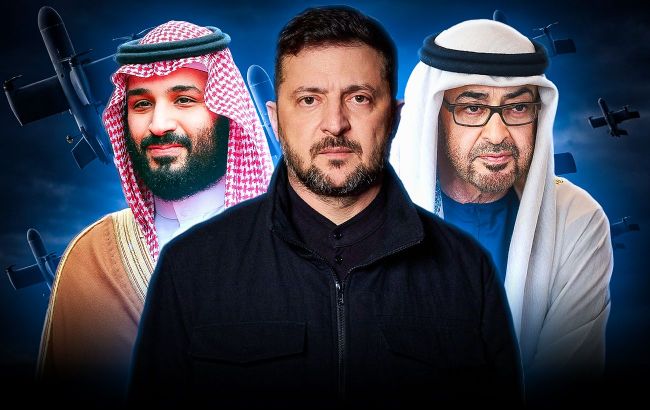 President of Ukraine Volodymyr Zelenskyy (center), Saudi Crown Prince Mohammed bin Salman (left), and UAE President Mohamed bin Zayed Al Nahyan (right) (collage: RBC-Ukraine)
With the start of the war in Iran, interest in Ukrainian weapons has sharply increased, primarily in the Middle East. And this is not only about anti-drone systems.
What helps and what hinders Ukraine from selling weapons outside Europe is analyzed in RBC-Ukraine's report.
Key points:
- Not only Europe and the US: Countries of the Global South are showing active interest in Ukrainian weapons
- Rising attention: The greatest demand is for Ukrainian drones, electronic warfare (EW) systems, and ground-based robotic systems
- Oplot tanks rehabilitation: Ukrainian tanks in Thailand have proven superior to Chinese ones in the conditions of drone warfare
- Export barrier: Despite the official launch of licensing, potential exports to the Middle East are de facto paused
- Arab investments: The UAE and Saudi Arabia are ready to invest in the joint production of Ukrainian weapons
Ukrainian weapons have long proven their effectiveness on the battlefield. Europe and the United States were the first to recognize this. Dozens of joint projects over recent years are proof of that. Now, Ukrainian developments are in demand beyond Europe as well.
If previously Iranian Shaheds were used only by Russia, now they have also begun to be launched by Iran itself against Arab monarchies in the Persian Gulf.
With the start of the war, some Middle Eastern envoys reached out to Kyiv, and the phones of Ukrainian weapons manufacturers were ringing off the hook — expertise in countering strikes played its role. In response to these requests, Ukraine has already sent its specialists to five Middle Eastern countries.
"This should serve as a foundation for further cooperation between countries, in particular in terms of deepening military-technical cooperation and participation of companies and investment funds in investing in Ukraine's economy and defense industry," said Anastasiia Mishkina, Executive Director of the TechForce in UA, in a comment to RBC-Ukraine.
However, the reality is somewhat more complicated. It is not possible to simply start large-scale sales of Ukrainian weapons, due to many reasons, according to RBC-Ukraine's defense industry sources.
Not all of these reasons are justified. However, the arms business is certainly not about short timelines, unlike other sectors. Therefore, the primary issue is establishing a legal framework between governments. Ukraine signed its first framework agreements with Saudi Arabia and Qatar last week. More are expected with other countries.
"We are agreeing on strategic cooperation in the field of miltech and other areas. We are talking about ten-year agreements," said President of Ukraine Volodymyr Zelenskyy in response to a question from RBC-Ukraine.
These documents lay the foundation for further contracts, technological cooperation, and investments. The key question now is how they will be implemented in practice.
Renewed interest
The war against Iran has given a new boost to interest in Ukrainian weapons, although domestic companies are not newcomers to markets in the Middle East, Asia, or Africa.
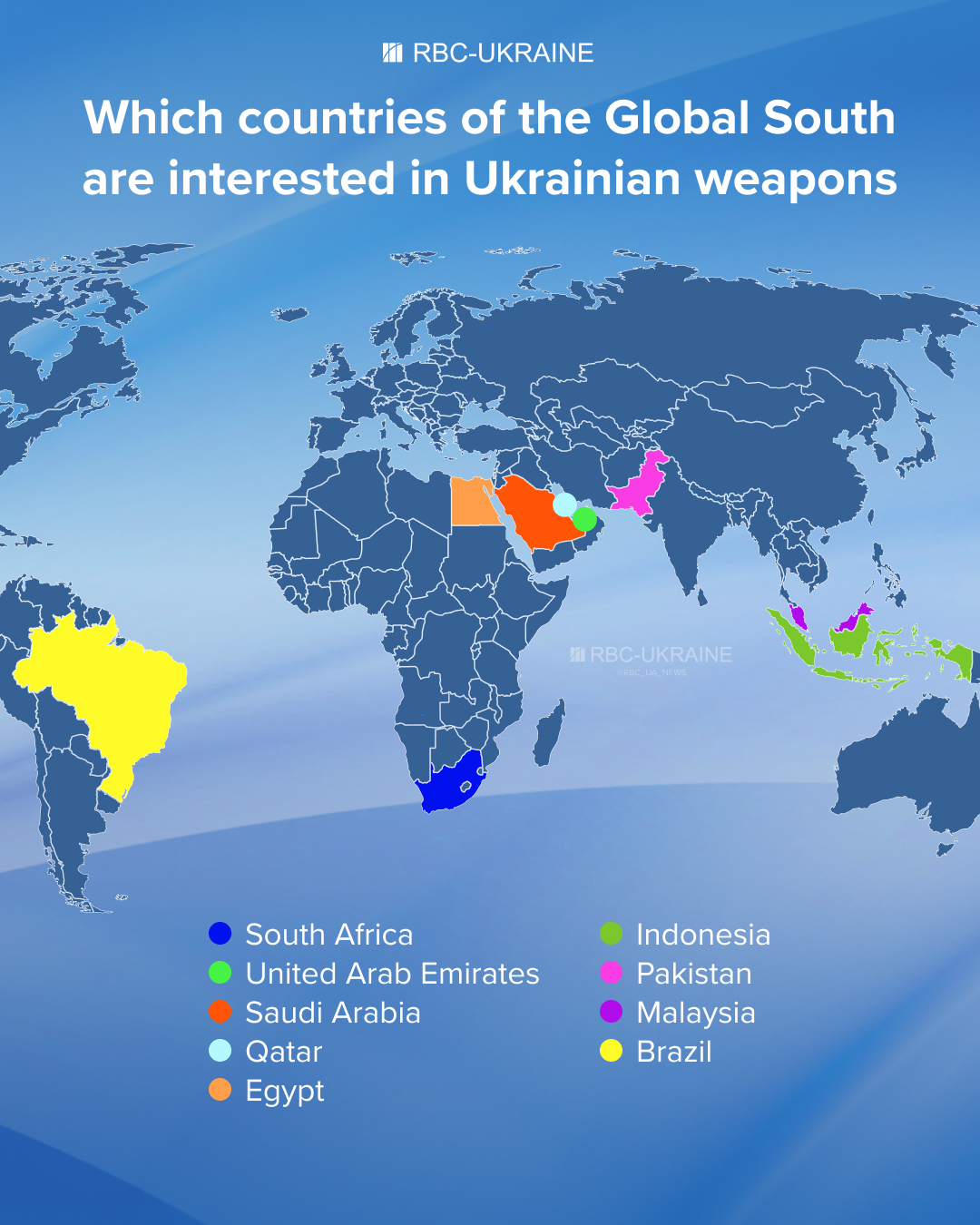 Countries where Ukrainian developments were presented at arms exhibitions, according to the Ukrainian Council of Defense Industry (infographic: RBC-Ukraine)
"The greatest interest right now is in Ukrainian unmanned systems and everything related to countering aerial threats," said Ihor Fedirko, executive director of the Ukrainian Council of Defense Industry, in a comment to RBC-Ukraine.
These primarily include strike and reconnaissance UAVs, interceptor drones, naval drones, and fiber-optic-based solutions. They also include electronic warfare (EW) systems, communications, detection, and targeting equipment.
"And of course, systems for drone detection: acoustic systems, radars, and situational awareness platforms. This is precisely the segment where Ukraine has real combat experience and a very fast cycle of adapting solutions to new threats," he noted.
However, interest is not limited to counter-drone warfare. "There is also growing demand for ground robotic systems — a technology that can have many applications, including casualty evacuation," Anastasiia Mishkina clarified.
At the same time, it is not only the products themselves that matter, because in today's world they can become outdated within months, but also their practical use and after-sales service.
"Partners are increasingly looking at a complete ecosystem — a combination of detection, tracking, interception, suppression, software, and continuous adaptation. This is exactly where Ukrainian manufacturers are strongest today," Ihor Fedirko emphasized.
But third countries are interested not only in new developments. What Ukraine was exporting before the full-scale war is also back in focus.
Return to traditional markets
Once, Ukraine was even among the world's top 10 arms exporters, mostly thanks to the legacy of the Soviet defense industry. Armored personnel carriers were shipped to Thailand and Myanmar, tanks to Ethiopia, and anti-tank missile systems to Algeria. Gradually, these positions weakened. And after 2022, arms exports stopped altogether for obvious reasons.
When it came to Ukrainian weapons, we suffered from the "Thai contract trauma," Ivan Kyrychevskyi, a serviceman of the 413th Unmanned Systems Forces regiment "Raid" and an arms expert at Defense Express, told RBC-Ukraine.
In 2011, Ukraine received an order for 49 Oplot tanks, but due to production difficulties and bureaucracy, the last vehicle was delivered to the customer only seven years later. This severely damaged Kyiv's reputation as a reliable supplier for years. But unexpectedly, the situation has changed.
"Especially against the backdrop of recent combat operations in Thailand, the Oplot-T performed very well, including in terms of protection against drones, unlike the Chinese VT-4, not to mention survivability. So it unexpectedly turned out that we are actually capable of producing even good tanks," Ivan Kyrychevskyi noted.
In February, Ukrainian systems were presented in Saudi Arabia, including the Bohdana self-propelled artillery system, the Varta-2 armored vehicle, and the Protector ground robotic complex.
Sources in the industry explain Riyadh's interest by the fact that Saudi Arabia borders Yemen in the south, where Iran-backed Houthis are entrenched. Therefore, over the next few years, a new ground war between Saudi Arabia and Yemen remains a possibility.
However, this does not mean that Ukrainian arms manufacturers have it easy. They also face additional difficulties created by their own state's policies.
Arms exports open?
There are several ways Ukrainian weapons can legally reach foreign customers: direct exports, licensed production abroad, or the creation of joint ventures.
Clearly, direct export is the most beneficial option for Ukraine. In this case, domestic production capacities remain loaded, and Ukrainian specialists are employed.
For a long time, many arms manufacturers have had the capabilities to produce more than the state could order. Therefore, allowing exports could also benefit Ukraine's Defense Forces.
"If we establish a mechanism to sell to foreign buyers at a higher export price, it will help reduce the cost of production and make it more scalable for us. Because precisely since we did not have arms exports, we did not have external sources of funding," said Ivan Kyrychevskyi.
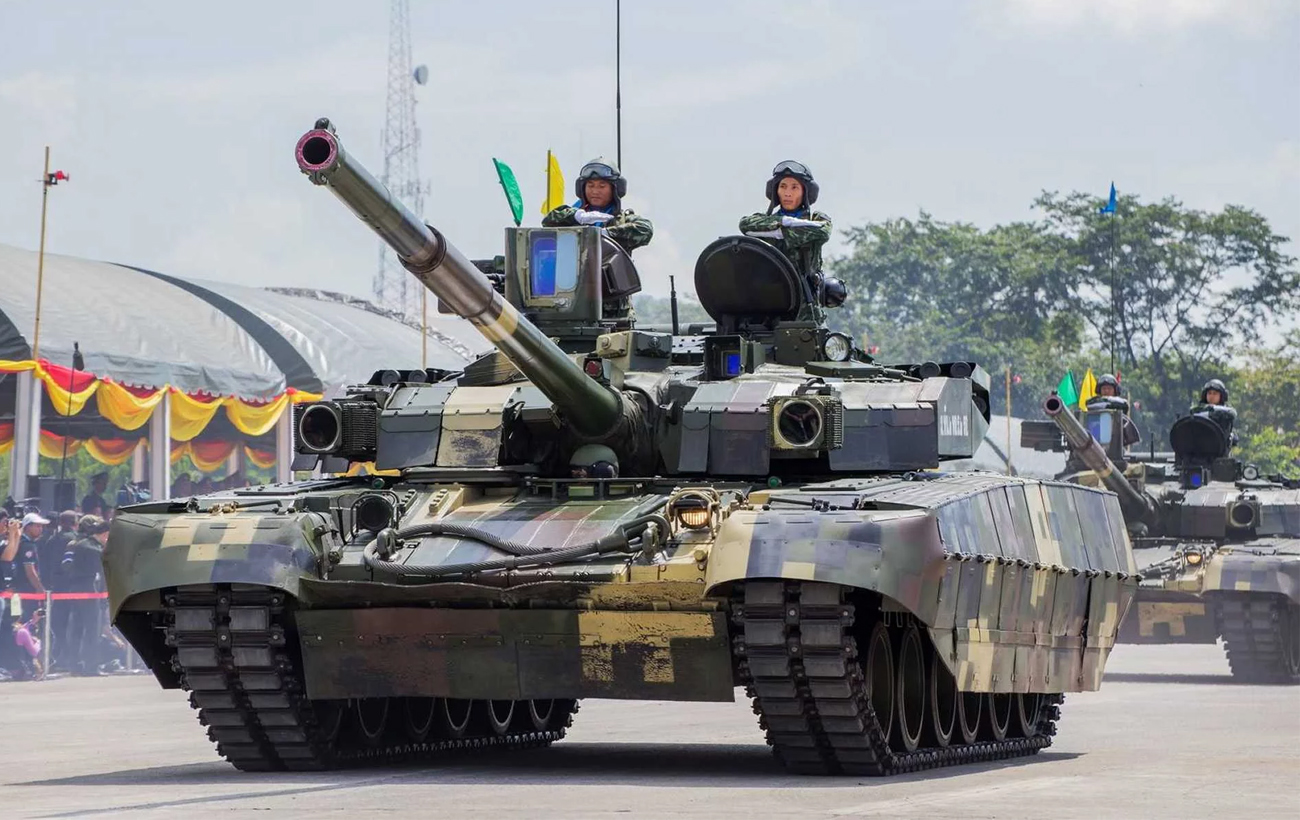 Ukrainian Oplot tank in Thailand (photo: Getty Images)
The decision to partially open arms exports has already been made. Since February 10, the state has announced that weapons manufacturers can submit applications to the State Service for Export Control.
According to Deputy Secretary of Ukraine's National Security and Defense Council, Davyd Aloyan, Ukraine could export military goods and services worth several billion dollars in 2026. Most of this would go to Europe and even the United States, although the Global South should not be discounted either.
In addition, the government is considering introducing a special export duty for defense companies. It is expected that revenues from this tax will be directed to funding Ukraine's domestic military needs.
Anastasiia Mishkina says that the procedure is complex. Under current legislation, Ukrainian arms and military equipment producers must submit the relevant documents and an application to the State Service for Export Control. It will review them together with the Interagency Commission on Military-Technical Cooperation and Export Control Policy. After that, a decision is made—either approval or rejection of the application.
However, on March 2, the export procedure to the Middle East and the Persian Gulf countries was de facto suspended. Defense manufacturers received a letter from one of Ukraine's security services stating that the State Service for Export Control would suspend the review of license applications.
Interestingly, the letter did not come from the service itself. Moreover, in response to an inquiry from RBC-Ukraine, the State Service for Export Control stated that no decisions on permit suspension had been made.
This likely reflects the position of one of the security services that are part of the interagency commission. However, the situation creates an atmosphere of uncertainty and complicates negotiations.
State understands this, but there is a caveat
For Ukraine, arms exports are not a purely commercial matter at the moment. Therefore, there is a certain political and security barrier.
"Every decision is tied to the national interest, the end user, diplomatic consequences, and whether it could weaken our own capabilities," said Ihor Fedirko.
That is why the state is very cautious when it comes to sensitive markets, particularly in the Middle East.
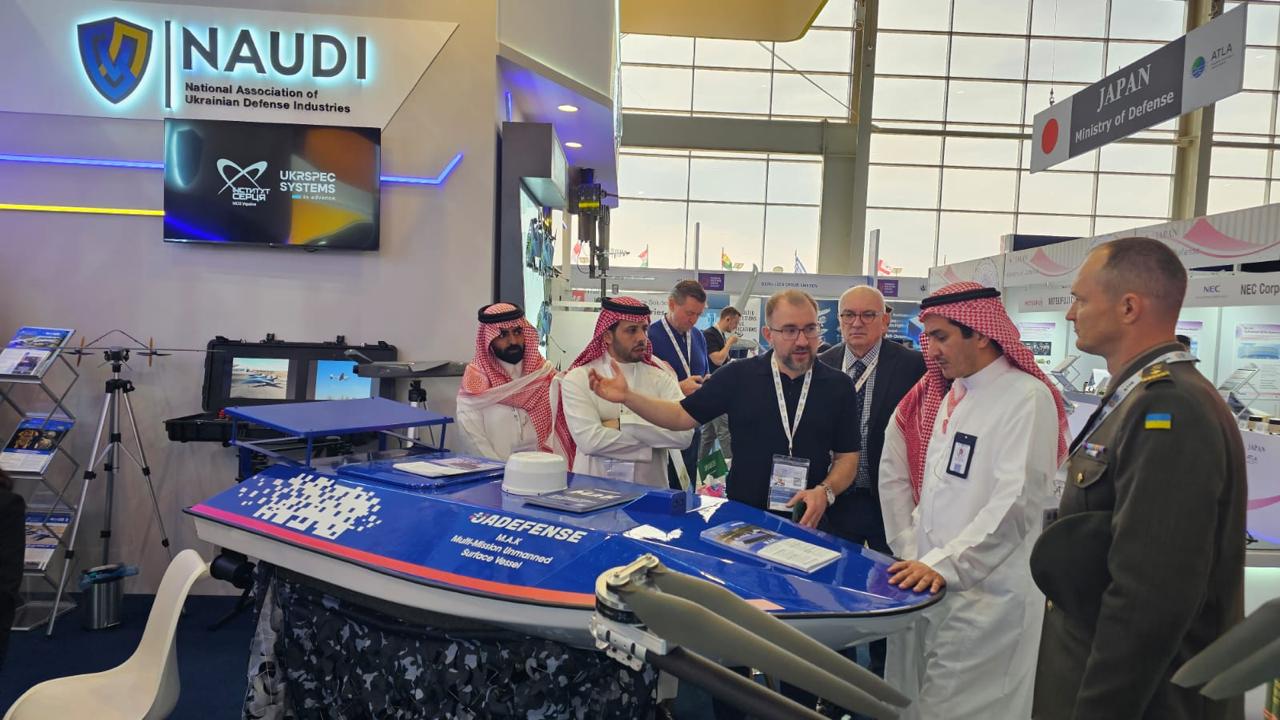 A naval drone at an exhibition in the UAE (photo: facebook.com/naudiUA)
"In the conditions of war and active combat operations, we understand the state's position and its prerogative to define export policy and, for example, through the signing of security agreements with allies, to determine countries with which the Ukrainian defense industry can build partnerships at different levels in Ukraine's interests," emphasized Anastasiia Mishkina.
At the same time, she noted that it is important to respond promptly and give the industry opportunities to quickly enter the markets of allied countries.
The main difficulties stem from Ukraine's gradual, controlled resumption of exports.
"Wartime licenses were issued only in February 2026. So the mechanism has already been launched, but it is definitely not yet a free commercial arms sales regime. The state is moving cautiously because the priority remains unchanged – ensuring our own front line," Fedirko noted.
However, it is important not to delay. If demand is not met legally, it will be met through gray-market schemes. For a long time, there has been a practice of setting up production outside Ukraine, formally not even connected to the Ukrainian developer company.
In practice, this means the state cannot control its operations and also does not receive tax revenues, a source familiar with the defense industry told RBC-Ukraine.
Investment prospects
Countries of the Global South are ready not only to purchase Ukrainian weapons but also to invest in them. For investors from Global South countries, Ukraine's defense industry is attractive for several reasons:
- Speed of technology adaptation;
- Lower cost of many solutions compared to traditional systems;
- Real combat experience is already built into the product.
"This is what gives Ukrainian companies a strong position in negotiations on joint production and localization for the needs of a specific market," Igor Fedirko emphasized in a comment to RBC-Ukraine.
The most well-known, but not the only, case here is the company Fire Point, which produces Flamingo cruise missiles. EDGE Group, a defense conglomerate from the United Arab Emirates, plans to acquire a 30% stake in the company for $760 million.
The Antimonopoly Committee is currently reviewing the application. However, a source in the Ministry of Defense leadership told RBC-Ukraine that no decision is expected by the end of the year.
In the context of investment, the state cluster for defense technology development, Brave1, plays an important role. This platform helps validate startups so that investors can be confident in the quality of the projects.
At last year's Defense Tech Valley summit, investors from the Middle East and Asia were present, along with representatives of BRICS+ countries.
For example, Saudi Arabia plans to localize 50% of its defense spending by 2030. In terms of joint production, the country is interested in Ukrainian missile technologies and armored vehicles. This is expected to receive an additional boost from the recently signed defense cooperation agreement between Kyiv and Riyadh.
Another potential partner is India, which is considering Ukraine as an alternative to Russia for servicing Soviet-era equipment. In addition, New Delhi is interested in joint ventures to develop air defense systems and electronic warfare capabilities based on Ukrainian experience.
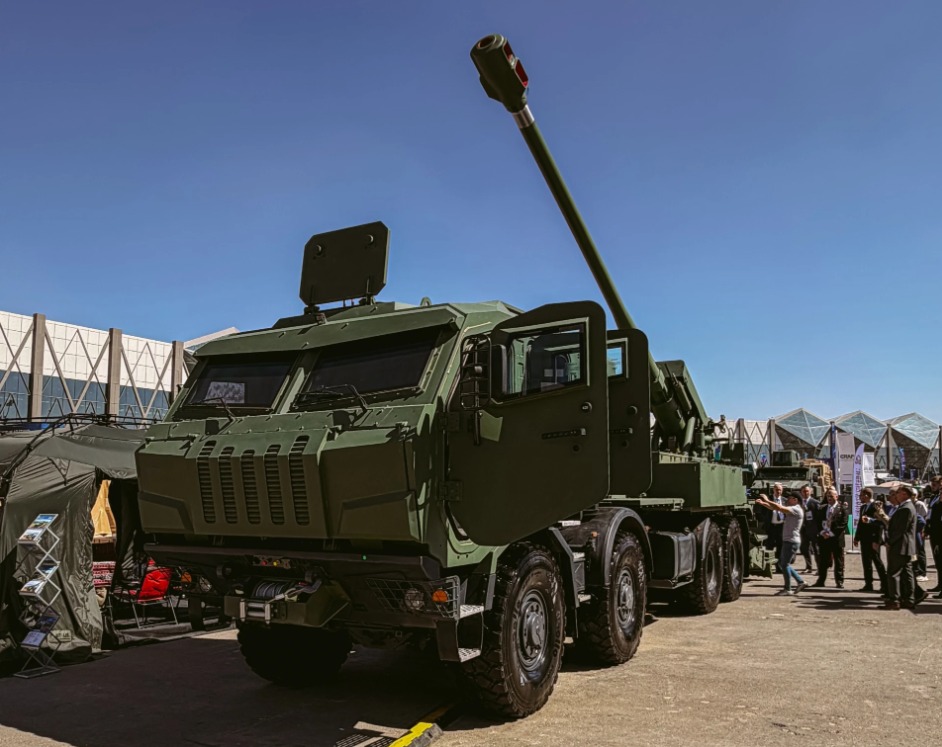
Self-propelled artillery system Bohdana in Saudi Arabia (photo: facebook.com/naudiUA)
Of course, such investments will only move forward where there is political trust, a clear export regime, end-user control, and guarantees that cooperation does not contradict Ukraine's security interests.
"Therefore, I would expect not a chaotic influx of easy contracts and quick profits, but rather targeted deals in segments where Ukraine has a clear advantage: drones, counter-drone systems, electronic warfare, sensors, communications, certain robotic systems, and software," Fedirko noted.
At the same time, there are constraints imposed by competition between different centers of influence. As a result, Ukrainian companies have to choose which partners to work with.
A telling example is a story shared by one of the publication's sources. Last year, several Ukrainian companies that maintain contacts with Saudi Arabia planned to attend an arms exhibition in the UAE. However, they soon received a message from Saudi representatives: if they attended, cooperation with Riyadh would be off the table.
Defense cooperation has always been politically sensitive. This is especially evident in the Middle East, Asia, and Latin America. There, Ukrainian manufacturers have to compete not only with Western companies but also with Russian and Chinese ones. This means that in each case, it is important to weigh all pros and cons. At the same time, decisions must be made quickly in order not to miss a unique window of opportunity.
Quick Q&A:
– What Ukrainian weapons are countries of the Global South most interested in buying?
The highest demand is for unmanned systems (strike, reconnaissance, and interceptor drones), electronic warfare (EW) systems, and ground-based robotic evacuation platforms. Foreign buyers are also interested in integrated “ecosystems” that combine radar systems, situational awareness tools, and target suppression capabilities.
– Will opening weapons exports help reduce costs for the Ukrainian Armed Forces?
Experts believe that selling weapons to foreign customers at higher market prices would allow manufacturers to attract additional capital. This, in turn, would help scale up production, purchase new equipment, and ultimately reduce the unit costs of equipment procured by the state for the Ukrainian military.
– Is Ukraine currently allowed to officially export weapons?
Since February 10, 2026, the state has officially allowed manufacturers to submit applications for export licenses through the State Service for Export Control. However, the procedure remains strict: every decision is reviewed by an interagency commission, with priority given to frontline needs.
– Which foreign companies are ready to invest in Ukraine’s defense sector?
The largest potential investor is the UAE-based EDGE Group, which plans to acquire a 30% stake in the company Fire Point for $760 million. Saudi Arabia and India are also showing interest in joint missile and armored vehicle production as part of their defense localization programs.