Air Force explains why Russia's jet-powered drones harder to intercept than Shaheds


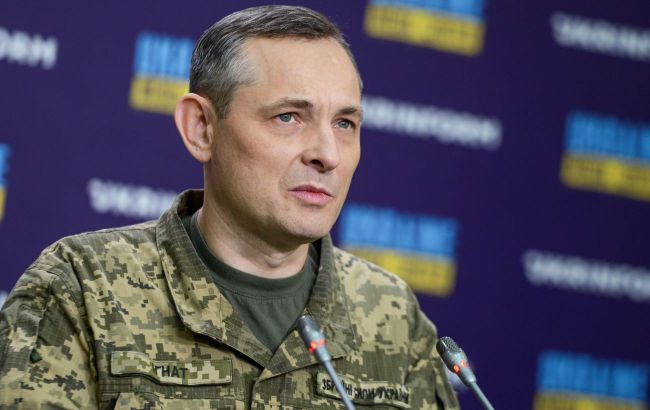 Photo: Yurii Ihnat, head of the Communications Department of the Air Force Command (Photo: Evgen Kotenko/Ukrinform)
Jet-powered drones are harder to intercept
Ihnat noted that the Geran-4 has a cruising speed of about 320 km/h and can climb to 4 km. The significantly larger Geran-5 flies at approximately 450-600 km/h and can reach an altitude of up to 6 km.
"These characteristics significantly narrow the range of means that can be used to counter them. Many of the cheaper systems that have become the backbone of the fight against conventional Shaheds either do not work against jet-powered models or are less effective," he said.
According to Ihnat, conventional Geran-2 drones can be intercepted with:
- Machine guns used by mobile fire teams,
- Interceptor drones.
Overall, according to the Air Force's assessment, the interception rate for conventional gasoline-powered Shaheds exceeded 90%.
A typical interceptor drone may simply not have enough speed to catch a jet-powered target.
Machine-gun teams, meanwhile, have much less time to open fire, while at high altitudes the target is completely beyond their capabilities. Therefore, unlike conventional gasoline-powered Shaheds, jet-powered drones cannot be shot down with machine guns or conventional interceptor drones, Ihnat says.
He clarified that if a jet-powered UAV flies low and slowly enough, it can be intercepted with a MANPADS – such cases have already occurred. However, the Russians usually try to fly these aircraft higher and faster.
"For example, a MANPADS can fire up to 4.5 km upward, and if a jet-powered drone is flying at an altitude of 5 km or higher, it can no longer be reached by such a system. Therefore, the chances of hitting jet-powered drones with MANPADS are lower," Ihnat explained to RBC-Ukraine.
According to him, Ukrainian forces currently primarily use the following against jet-powered Shaheds:
- Electronic warfare systems,
- Aviation,
- Surface-to-air missile systems.
Pilots try to intercept these drones not only with missiles but also with aircraft cannons.
"At the same time, aircraft cannot operate simultaneously in the same area as ground-based air defense systems. Therefore, depending on weather conditions and other factors and circumstances, the command makes an operational decision on which means should be used and where," Ihnat explained.
What needs to be done
In practice, the widespread use of jet-powered drones shifts the fight against Shaheds from a relatively cheap layer of air defense to a much more expensive and, at the same time, more limited one. Ukraine is short of missiles not only for Patriot systems, but also for NASAMS and IRIS-T air defense systems, as well as RIM-7 missiles for FrankenSAM systems.
"Therefore, the military and political leadership is doing everything possible to ensure that our partners provide us with more defensive capabilities – surface-to-air missiles for short- and medium-range systems, and air-to-air missiles of various types, especially ahead of winter," Ihnat said.
According to him, the overall interception rate for jet-powered UAVs currently stands at slightly more than 60%. At the same time, the results have already been higher in some attacks: on September 1, the Air Force reported that 57 of 72 jet-powered drones launched during the day were shot down or suppressed – nearly 80%.
The task for the fall is to further increase the effectiveness of countering drones. On August 30, Volodymyr Zelenskyy said the rate of Russian UAV interceptions of all types needs to be raised above 90%, separately identifying jet-powered drones as the most difficult targets.
Recently, Defense Minister Yevhenii Khmara said that Ukraine already has four types of potential interceptors capable of shooting down jet-powered Shaheds that have passed field tests. Work is now underway to bring these developments to the required level as quickly as possible.
RBC-Ukraine previously reported that Russia had changed its air attack tactics and begun mass use of Geran-4 and Geran-5 jet-powered drones against Ukraine. Kyiv and the Kyiv region are the main targets.
It was also reported that Russia is preparing a series of combined attacks on Ukraine involving missiles and drones in September. Warehouses in western regions and energy facilities are at risk of new strikes.