Iran regime change desirable but not the goal: Interview with Israeli Ambassador to Ukraine Michael Brodsky


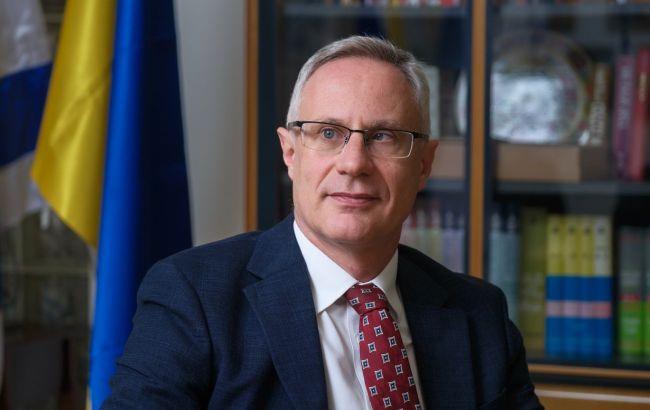 Israeli Ambassador to Ukraine Michael Brodsky (photo: Vitalii Nosach / RBC-Ukraine)
What are the objectives of the military operation against Iran being carried out by the US and Israel? When might it end? And what does Israel think about Russia’s support for Tehran?
Read the answers, as well as how Ukraine is now following the path that Israel once took, in an interview with Michael Brodsky, Israel’s Ambassador to Ukraine, for RBC-Ukraine.
Key points
- Russia and Iran's role. The weakening of Iran in the medium term will inevitably lead to a weakening of Russia’s position in the Middle East. Israel considers any military aid to Iran unacceptable and is conveying this message to Moscow.
- Cooperation with Ukraine. The two countries are engaged in dialogue on security and the exchange of unique combat experience. Brodsky agrees that Ukraine has already become a contributor to global security by helping Gulf countries defend against drones.
- Ground operation possibility. The Ambassador does not rule out any scenarios, including a ground phase of the war. He emphasizes that Israeli forces are capable of operating behind enemy lines, and coordination with the US on all matters is complete.
- War against Iran objectives. Israel seeks to permanently destroy Iran’s nuclear program and missile capabilities, including drone production. Regime change in Tehran is desirable but not a prerequisite for the operation’s completion.
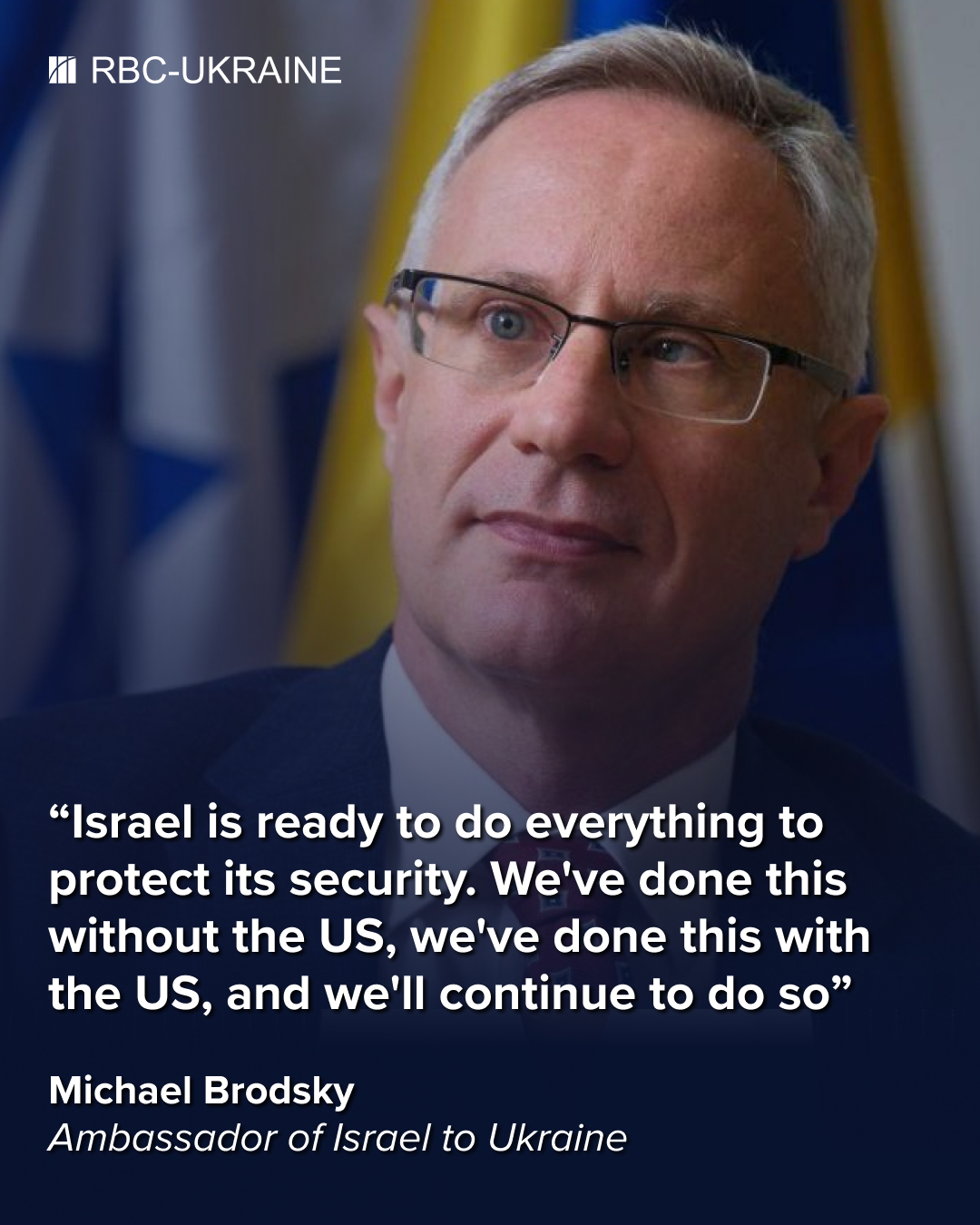 Ambassador Brodsky on Israel's readiness to defend its security (source: RBC-Ukraine infographic)
The war in Iran, which has been ongoing for three and a half weeks, directly affects Ukraine not only because it has shifted the attention of the global media and Donald Trump personally. Nor is it merely because rising oil prices allow Russia to significantly replenish its depleted budget. It is also because Ukraine is directly involved in events in the Middle East, helping Gulf Arab countries repel attacks by Iranian drones.
At the same time, it is completely unclear how long the hostilities will continue, despite Trump’s optimistic comments (and, perhaps, because of them). The US President himself has put forward numerous versions of why the operation against Iran was necessary and what its overall objectives were.
Israeli Ambassador Michael Brodsky notes in a conversation with RBC-Ukraine that Israel’s goals coincide with those of the United States, but are likely more narrowly defined, namely, the elimination of Iran’s missile and nuclear programs. This is to ensure that Tehran (even if the regime survives) is no longer a constant source of threat to everyone around it.
At the same time, the Ambassador cautiously does not rule out a wide range of possible scenarios, including a ground operation, in which Israel could potentially assist the Americans as well.
On exploding barrel and new reality after October 7
Michael Brodsky confirms that the Middle East is at the epicenter of tectonic shifts, and the events of October 7, 2023, the attack by Hamas terrorists on Israel, have become a definitive watershed moment for the region’s security.
"We are now at the center of tectonic shifts... as a result of which the landscape of the Middle East may change radically. And the goal of many of Israel’s actions is to change the landscape of the Middle East so that this region becomes a place where one can live without fearing for one’s existence every second," Brodsky says.
The Ambassador emphasizes that the Hamas attack has stripped Israeli society of any illusions about the possibility of dialogue with terrorists:
"October 7 drew a completely clear line and made the world, in a sense, black and white. For us today, it is either them or us... I am referring to our enemies, those who openly say they want to destroy Israel, first and foremost Iran, along with all its proxy groups... On October 7 took the rose-colored glasses off. And Israel understands once and for all: either we eliminate this threat, or it will end sadly for us," the Ambassador says.
Operation in Iran objectives: Nuclear program and missile capabilities
Despite the scale of the current actions, Israel’s objectives remain specific and are aimed at permanently depriving Tehran of the tools of aggression.
"As of today, there are two objectives of this war from Israel’s perspective. The first is to destroy Iran’s nuclear program, making it impossible to rebuild in the coming years, or better yet, decades. The second is to destroy its missile capabilities, not only the missiles themselves but also the launchers and the production of missiles and drones on Iranian territory," Brodsky says.
At the same time, the issue of regime change in Tehran, according to the ambassador, is not a direct military objective for Jerusalem:
"As for regime change, yes, that would be desirable... But from Israel’s perspective, that is not the objective of this operation. We understand that this decision ultimately rests with the Iranians themselves; we cannot directly influence it. Even with all the desire to change the regime, Israel cannot do so either on its own or even together with the United States through airstrikes," he notes.
Coordination with US and ground operation likelihood
Brodsky notes close coordination of actions with Washington, while allowing for any possible scenarios for the conflict’s development.
"Our objectives may be narrower than the Americans', but I am confident they are included in the list of American objectives. Therefore, there are no disagreements; we are fully coordinating our actions with the Americans. Israel will be ready to conclude this operation once it has achieved its objectives."
When asked about the possibility of a ground invasion and Israel’s participation in it, Brodsky responds cautiously:
"I wouldn’t rule anything out... It depends on what you mean by participation. Israel is a small country; naturally, we can’t claim to play a major role, but theoretically… Israelis know how to operate behind enemy lines. So, theoretically, I wouldn’t rule it out."
Ukraine as player in Middle East and its war experience
The Ambassador highly values Ukraine’s transformation from an aid recipient to an active contributor to security, including in the Middle East region.
"Yes, certainly, we’ve seen this, especially recently, that Ukraine is assisting Gulf countries in defending against drones. And Ukraine has something to offer the world in terms of technology... Ukraine has come a long way in the development of military technology, finding creative and relatively inexpensive solutions that we are confident will be in demand around the world for a long time to come," he says.
Brodsky sees direct parallels in the development of the two countries:
"In a sense, Ukraine is following in Israel’s footsteps... Today, Israel and Ukraine are the two countries with the most combat experience. Experience in waging different types of war... Both countries have vast experience, different yet complementary, so I think there is great scope for cooperation here."
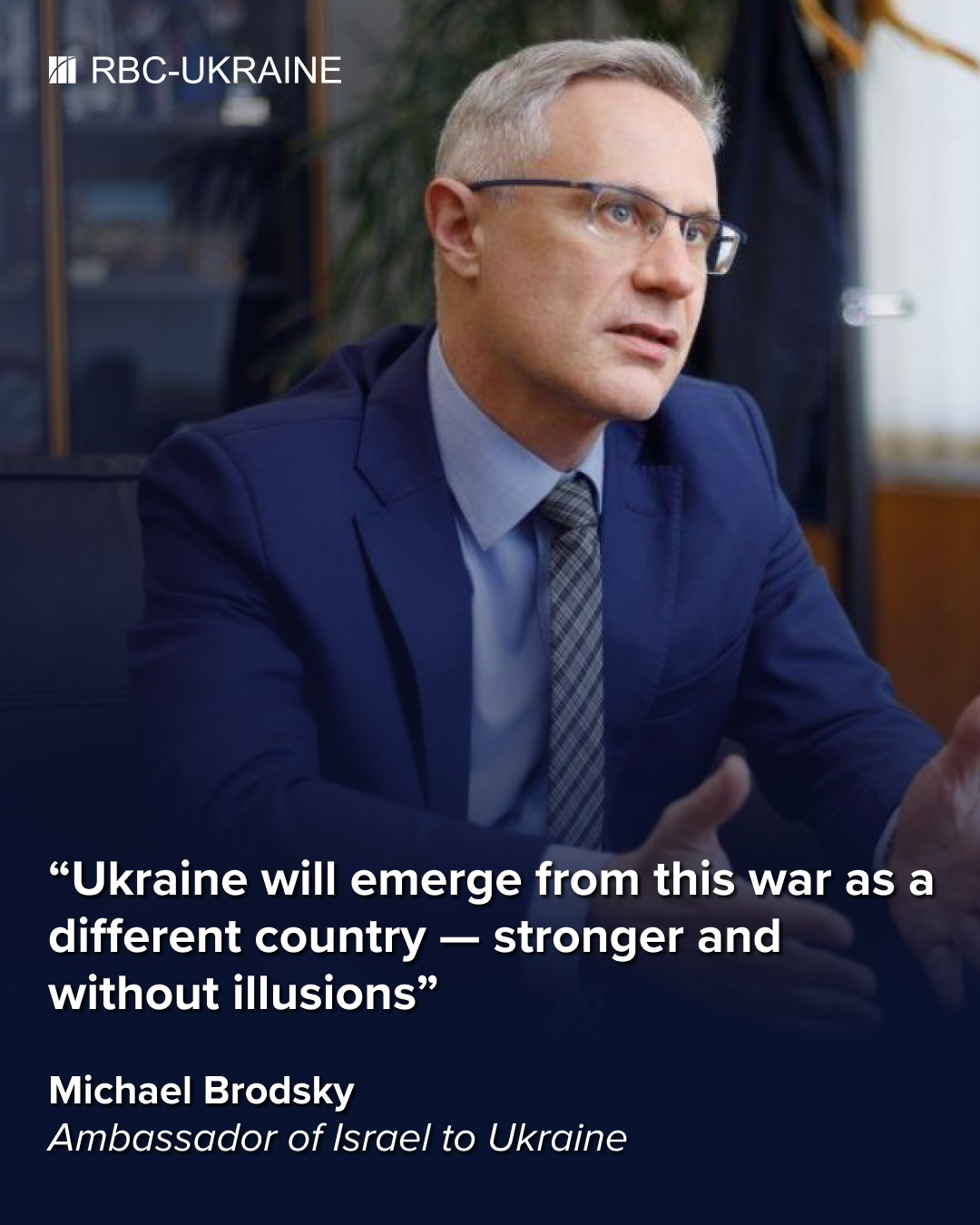 Ambassador Brodsky on the lessons Ukraine will learn after the war with Russia ends (source: RBC-Ukraine infographic)
Russia's role and support for terrorists
Moscow’s stance, hosting a Hamas delegation and cooperating with Iran, is met with sharp rejection by Israel, although the forms of diplomatic response may vary.
"We do not like and have never liked the military-technical cooperation between Russia and Iran... We consider Iran to be a terrorist state. ... and any assistance to Iran is absolutely unacceptable to us. As for the visit of the Hamas delegation to Moscow, this is not merely unacceptable; for us, it constitutes indirect support for terrorists," Brodsky says.
Regarding Russia’s future influence in the region, the Ambassador offers the following forecast:
"In the medium and long term, the weakening of Iran will also lead to the weakening of Russia. Iran is one of Russia’s main allies... The weakening of Iran clearly does not play into Russia’s hands. And this will weaken Russia’s position in our region, in the Middle East."