Donbas isn't Putin's endgame - Kaja Kallas in a blitz interview


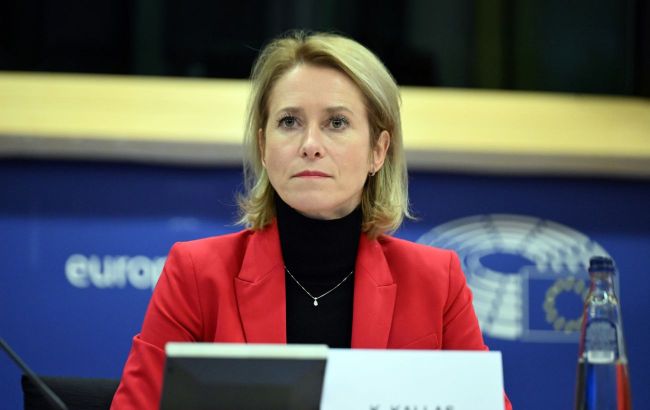 Photo: Kaja Kallas (Getty Images)
Why isn’t Donbas Putin’s end goal, and what does Bucha have to do with it? Could the Kremlin launch a military provocation against the Baltic states in the near future?
These questions, and how Russia’s war against Ukraine is linked to the conflict in Iran, are addressed in a blitz interview with the EU’s top diplomat, High Representative for Foreign Affairs and Security Policy Kaja Kallas, for RBC-Ukraine.
Key points:
- Risks of territorial concessions: Kallas stresses that the war is not only about territory but also about people. A ceasefire at the cost of Donbas would only lead to new atrocities (like in Bucha) and embolden the aggressor.
- Europe’s role in support: Over the past year, all financial aid to Ukraine has come from the EU; Europe is ready to continue bearing this burden, even if US attention fully shifts to Iran.
- Russia’s historical aggression: Over the past 100 years, Russia has attacked at least 19 countries (excluding Africa), and none of them were aggressors.
- Global axis of aggression: The wars in Ukraine and the Middle East are closely interconnected: Russia provides Iran with intelligence for attacks on US forces and produces drones used in regional provocations.
"If somebody says that 'why don't you just give this territory up'?… There are also people living on those territories. And what we saw in Bucha is what is going to happen to those people in the occupied territories," EU foreign policy chief Kaja Kallas told RBC-Ukraine.
The interview took place on the sidelines of an EU Foreign Affairs Council meeting held in Kyiv. Before it began, European ministers led by Kallas visited Bucha, which was liberated from Russian forces four years ago.
"If the victim would surrender, you would have a quick deal. But that is not the long-lasting peace, because the appetite for the aggressor would only grow," Kallas said, maintaining her consistently pro-Ukrainian stance.
When asked whether Europe can convince the US with these arguments, Kallas noted that the issue has been raised, but Washington sees itself primarily as a mediator.
"At least we have taken the approach that we are not walking into these traps of whatever they demand," she added.
– Madam High Representative, I want to ask you about the peace negotiations. As both the US and Russia want Ukraine to withdraw from Donbas, and Ukraine obviously refuses, do you see any real room for any way forward in these negotiations? And a short follow-up: what's your opinion on such a position of the US who effectively supports Russian demands on Donbas? Isn't it some sort of betrayal?
– Well, today we are here to commemorate the liberation of Bucha – a suburb of Kyiv where regular people lived. And when the Russians occupied, then the people suffered immensely.
So why is it important? It is never only about territories. If somebody says, 'Why don't you just give this territory up'?
There are also people living on those territories. And what we saw in Bucha is what is going to happen to those people on the occupied territories. And that's why we are also trying to explain this to whoever listens, also to our American colleagues, that don't pressure Ukraine.
There are rarely cases where wars are so black and white. There is one aggressor and one victim. Of course, you know, if the victim would surrender, you would have a quick deal.
But that is not the long-lasting peace, because the appetite for the aggressor would only grow. And Donbas is not their endgame if they get it so easily. I mean, they haven't been able to conquer it in 12 years. And now they hope that it will be delivered to them around the negotiation table.
– Do you believe you'll be able to persuade the Americans with these arguments?
– Well, we have been raising these issues, and they are saying that they are mediating between the demands. But of course, it's clear that the Russian demands are unreasonable. So at least we have taken the approach that we are not walking into these traps of whatever they demand.
Because we are keeping in mind all the time that Russia started this war. If they are, sort of rewarded for this, then we will see more of it. And the history is full of it.
I mean, over the last 100 years, Russia has attacked at least 19 countries. And I'm not counting the African countries. Some as many as three or four times. And none of these countries has ever attacked Russia.
– How do you assess the risk that Russia will be able to replenish its budget because of the oil prices that are getting higher and higher due to the situation in the Middle East? And that Russia will be able to wage the war now for a long, long time?
– Well, it depends, of course, on how long this war in the Middle East will continue and whether the Strait of Hormuz will be opened also for the oil and gas supply. But of course, the oil price hike gives relief to Russia because we see that their economy is not doing well.
But let's hope that it's just a short pause, that they get the relief. But it's actually not the long term. Because if we look, the budget gap for Russia is enormous.
– Is the EU ready to start the physical detention of Russian shadow fleet tankers in the Baltic Sea?
– We have done the best practices of treating the shadow fleet under international law. So, UNCLOS Article 110 actually gives the right to board these ships. So we have also shared the best practices with the member states.
And some have already made the steps. If you think about Sweden, Belgium, and France, which have actually boarded the ships. And considering that these are also environmental risks, we have to take them very, very carefully, so that we use the measures under the law that are the tools that we can use.
– If the US eventually decides to fully focus on Iran and Middle East affairs, is Europe ready to take on the entire burden of helping and supporting Ukraine?
– Well, these two wars are very much interlinked. If you're worried about Iran, you should be worried about Russia. Because Russia is providing Iran the intelligence to target American soldiers.
Also, Russia is producing now the drones that Iran needs to attack its neighboring countries. So these are very much interlinked.
When it comes to support for Ukraine, then for the last year, all the financial support has come from Europe already. So we will definitely continue with this because I think Russia is not winning this war. And if we focus our efforts, then we are also able to help Ukraine to resist.
– Given that the US is now fully focused on the Middle East, do you think that Vladimir Putin may try to use the opportunity and try to carry out some large-scale military provocation against some EU nations, for example, Estonia?
– I think, Putin is definitely happy that the attention is on the Middle East. And we shouldn't give him this pleasure. And we should keep Ukraine on our focus.
And it is also clear that the member states today were stressing this, that we don't let it slip off the table.
– And the very last one – about the EU enlargement. Is the European Union able or ready to give some sort of intermediary status for Ukraine, such as access to the single market in some form, before full membership?
– These discussions, of course, haven't really taken up speed, although we should have this speed. Enlargement is always a geopolitical choice. And that's why I think we need a strong message that all those countries who want to join the European Union, we are stronger when we are together, we are equal geopolitical powers if we work together. And Ukraine is really fundamental to that.