Trump threatens NATO exit: What it means and what to know


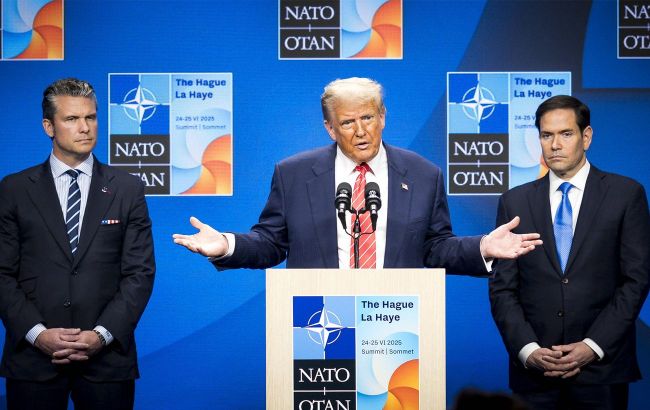 US Secretary of War Pete Hegseth, President Donald Trump, and Secretary of State Marco Rubio (photo: flickr.com/photos/ministeriebz)
RBC-Ukraine answers the key questions: what is behind these statements, whether it is feasible in practice, and what the consequences could be.
Key points:
- Reason for the move: Europe’s refusal to support the US operation against Iran and to join efforts to open the Strait of Hormuz.
- Legal barrier: the Rubio-Kaine law prohibits withdrawal from NATO without the approval of two-thirds of the Senate or an act of Congress.
- Military factor: around 100,000 US troops are stationed in Europe, and their withdrawal would require billions of dollars and years of logistics.
- Risk of sabotage: Trump could paralyze the alliance by halting intelligence sharing and ignoring Article 5 of the NATO treaty.
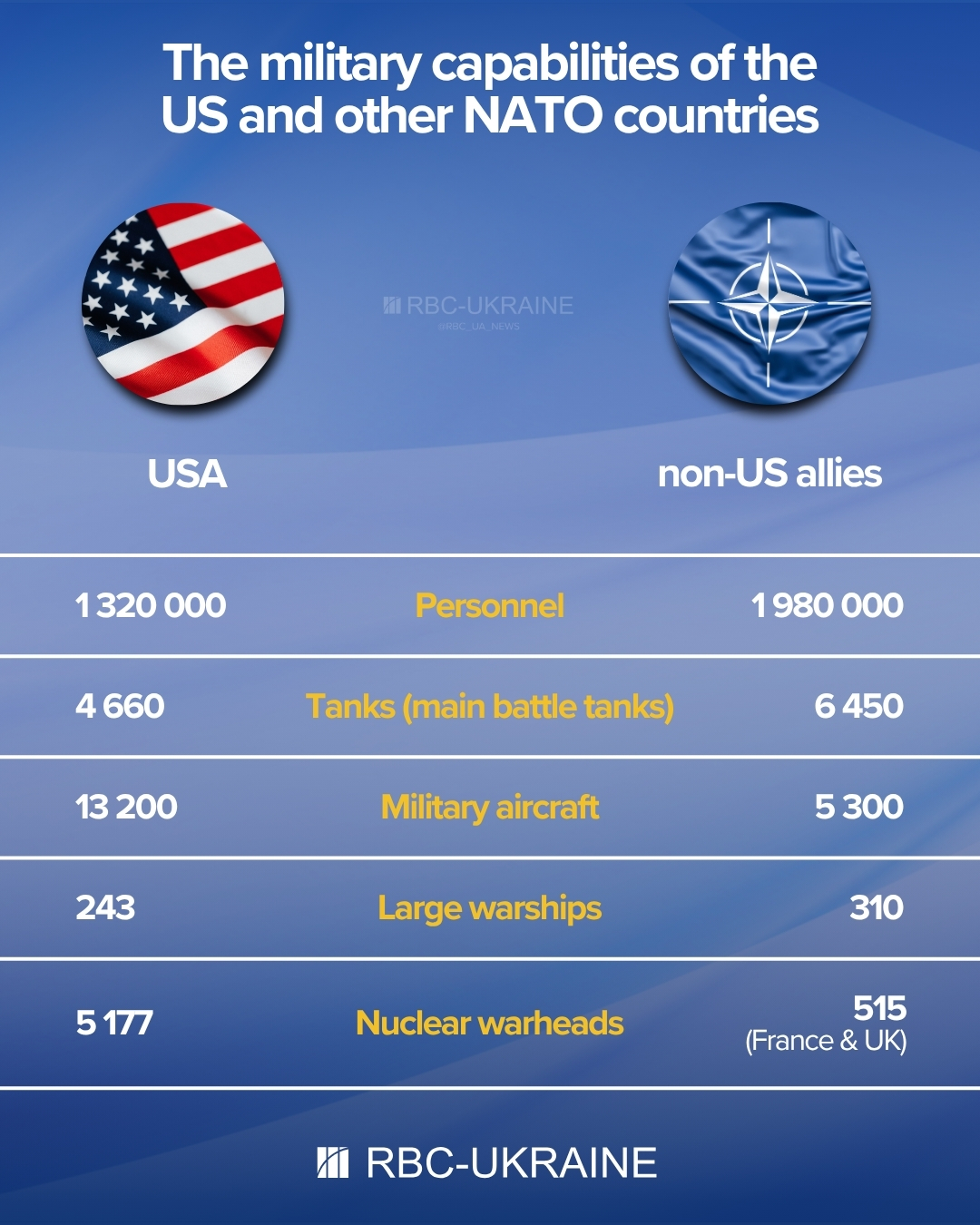 In the event of a US withdrawal, NATO would lose a significant part of its capabilities (infographic: RBC-Ukraine)
Why is Trump talking about a US exit from NATO?
The statement is in line with Trump’s quid pro quo style of diplomacy. The main trigger for this move was a split between Washington and European capitals over the war against Iran.
At first, Europe did not join the US in carrying out airstrikes on Iran. When Tehran then blocked the Strait of Hormuz, Trump demanded that NATO allies take part in a full-scale operation to open it.
By refusing to join the operation, key European nations showed the US President that the alliance is not ready to defend American economic interests outside Europe. This, in turn, prompted accusations of NATO’s ineffectiveness and weakness.
Personal factors also play a role. For Trump, NATO is an outdated and overly expensive bureaucratic mechanism that imposes one-sided obligations on the United States. He has also insisted that Europe and Canada spend a higher share of their budgets on defense, arguing that the US is protecting them at the expense of American taxpayers.
Does Trump really want to pull the US out of NATO?
Only Donald Trump himself knows his true intentions. However, given the inconsistency of his statements, there are doubts about his consistency. His remark about a possible withdrawal is the strongest signal of this kind in recent years.
However, no final decision has been made yet. As US Secretary of State Marco Rubio said, the United States will review the necessity of NATO membership after the war in Iran ends.
At the same time, Trump has previously used threats as part of political bargaining to pressure his opponents. In such cases, he has not always followed through if the other side made concessions.
Is this realistic in practice and how soon could it happen?
Trump insists on his right, as the head of foreign policy, to withdraw from any agreements. However, US law, introduced by current Secretary of State Marco Rubio, directly prohibits a President from leaving NATO without the approval of two-thirds of the Senate or a specific act of Congress.
Securing such a number of votes would be extremely difficult. There is no unity on this issue even among Republicans. "Hawks" within the party believe that dismantling the alliance would undermine US dominance in Europe and give America’s adversaries greater freedom of action. Members of the Democratic Party are also strongly opposed to leaving NATO.
Moreover, any attempt to issue an executive order to withdraw from NATO would immediately be challenged in court. The legal process could drag on for years, possibly even until the end of Trump’s term.
If the US does not leave NATO, how could it reduce its role in the alliance?
If a legal withdrawal from NATO is blocked by the courts or Congress, the White House still has enough tools to effectively step back from active participation in the alliance.
Trump could simply refrain from appointing an ambassador to NATO, leaving the position vacant, or block funding for the alliance’s civilian and military budgets.
The most painful blow could be cutting off intelligence sharing and withdrawing American officers from Allied Command Operations in Mons, Belgium.
Without US logistical capabilities, its fleet of aerial refueling aircraft, and space-based intelligence, the European part of NATO would lose the ability to conduct large-scale operations, turning the alliance into the "paper tiger" Trump has described.
Could Trump withdraw US troops from Europe?
Currently, around 100,000 US troops are stationed in Europe, primarily in Germany, Italy, Poland, and the United Kingdom.
Trump, as Commander-in-Chief of the US armed forces, has significantly more direct authority when it comes to withdrawing American troops from Europe.
He could order the redeployment of contingents from Germany or Italy back to the United States or, for example, to the Indo-Pacific region. However, carrying out such an order would be a logistical operation of unprecedented scale, requiring billions of dollars and years of preparation.
Congress would likely try to block funding for transporting equipment and closing bases through budgetary mechanisms. In addition, mid-level officials in the Pentagon could engage in passive resistance, delaying the implementation of orders under various pretexts.
Can Trump simply ignore US obligations to NATO allies?
Ignoring NATO commitments is a far more realistic risk than a formal withdrawal from the alliance.
The key issue lies in the wording of Article 5 of the North Atlantic Treaty, which does not obligate a NATO member to immediately enter a war using its full military power.
The article states that each country will provide assistance it deems necessary. This gives the US President significant room for maneuver: he could argue that assistance means only a diplomatic protest or humanitarian aid, rather than deploying troops. Trump has repeatedly hinted at such an approach, saying that only countries that spend enough on defense will be protected.
Ignoring obligations could also take the form of the US refusing to support consensus decisions at meetings of the North Atlantic Council. For NATO to officially recognize an incident as an armed attack under Article 5, unanimity among all members is required.
A US representative, acting on Trump’s instructions, could block such a decision by arguing that the incident is just a border provocation that does not fall under the treaty. This could effectively paralyze the alliance.
How is Europe reacting to Trump’s statements?
Europe’s response so far has been limited and cautious. Polish Defense Minister Władysław Kosiniak-Kamysz said that NATO does not exist without the United States, but there is also no US strength without NATO.
UK Prime Minister Keir Starmer stressed that it is the most effective alliance. Despite pressure from the Trump administration, he will prioritize national interests and is unlikely to take part in a war with Iran.
Further actions by European leaders will likely depend on whether Trump moves beyond rhetoric and takes real steps regarding NATO, rather than just making sharp statements.