Another brutal chapter or peace? Ukraine faces crossroads as Russia's full-scale war hits year four

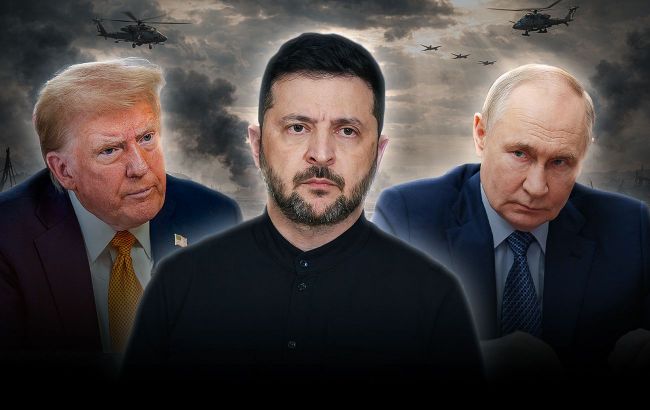 Donald Trump, Volodymyr Zelenskyy, Vladimir Putin (photo: collage by RBC-Ukraine)
Ukraine is entering the fifth year of Russia's full-scale invasion with vague prospects for its end. And acute internal contradictions.
Read about how Ukraine is being pressured by external ultimatums and domestic conflicts in the editorial article by RBC-Ukraine.
Read also: Ukraine-Russia talks near decisive moment, President's Office chief Budanov says
Key takeaways
- The fifth year of Russia's full-scale invasion of Ukraine: Ukraine is entering a new phase of confrontation. The spirit of resistance remains unbroken, but no one expects victory, especially a quick one, anytime soon.
- Political false start: Zaluzhnyi's interview criticizing Zelenskyy is seen as preparation for the upcoming elections, for which, despite the lack of dates, all players are already preparing.
- Trump's ultimatums: The US has gone from being the main partner to an indifferent mediator. The White House is pushing for negotiations, seeking to end the war before the congressional elections.
- Deadlock in Geneva: The fate of peace depends on the status of Donbas. No compromise can be found on this issue.
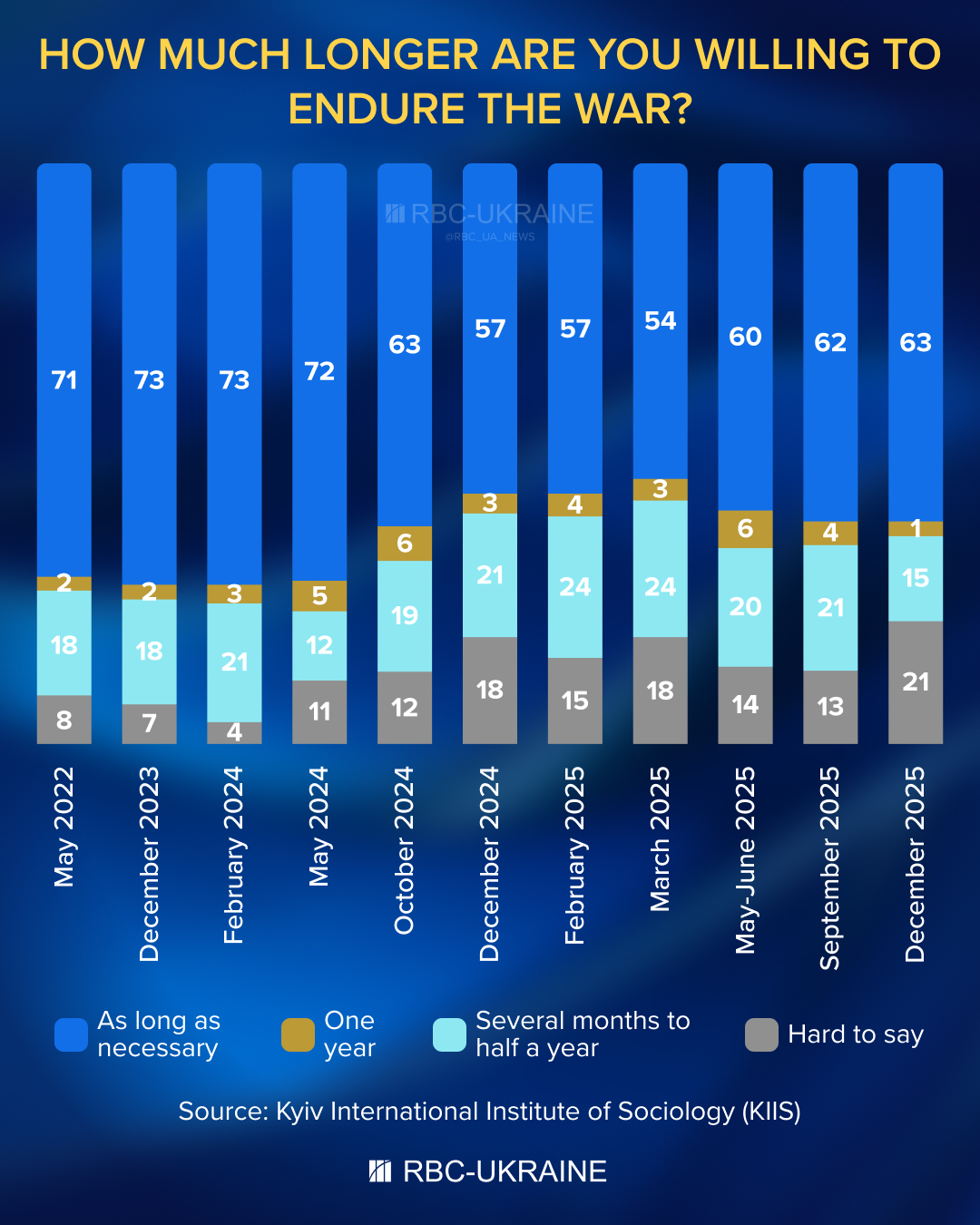 Ukrainians' willingness to endure war-related hardships changes over time (infographic: RBC-Ukraine based on KMIS data)
Four years ago, Russia launched a full-scale invasion of Ukraine. Having seized part of the country's territory since then, the Russians have not achieved their main goal – they have not destroyed the Ukrainian state. Nor have they broken the spirit of Ukrainian resistance.
Russian troops were not greeted with flowers here, and Russia was unable to take Kyiv in three days, receiving a powerful rebuff. Russia responded with ballistic missiles and swarms of suicide bombers targeting civilians, as well as torture and violence in the frontline areas. After thousands of human casualties, destruction, the departure of millions of people from the country, and a lack of light and heat, Ukrainians clearly saw the true face of the Kremlin regime.
The Russians, on the other hand, got the opposite of the expected effect. Subsequently, the war spread to Russian territory, with hundreds of drones regularly attacking Russian oil refineries, military-industrial complex enterprises, and military facilities. In many countries, holders of passports with the double-headed eagle have become outcasts, and Russia's economy has been subjected to unprecedented sanctions, setting it back for years.
The dignity with which Ukrainians endure the hardships and trials that have befallen us is sometimes beyond explanation, evoking silent admiration from foreigners who sympathize with us.
But if, four years ago, on February 24, 2022, Ukrainians had been told that Russia's full-scale invasion would last at least four years... then surely many would not have reflected on it for long. There was no time for that. It was necessary to save the country and, in particular, their families urgently.
Everyone made their own individual choice: some headed east, north, or south, while others headed west. The former were enough to hold back and repel the first wave of the offensive. They were actively supported by those who did not flee but helped the front from the rear.
The Ukrainian people made their choice and once again showed that they are like a spring: under external pressure, they become rigid, strong, and resilient. When the pressure eases or simply becomes normal, they sway from side to side.
Ukrainian society is entering the fifth year of the great war in a state of flux. Despite constant insider reports about the war's imminent end, the belief that it will soon be over is not as strong as it once was.
Ukrainian society is regularly shaken from within. For foreigners who come to the country, Ukrainians remain a model of unity and resistance. If we look deeper into the context, the picture is not so monochromatic.
And although Ukrainians, with rare exceptions, are no longer concerned about issues of language or religion, scandals instantly erupt on social media after another video involving the Territorial Recruitment Centers.
The reaction to the latest terrorist attack in Lviv is a case in point. Based on a series of absurd conclusions, many citizens even manage to rejoice that Ukrainian police officers were killed in the terrorist attack organized by the Russians. Yes, a huge number of those who rejoice are Russian bots, but there are also real Ukrainian people among them. Moreover, many of them have tridents and 'I believe in the Armed Forces of Ukraine' on their avatars.
Ephemeral elections
Ukrainian politicians also contribute to media scandals. Just look at the sensational interview with Valerii Zaluzhnyi, Ukraine's Ambassador to the United Kingdom. The former head of the diplomatic service, apparently for the first time since his resignation, allowed himself to criticize Zelenskyy and his team in the context of events on the battlefield almost four years ago.
Many saw Zaluzhnyi's harshness as an attempt to provoke Zelenskyy into removing the Ambassador in London, thereby giving him a powerful political start. If this version is correct, then it would be more accurate to talk about a false start. Although work on the post-war (or even during?) election law is in full swing, this does not mean that elections are on the horizon. At the same time, some anonymous channels have been attacking Zaluzhnyi himself for a long time and without any apparent reason.
Therefore, everyone is preparing for the elections, of course, even if they do not admit it. Many political players are at a low start, some are looking for a place in new projects, some are thinking about possible coalition formats, looking back at the still vague sociology.
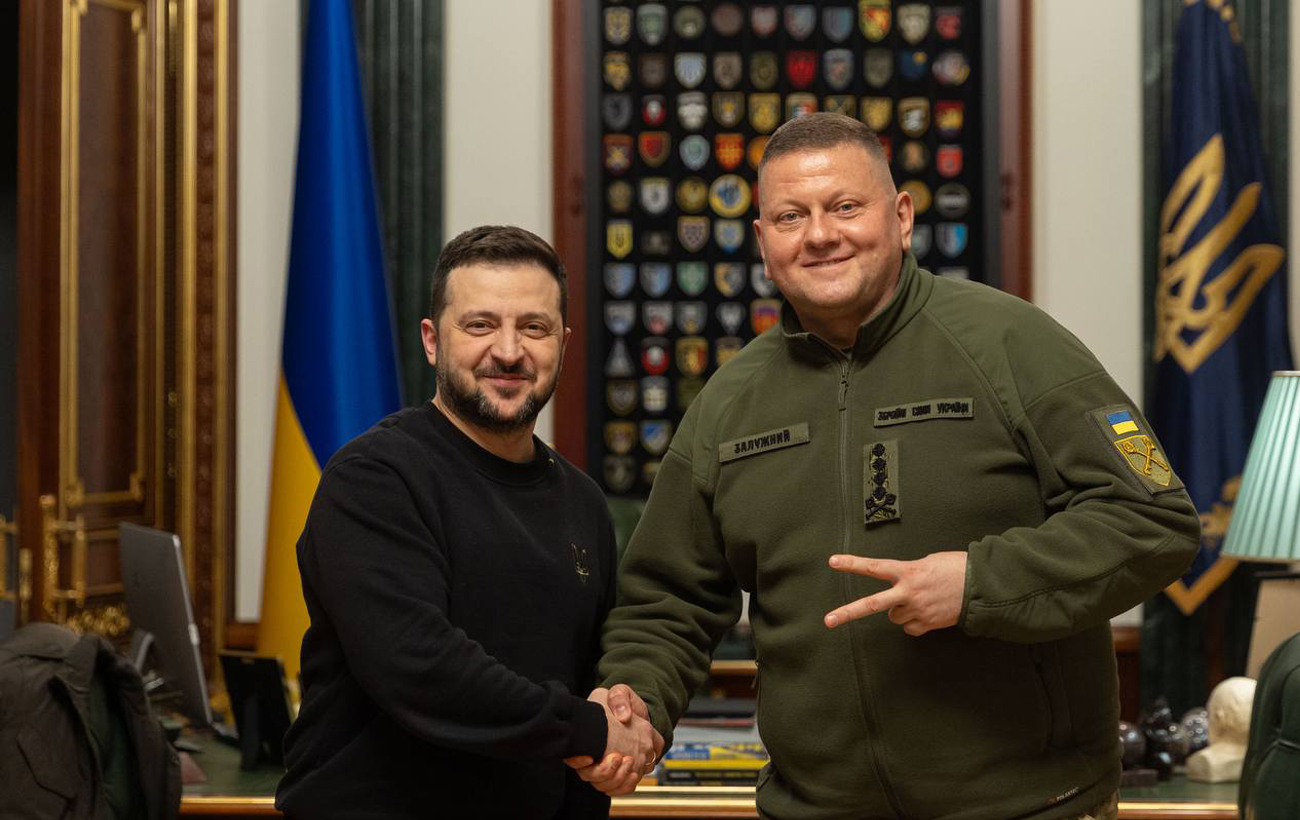 Volodymyr Zelenskyy and Valerii Zaluzhnyi (photo: t.me/V_Zelenskiy_official)
What is certain is that as soon as the specter of elections takes on a more or less clear outline, there will be a significant increase in mudslinging and negative media coverage. There will also be attempts to determine which politicians are more patriotic, which fought correctly, and which did not spare people and surrendered territory to the enemy.
Trump's ultimatums
Another extremely toxic and controversial topic for Ukrainians is how and on what terms peace with the Russians is possible after all their crimes in Ukraine.
Sensing the mood of the majority, President Zelenskyy says that stopping where we are is already a big compromise in itself.
US President Trump sees things quite differently. During his year in office, the US has ceased to be Ukraine's unconditional main partner, taking on the role of mediator. Trump has managed to bring Ukrainians and Russians to the negotiating table. But the US President is clearly rushing the process and hastily calling these negotiations successful.
According to some sources at RBC-Ukraine, the next meeting of the working groups in Geneva at the end of this week may be the last. Despite the fact that the military subgroup has made real progress on purely practical issues (such as monitoring the ceasefire), politically, everyone is in the same place they were a year ago. Russia wants Donbas for itself, Ukraine will not give up Donbas – this is 99% of the problem.
Therefore, says the interlocutor, either a political decision will finally be made at this meeting on what to do with Donbas, opening the way for a meeting between the leaders of Ukraine, the US, and Russia, or the negotiations will de facto cease and the US will withdraw from the process.
However, other sources close to the negotiation process assure that nothing has been decided yet. Several dozen people are involved in the process, and it is in someone's interest to send signals that the US may withdraw from it.
Moscow's calculations are probably based largely on the fact that it still has enough time in reserve. The state budget is bursting at the seams, but there is still enough money for now. The cannon fodder is almost all rotten, but it's not over yet.
The Americans, on the other hand, have a clear deadline, not like Trump's usual vague ones – November 3, when the US Congressional elections will take place. The Republican Party's ratings are fully in line with Trump's policies – the ruling party risks losing not just one, but both houses of Congress.
Since there is nothing to boast about in domestic politics, at least one war must be truly ended in foreign policy, and it must be the biggest and most important one.
Read also: Witkoff on meetings with Putin: He's never been anything other than straight with me
Therefore, with the approach of summer – at least that is what Moscow will surely think – Trump and his team will come under increasing pressure. And as always, they will put more pressure on the weak, in this case, Ukraine, to force it to make concessions. This point of view is generally shared by RBC-Ukraine's interlocutors, both in the government and in Western diplomatic circles.
It is noteworthy that, in the end, the question boiled down to who would control certain territories. Just like in the days of those same princes to whom Putin feels such an irresistible attraction. Of course, at the final stage of negotiations, the Russians may well put cultural, humanitarian, and historical issues on the table. But still, as hundreds of years ago, the main task is to seize the neighbor's land, and imposing one's language and faith there is just a bonus.
Each of us is a President
As was the case four years ago, Ukraine is extremely vulnerable and dependent on the support of its partners. Without American missiles for Patriot systems, Ukrainian cities will remain defenseless, just as without European money, the Ukrainian economy will not be able to meet the needs of the Armed Forces. And, unfortunately, even after four years, the Ukrainian government still needs to convince the West of the obvious, proving who is the victim in this war.
Ukrainians may soon face another challenge—a referendum on the approval of a peace agreement. What it will be like is still unclear. The only clear thing is that it will certainly not meet the criteria for absolute victory in the war.
Therefore, a number of politicians will frame it as a choice between a terrible end and endless horror. Others will frame it as a choice between bad and worse. Some will frame it as a chance to have at least some period of peace after many years of war.
In its existential nature, this choice will resemble the one Ukrainians made four years ago, taking responsibility for themselves and their country, rather than placing it on a single President. After all, as was said almost seven years ago, each of us is a President.
Quick Q&A
— What stage are the peace talks in Geneva at?
— The process is close to completion or collapse. The military subgroup has made progress on fire monitoring issues, but there is no political compromise on Donbas. This week's meeting could be decisive: either the parties will reach the level of a meeting of leaders (Ukraine, the US, and Russia), or the negotiations will end.
— Why is Donald Trump pushing for the signing of the agreement?
— The US is operating within a tight deadline – the congressional elections on November 3. Due to low ratings, Republicans need a major foreign policy success, which is forcing Washington to increase pressure on Ukraine to achieve quick concessions.
— What are the key issues causing the most division within Ukraine?
—The most toxic are the terms of peace with Russia and the methods of mobilization. Scandals on social media show a loss of former unity in society.
— How are politicians starting to play the election game?
— Despite the lack of an election date, politicians have effectively begun their campaigns. Zaluzhnyi's sharp criticism of Zelenskyy and the preparation of new party projects indicate that media aggression will only increase.