Zelenskyy's tough call: Why White House urging Ukraine to hold elections during war


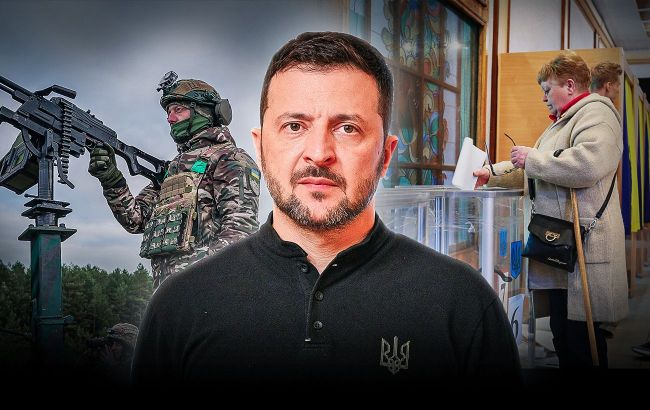 President of Ukraine Volodymyr Zelenskyy (photo: collage by RBC-Ukraine)
Washington has set Kyiv a strict deadline: to hold presidential elections in May. Financial Times rushed to announce Zelenskyy's election on the anniversary of Russia's full-scale invasion.
But the Office of the President of Ukraine is preparing its own scenario. RBC-Ukraine found out what the President's Office is ready to do and why it is practically impossible to hold elections in May.
Read also: Zelenskyy outlines conditions under which elections will be held in Ukraine
Key takeaways:
- On US pressure: Washington is demanding that elections be held by summer 2026 to conclude the Ukrainian case before the start of the congressional campaign.
- On the impossibility of elections in May: The Office of the President of Ukraine and the Verkhovna Rada consider holding elections in the spring unrealistic due to security risks and lack of preparation.
- On the idea of a referendum: The authorities considered combining the elections with a referendum on a peace agreement, but experts and the law indicate that such a step is impossible.
- On electoral chances: Closed polls show that Zelenskyy is leading in the first round, but may lose to Zaluzhnyi in the second due to his higher anti-rating.
- On the organization of the elections: The main problems are the verification of millions of refugees, internally displaced persons, and military personnel voting.
Mid-February. Politicians are discussing early presidential elections, and some are already preparing for them. Behind the scenes, a specific date is being mentioned—the elections will take place in May. Everyone cites Donald Trump as their argument.
The calendar read 2025.
Then, exactly one year ago, Ukrainian politicians were excited by the new US President's promises to end the war quickly. Maybe not in 24 hours, but still, fairly quickly. And so, elections would soon be held.
Then a scandal broke out in the Oval Office. And it became clear to everyone that there would be no end to the war and no elections in the near future. Trump set new deadlines for Kyiv and Moscow before ultimately giving up on the matter altogether. The elections were postponed again and again.
But the latest escalation in the negotiation process, which began last fall, gives Ukrainian politicians new hope for a quick trip to the polls.
Yesterday, February 11, the Financial Times revealed insider information that on the 24th, the fourth anniversary of the full-scale Russian invasion, Zelenskyy may announce elections and a referendum on a peace agreement. Of course, this is due to pressure from the US.
"As long as there is no security, there will be no announcements (about elections – ed.)," a source close to the President told RBC-Ukraine. Last night, Zelenskyy himself publicly confirmed this in a conversation with journalists.
"February 24 is a special date. Even if there were steps taken regarding certain elections, it would be a bad idea to choose such a date to talk about politics," the President added.
Shortly before that, Zelenskyy told journalists that the Americans were insisting that Ukraine and Russia end the war before the summer, as they will soon be busy with the midterm congressional elections.
Other sources confirm that the Americans are once again exerting strong pressure. Clearly, Trump's team wants not only to get rid of the tiresome Ukrainian track but also to score at least one real victory in the war. Especially one on such a large scale.
The White House seems to be largely unconcerned about the difficulties of the electoral process in wartime (or even post-war) conditions. Although it is precisely these conditions that pose a multitude of problems.
RBC-Ukraine reveals details of how Zelenskyy's team is preparing for the elections and what the electoral process might look like.
How authorities want to hold elections and referendum
"The initial task was to understand how a referendum could be held. Then the topic of presidential elections came up. But in the end, we will at least understand what ideas regarding the elections can actually pass through parliament," says RBC-Ukraine's interlocutor in the working group that is preparing a bill on new election rules.
The group itself appeared, of course, after another push from Trump. In December, he once again criticized Ukraine for not having held elections for a long time.
"I am ready for elections," Zelenskyy immediately responded. And he called on deputies to develop election rules during martial law.
Soon, the topic of a referendum came up, for which Bankova proposed to submit a draft peace agreement along with all its potentially controversial points (in particular, regarding territories).
All these issues are being addressed by a working group of several dozen people: MPs, representatives of the Central Election Commission, the Ministry of Foreign Affairs, and experts.
The head of the Servant of the People faction, Davyd Arakhamia, publicly set a deadline: by the end of February, the text of the draft law on elections must be developed so that it can be registered in the Rada.
But it is almost certain that the deadline will be missed. The working group has held only two meetings with all members present so far, and the third will take place today, February 12. It will present the results of the work of seven subgroups, each of which deals with a specific issue in the organization of elections.
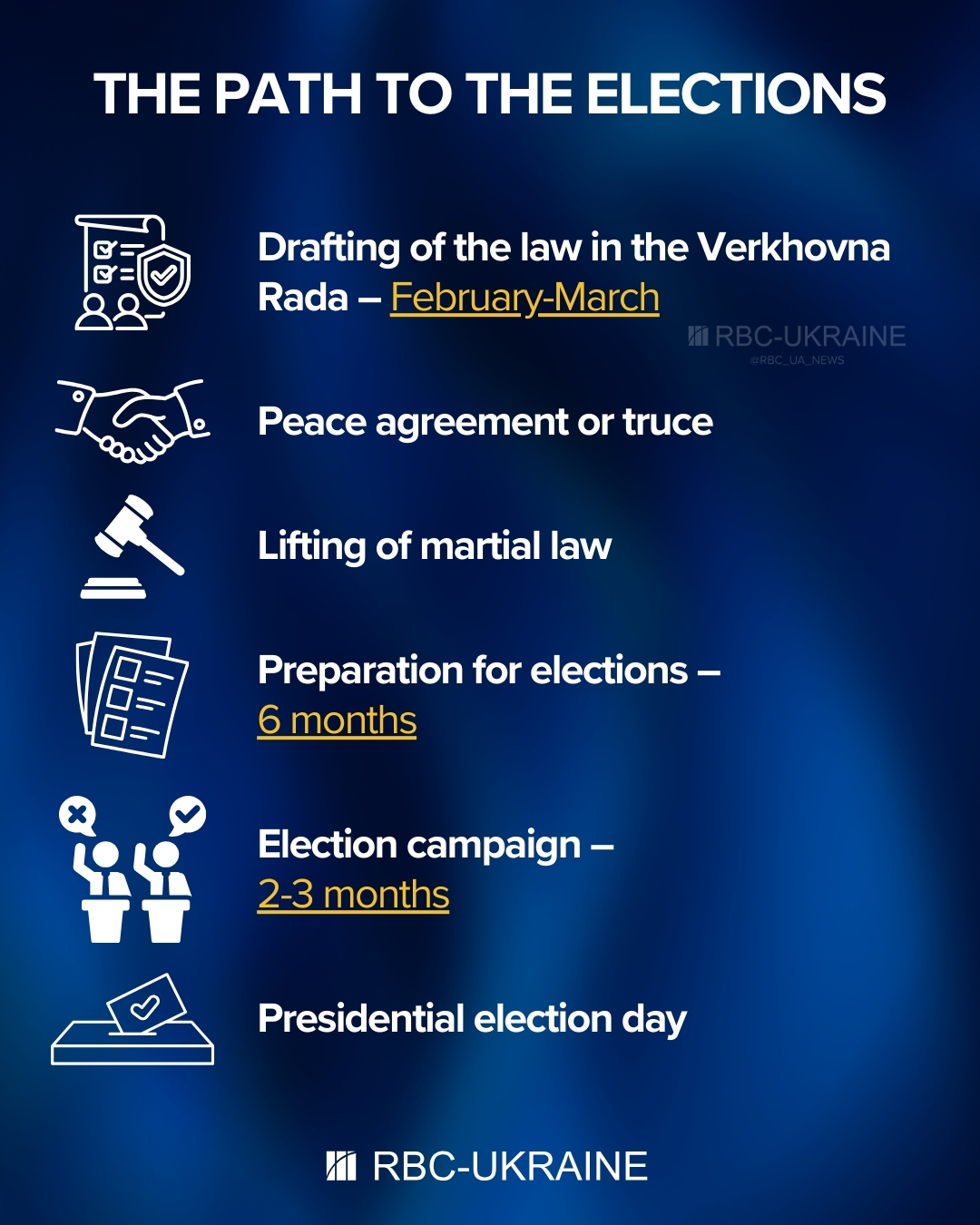 For the elections to take place, Ukraine must go through several difficult stages (source: RBC-Ukraine)
"If this whole process is just for the sake of formally introducing a bill, regardless of its quality, then anything is possible in the Verkhovna Rada. But if we are talking about a high-quality, comprehensive product, then there is very little chance of getting it done by the end of February," says RBC-Ukraine working group member Olha Aivazovska, chair of the OPORA network.
Other interlocutors agree with her. "We are not really limited by a deadline. We are tied to the negotiation process, and it is essentially stalling," adds RBC-Ukraine's interlocutor in Zelenskyy's team.
According to him, a political task was set in parallel – to understand, or rather to explore, the possibility of holding elections during the war or during martial law (when the Russian Shahed drones and rockets are no longer flying, but there is still no peace agreement).
As a result, everyone has agreed so far that elections during the active phase of the war are impossible. "Consider that we are creating, roughly speaking, 30,000 targets, polling stations, for the Russians. This is wrong, and the President agrees with this," says RBC-Ukraine's interlocutor in Zelenskyy's circle.
The situation with martial law is a little more complicated. The initial task of the Office of the President of Ukraine was to find a way to hold elections during martial law. So far, no solution has been found.
"The working group has reached a consensus that elections cannot be held during martial law. That is, we are talking about developing legislation primarily for the first post-war elections," one of the interlocutors in the working group tells the agency.
Another source is slightly less categorical. "Obviously, martial law will have to be lifted, but we will have to come up with some alternative. A lot of things are tied to martial law, such as mobilization. If we simply remove it in one fell swoop, everything will fall apart," he believes.
The impossibility of holding elections during martial law was also recently supported by the PACE. At the session on January 27, delegates voted for the resolution Elections in times of crisis, which states that, according to international democratic standards, elections cannot be held under martial law.
"This resolution reinforces our point of view. Plus, everyone in the working group agreed that the first elections should be the presidential elections – the logic being that they are simply easier to hold. In terms of timing, it could look like this: one month after the end of martial law, presidential elections are announced, followed by six months of preparation and 90 days for the election process itself," explains one of the sources in the working group.
This timing is, of course, very approximate, because its starting point is directly linked to the end of martial law. And, therefore, to a peace agreement that does not yet exist.
There are also rumors in political circles that martial law may end as early as May. In that case, the first post-war presidential elections will take place in the fall.
According to another informed source at RBC-Ukraine, who is not part of the presidential team, it is about the electoral process during martial law, not after its end.
"After all, there is no end in sight to the war yet. Therefore, the idea is to hold such elections during the war. Together with a referendum, this is already our idea. For the period of voting, the Russians may promise not to shoot, something like an air truce, but without a ceasefire," the source believes.
A separate aspect is the possibility of combining the presidential elections with a referendum on this peace agreement. Initially, the authorities did indeed advocate this option.
The formal reason is that it will be easier, cheaper, and faster than two consecutive campaigns, one for the elections and the other for the referendum. The political reason is that a referendum could help mobilize the electorate loyal to Zelenskyy.
Read also Elections or referendum: Zelenskyy outlines how territorial questions should be decided
But at the working group meetings, almost the entire expert community argued that such a combination is impossible, that it contradicts both the letter and the spirit of the law.
"It is prohibited to hold elections and a referendum at the same time. This is not an argument, it is a fact that is in the law, and there are no votes to change it, nor will there be any in the near future. If this is a revelation to someone, fine, but this is not about how to act correctly, but about the fact that exists," Olha Aivazovska tells RBC-Ukraine.
The interlocutor in Servant of the People generally agrees that combining elections with a referendum is wrong. "Eurosolidarity will be against it, as will many others. But if everyone understands that this is part of a larger peace package and that there is no other way, I think it will pass. Even if it is met with angry cries," he says.
However, the source points to a host of legislative and other complications that will arise if the referendum and elections are held simultaneously.
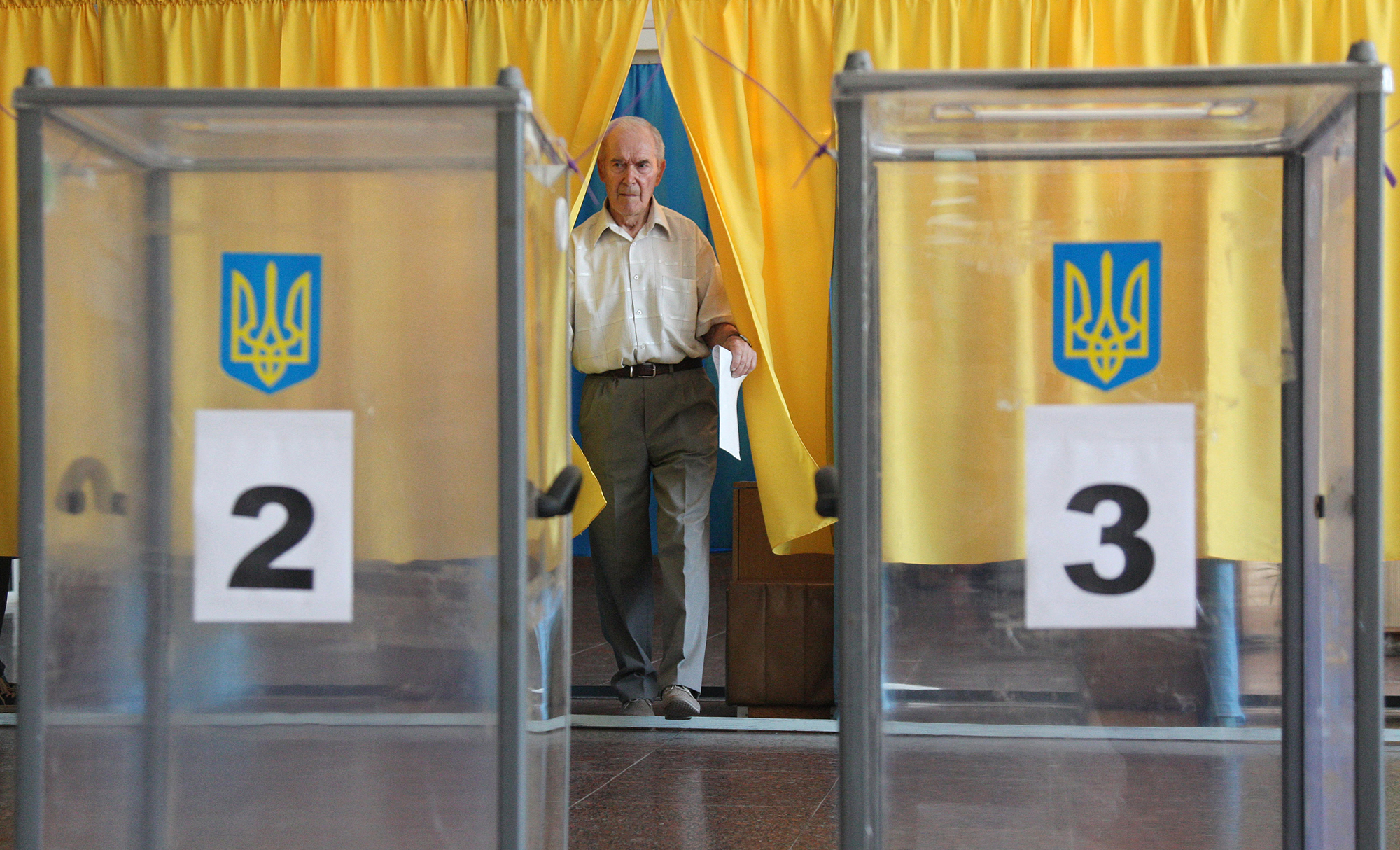 Polling station in Ukraine (photo: Getty Images)
For example, according to the law, such a referendum must be held based on a popular initiative, collecting millions of signatures, which is a challenge in itself in the current circumstances. And what will happen to the election campaign at that time? Will it be paused? Will it continue in parallel?
Many other questions arise when the reality of, say, the White House collides with the reality on the ground.
For example, what if the elections and referendum have to be held before any peace agreement is reached? Should martial law be lifted, because there is no other option? But the war will continue.
What if the Russians promise a ceasefire during the election campaign and preparations for the referendum, and then violate it five or ten days before the election? Should the vote still go ahead, under drones and rockets? Put everything on hold? Cancel it altogether? What if the people suddenly vote differently than expected in the referendum?
RBC-Ukraine has not heard any clear answers to these questions from any of its interlocutors over the past year. Probably because there are no clear answers, the only clear thing is that in any of these scenarios, the level of anxiety in society will exceed all conceivable limits.
Not to mention that a vicious circle may arise. When it will be impossible to hold a referendum without ending the war, and the war will not end without a referendum.
Although Trump and his team are certainly not concerned about all these nuances (if they understand them at all), and in any case, the elections and the referendum will have to be held not in the US, but in Ukraine. With all the consequences that entail.
Zelenskyy's ratings and parliamentary elections
Almost two weeks ago, in an interview with Czech television, Zelenskyy said he sometimes considered running in the upcoming presidential elections.
On the one hand, the President usually responded to such questions by saying that all his thoughts were currently occupied with the war and the struggle to achieve a just peace (although this time he also said that everything depended on how the war ended).
On the other hand, some in the political arena took this statement from a completely different angle. "Some of us are thinking, why did he say that so uncertainly? Why is he giving us reason to think that he might not run?" says an RBC-Ukraine source in the Servant of the People party.
According to two interlocutors, both inside and outside the presidential team, according to closed sociological data, Zelenskyy is currently slightly ahead of his main potential competitor, Ambassador to the United Kingdom Valerii Zaluzhnyi, in the first round.
However, in the second round, the President still loses to the former Commander-in-Chief. According to the laws of elections, the second round is primarily a battle not of ratings, but of anti-ratings. During his tenure, voters may have raised many complaints about Zelenskyy.
"Although we'll see how we play the Budanov card here. He is now gaining ground, taking voters away from Zaluzhnyi, Poroshenko, and various popular military figures," says a source in the President's circle. He assures that there are now up to 30% of Ukrainians who would support any peace, even on bad terms — for them, the main thing is a life without Russian drones, rockets, and mobilization.
If the elections ultimately mean the end of the war, then it is highly likely that a significant portion of these Ukrainians will vote for Zelenskyy. Although, of course, all of his opponents from different camps will exploit a potential bad peace agreement against him.
At the same time, according to a source in the President's circle, no one is ruling out a defeat in the elections.
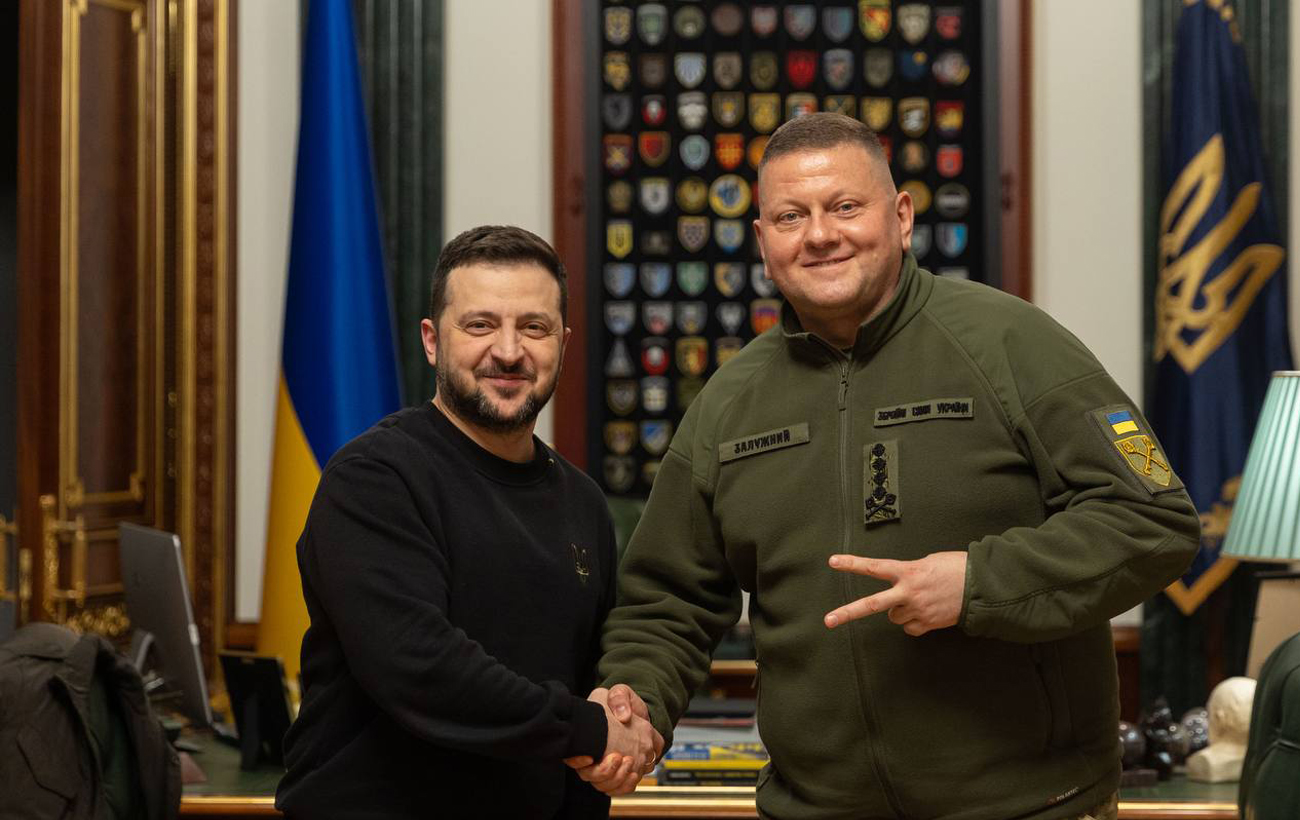 Volodymyr Zelenskyy and Valerii Zaluzhnyi (photo: t.me/V_Zelenskiy_official)
The issue of elections to the Verkhovna Rada will then be on the agenda. This again shifts attention to the activities of the working group.
According to one of its participants, the final documents it will develop will primarily concern the general principles of elections in the current conditions and the presidential elections. Issues related to parliamentary elections will obviously be considered later.
"We do not yet understand what we will need in terms of technology. Because we do not understand in what format and in what position we will go to the elections to the Rada, it depends on the outcome of the presidential elections," says the interlocutor in Servant of the People.
In addition, the question already arises: who are 'we'? After all, there are different interest groups in the same Servant of the People party.
"A situation has arisen in which no one has a controlling stake in the votes to adopt new election rules, but many have blocking votes," says the interlocutor.
In particular, several dozen Servant of the People party MPs who are majority shareholders regularly raise the issue of returning to a mixed, list-majority election system. Although in practice this is hardly possible, as several dozen districts will certainly remain under Russian occupation, and it will be impossible to elect deputies there, even technically.
Many deputies dislike the current open-list system, which requires active field work during the campaign; they would prefer to campaign on YouTube and Telegram. The Fatherland party supports the current system and opposes voting by Ukrainians abroad. The Dovira party is looking for ways to be re-elected to the new convocation in the absence of majority constituencies. And so on.
In any case, the search for a compromise within the working group and beyond will continue.
Main problems of elections
The final draft law on the new election rules is still a long way off, but some of its parameters are already clear.
In particular, RBC-Ukraine's interlocutors say there will likely be no radical innovations, such as electronic voting or mail voting. The main reason is voters' low confidence in such technologies, which are not yet well established in Ukraine.
However, multi-day voting could potentially be introduced for Ukrainian refugees abroad. This is because the Ukrainian diaspora has grown significantly as a result of the Russian full-scale invasion of Ukraine.
But there are no illusions that everyone who wants to vote will do so. "We used to have 200,000 people voting abroad. I think if 500,000 people vote, that's already a great result," says a source in the Servant of the People party.
Read also: Online elections in Ukraine during wartime: Risks and conditions
At the same time, those who want to vote abroad will have to officially register themselves in any case. Otherwise, it could undermine the legitimacy of the entire electoral process, says Olha Aivazovska. Otherwise, all these people will be included in the voter lists in the territory controlled by Ukraine.
"We understand that there are now 20 times more people abroad than are registered with the consulate. Turnout is never 100%; in the last national elections in Ukraine, it was 64%. If people who are abroad are included in the lists here, we may end up with a turnout of 25%, which is bad in terms of legitimacy," explains Aivazovska.
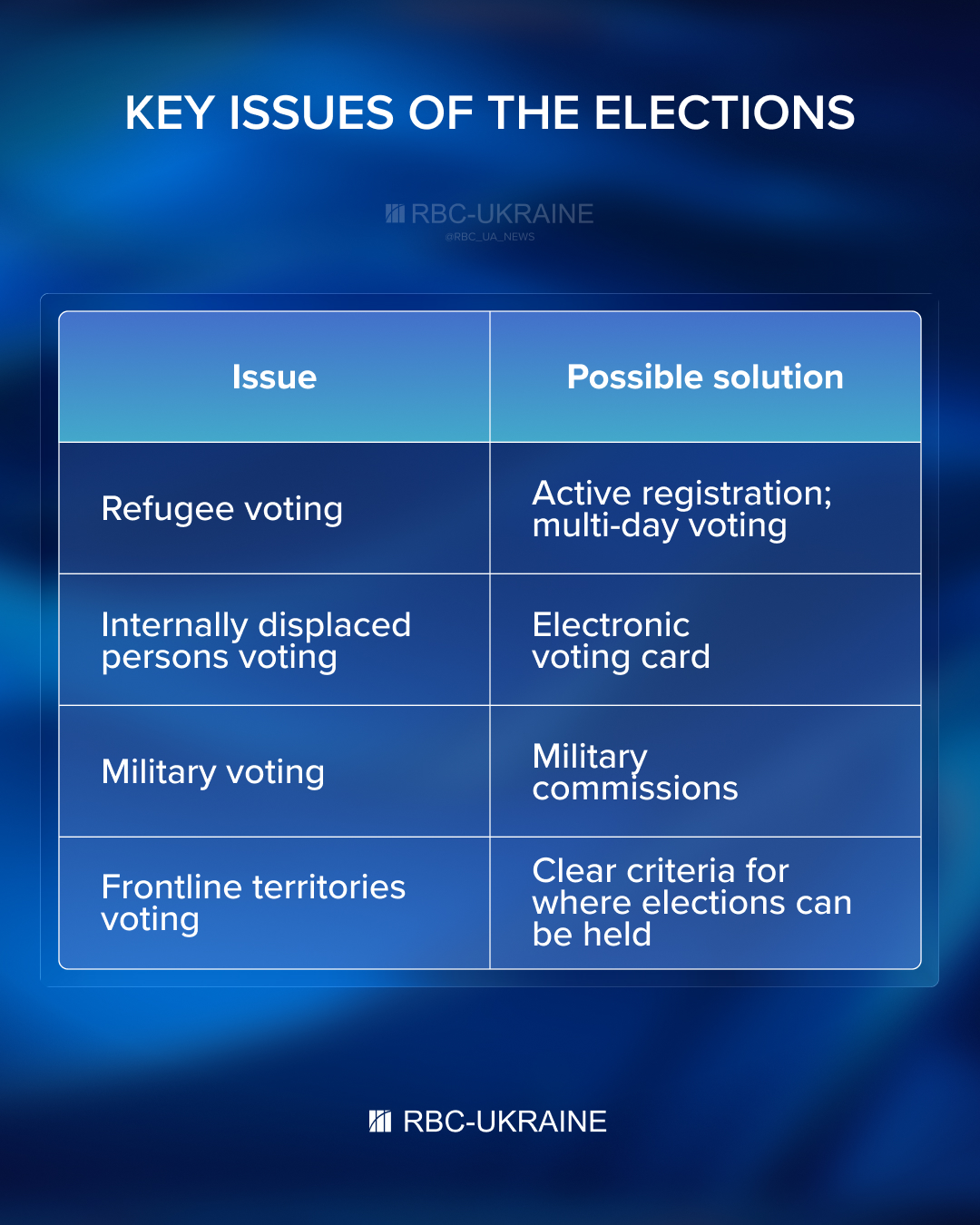 Only partial solutions have been found for the main problems with elections in Ukraine (source: RBC-Ukraine)
The situation with internally displaced persons, whose number is estimated by RBC-Ukraine's interlocutors at five million, will also need to be addressed, even though significantly fewer are recorded in the IDP register. Hundreds of thousands of people are still listed as voters in occupied or depopulated frontline territories.
A partial solution could be active registration, making maximum use of the achievements of Ukrainian digitalization, such as Diia. "Obviously, there will be some kind of electronic absentee ballot, but there is no final decision," says a source in the working group.
He points to another obvious problem: a significant part of the male population of draft age is afraid of any contact with the state to avoid coming to the attention of the Territorial Recruitment Centers, and will definitely not register anywhere.
As for military personnel, especially those on the front lines, there is no ready solution either. Obviously, special commissions will be created, whose members will be military personnel themselves, but it has not yet been decided who will form them. And how to ensure election standards in such conditions. "We are looking for a balance between democracy and military reality," say members of the working group.
Another unresolved issue—somewhat less relevant in the presidential election, but extremely important in the parliamentary and, even more so, local elections—is in which territories it is possible to hold any elections at all.
This concerns many settlements that are under Ukrainian control but have been severely damaged. Previously, decisions on this were made arbitrarily. Therefore, in 2020, local elections were held in Mariupol, a few kilometers from the front line, but not in communities in the Luhansk region, which were far from the front line at the time.
There are plans to develop a clear list of criteria covering not only security but also infrastructure, the ability to ensure the work of commissions, and the availability of stable internet coverage for communication with the Central Election Commission server. Based on these criteria, it will be determined where elections can and cannot be held.
These are far from all the practical problems that need to be solved before the elections, whatever their timing. Therefore, the six-month preparation period was not chosen arbitrarily.
However, RBC-Ukraine's interlocutors in the government do not rule out that this period will have to be seriously shortened. Political necessity in Ukraine has always trumped reality, even before Russia's full-scale invasion. And even more so for the sake of ending it.
Quick Q&A
— Will President Zelenskyy really announce elections soon?
— Despite the Financial Times' insider information, the Office of the President of Ukraine calls this a bad idea. The President has publicly confirmed that until there are security guarantees, there will be no announcements about elections. Washington's deadlines, which want to close the so-called Ukrainian case by the summer of 2026 due to its congressional elections, are facing a harsh reality on the ground.
— How realistic is it to hold elections in May 2026, as the US allegedly demands?
— It is practically impossible. A working group in the Verkhovna Rada has acknowledged that elections in the midst of active warfare are impossible, as polling stations will become targets for attacks. Even if martial law is lifted in May, it will take at least six months to prepare properly (voter registries, work with IDPs and refugees) according to the law and logic.
— Are the authorities preparing a referendum on a peace agreement to coincide with the presidential election?
— This idea has been discussed as a way to mobilize the electorate, but experts and the opposition are strongly opposed to it. The law expressly prohibits combining elections and referendums. In addition, the question remains: what if the people vote against the peace agreement? There is no answer to this question.
— What are Volodymyr Zelenskyy's chances of re-election according to closed polls?
— The situation is ambiguous. According to closed polls, Zelenskyy beats Valerii Zaluzhnyi in the first round, but loses to him in the second round due to his accumulated anti-rating. However, the demand of part of society for peace at any cost plays into the President's hands in electoral terms.
— What are the main technical problems preventing fair elections from being held now?
— Millions of refugees abroad (who are difficult to verify), the registration of millions of internally displaced persons within Ukraine, and voting by military personnel on the front lines. There is also the problem of active registration: many men of draft age are afraid to provide their data to the state so as not to come to the attention of the Territorial Recruitment Centers. This jeopardizes voter turnout and the legitimacy of the elections.