Russia's offensive is losing momentum: Is peace possible this fall?


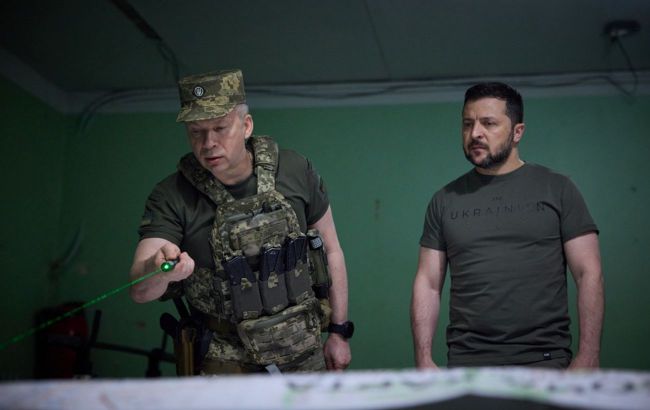 Photo: Oleksandr Syrskyi and Volodymyr Zelenskyy (president.gov.ua)
The slowing pace of the Russian offensive and the shift of the war onto Russian territory have made the Kremlin nervous. While Ukraine's Defense Forces disrupt the enemy's logistics, Moscow responds with massive terror attacks on Kyiv, seeking to negotiate peace on its own terms.
We break down the key insights on the shifting dynamics on the battlefield and behind-the-scenes negotiations in the RBC-Ukraine report below.
For the first time during the full-scale war, time has begun to work in Ukraine's favor. Thanks to Oleksandr Syrskyi’s concept of active defense and the mass application of technology, the Ukrainian Armed Forces have stabilized the front. Against this backdrop, Kyiv sees a chance to end the hot phase of the war by November 2026, ahead of the US congressional elections.
Key factors and events of the conflict:
-
Slowing of the Russian offensive: The Russian advance on Pokrovsk and Kostiantynivka has stalled. Enemy casualties have reached 35,000 per month, which is barely covered by the recruitment of new contract soldiers. For a breakthrough or an offensive from Belarus, Putin would need to declare a mobilization of 100,000 people and spend 3 months on training.
-
Technological "death zone": The mass deployment of middle-strike drones has expanded the strike zone 20–40 km into the enemy's rear. This has quadrupled the destruction of Russian logistics and made the land corridor to Crimea highly dangerous for Russian soldiers.
-
Parity in long-range strikes: The Ukrainian drone campaign is systematically destroying Russia's military-industrial complex and oil refining industry. Ukraine has achieved quantitative parity with Russia in long-range UAVs, with 10–12% of Ukrainian drones consistently hitting targets (compared to 3-5% for Russian Shahed drones).
-
Terror against Kyiv as blackmail: Following strikes on the Moscow region, Russia is threatening attacks every 5–10 days. The true goal is an attempt to halt the Ukrainian military-industrial complex and pressure Kyiv into an "unofficial partial truce" (ceasing strikes on Moscow in exchange for calm in Kyiv).
Prospects for a ceasefire by November:
Ukraine's calculation is based on the US desire to resolve the situation before the November 3 elections. A visit to Ukraine by Donald Trump's negotiators—Jared Kushner and Steve Witkoff—is expected. The EU is also seeking a compromise regarding the appointment of a single mediator.
Putin's position will depend on the front line: if the Russian army definitively stalls in the Donbas, economic exhaustion and blackouts caused by Ukrainian strikes on the Russian rear may force the Russian President to put the war on pause before winter. Ukraine's maximum objective for the next 5–6 months is to achieve an acceptable peace.
However, even in the event of a freeze, Russia will attempt to put forward humiliating humanitarian demands to split Ukrainian society, hold elections, and restart the war against a weakened Ukraine.