Battle for Armenia's future: Can Pashinyan resist Moscow and stay on a Western course


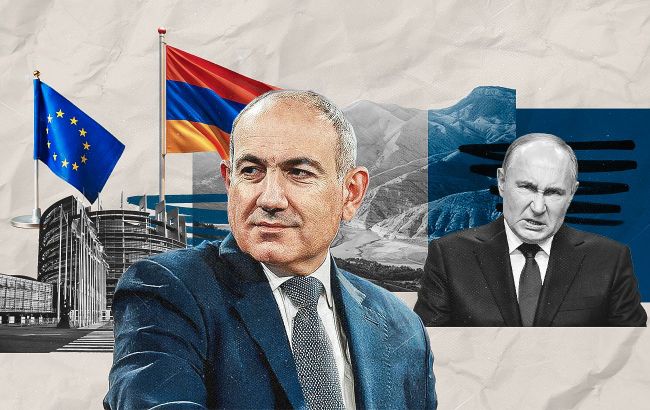 Photo: Nikol Pashinyan and Vladimir Putin (RBC-Ukraine collage)
This Sunday, June 7, Armenia will elect a new parliament. At stake is the country's pro-European course, which it has pursued in recent years under Prime Minister Nikol Pashinyan.
Will Pashinyan manage to stay in power, and how is Russia trying to stop him? Read the analysis by RBC-Ukraine.
Key points:
- A strategic shift: Armenia is electing a new parliament in a bid to cement its break with Russia following the loss of Nagorno-Karabakh.
- The balance of power: Pashinyan's Civil Contract Party leads in opinion polls, ahead of three pro-Russian opposition forces.
- Hybrid pressure: The Kremlin has launched a trade war and energy pressure campaign, including threats to raise gas prices.
- A Western alternative: Pashinyan is countering Russian pressure with open diplomatic and economic backing from Europe and the United States.
- A backlash for Moscow: Russia's attempts to punish Yerevan for turning toward the West are only accelerating Armenia's departure from the Kremlin's orbit.
"Voting for Pashinyan is only possible under a strong hallucinogenic, drug- or mushroom-induced intoxication." These words by Russian propagandist Margarita Simonyan are perhaps among the most benign compared to the Kremlin’s overall tone toward the current Armenian authorities.
Today, Nikol Pashinyan has definitively become one of Russia's main enemies in the post-Soviet space. And Moscow has solid reasons for this.
Modern Armenia is undergoing a period of deep and painful transformation. After the defeat in the 2020 war with Azerbaijan and the final loss of control over Nagorno-Karabakh — an unrecognized republic where ethnic Armenians made up an overwhelming majority — Yerevan is now attempting to reconcile with Baku.
The stakes are high — Armenia's exit from international isolation and from Russia's shadow. Back in the 1990s, during the first Karabakh conflict, Yerevan gained control over the region but made key neighbors — namely Azerbaijan and Türkiye — its adversaries.
As a result, the country became entirely dependent on Moscow, the only player willing at the time to support the Armenian side. In this setup, Nagorno-Karabakh functioned as a kind of short leash around Armenia's neck. Once it disappeared, Yerevan gained a long-awaited opportunity to look less toward the Kremlin.
Therefore, in recent years, Prime Minister Nikol Pashinyan has been steadily steering the country toward the West. The most notable step in this direction has been the suspension of Armenia's membership in the Collective Security Treaty Organization — Russia's NATO analogue.

Photo: Political shift. Where Armenia is headed (infographic by RBC-Ukraine)
Not everyone in Armenia supports this. Opposition forces with pro-Russian sentiment and direct backing from Moscow are trying to derail this reorientation. This is compounded by significant difficulties in negotiating a final peace agreement with Azerbaijan, which is exerting pressure from a position of strength.
But in order to continue his chosen course, Pashinyan needs once again to prove his legitimacy and secure full authority for a new term.
"Several dilemmas must be resolved in these elections: whether Armenian statehood will survive or not; whether peace in our region will continue; whether Armenia will continue its European integration course, or whether Putin will derail it," Armenian political scientist and vice president of the For the Republic Party, Ruben Mehrabyan, told RBC-Ukraine.
Balance of power
Sociological polls show that Prime Minister Nikol Pashinyan's Civil Contract Party is leading by a wide margin in the rankings. However, the degree of its lead varies significantly across different surveys—likely depending on the sponsor's political preferences.
For example, according to a poll by the International Republican Institute (IRI), the ruling party's support among decided voters stands at around 30–32%. At the same time, a survey by Breavis suggests that Pashinyan's party could secure as much as 65% of the vote.
The government is opposed by three pro-Russian forces that have a chance of entering parliament.
These are Strong Armenia and Prosperous Armenia, linked to oligarchs Samvel Karapetyan and Gagik Tsarukyan, as well as the Armenia Alliance led by former president Robert Kocharyan.
According to IRI data, the strongest results among the opposition camp belong to Strong Armenia — 12–14% among decided voters. It is followed by the Armenia Alliance, which consistently polls at 8–10%, while Prosperous Armenia hovers near the electoral threshold at 5–6%.

Photo: Nikol Pashinyan and French President Emmanuel Macron at a rally in Armenia (Getty Images)
External influence
To help pro-Russian forces stage a comeback, the Kremlin has deployed its full hybrid toolkit against Pashinyan's team.
First and foremost, this includes a large-scale information campaign in Armenian-language social media, carried out by Russian bot farms.
According to Reuters, the Kremlin also discussed a plan for the mass organized transportation of up to 100,000 Armenians living and working in Russia to vote in the elections.
At the same time, Moscow's attempts to use the Armenian Church as a battering ram against Pashinyan have effectively failed. This factor is currently considered marginal, Armenian political analyst Stepan Grigoryan told RBC-Ukraine.
However, Moscow appears to be placing its biggest bet on a trade war scenario. First, Russia's Rosselkhoznadzor (Federal Service for Veterinary and Phytosanitary Supervision) imposed a temporary ban on imports of Armenian tomatoes, cucumbers, peppers, strawberries, and fresh greens. This was a direct blow to thousands of Armenian farmers.
In addition, restrictions were extended to Jermuk mineral water, cut flowers, and Armenian brandy, which accounts for more than half of its segment in the Russian import market. The latest economic "message" from the Kremlin is a full blockade of Armenian live fish exports.
At the same time, the Kremlin has moved toward open energy blackmail. At the end of May, Russia's Ministry of Energy sent Armenia a warning about the possible termination of a bilateral agreement from 2013.
The document guarantees gas, oil products, and unprocessed diamonds without Russian export duties. If the agreement is canceled, gas prices would rise from $177 per thousand cubic meters to the market level of $600.
"Obviously, this will scare some people. They will be afraid to vote for the current government because they see Putin opposing Nikol Pashinyan," Grigoryan admits.
Still, Pashinyan is moving away from Moscow relatively cautiously. For example, leaders of Russia, Belarus, Kazakhstan, and Kyrgyzstan recently called on Armenia to hold a referendum as soon as possible and clearly define its geopolitical direction between Russia and the EU.
In response, Pashinyan said the country's European integration process has not yet reached a stage where citizens can be offered a definitive choice. According to him, Armenia will continue working within the Eurasian Economic Union until a choice between the two blocs becomes unavoidable.
At the same time, Pashinyan is countering Russian influence with support from Europe and the United States.
The current prime minister undoubtedly gained political capital from hosting the European Political Community summit in Yerevan on May 4, which brought together EU leaders and non-EU European countries, including Ukrainian President Volodymyr Zelenskyy.
At the end of May, US Secretary of State Marco Rubio also visited Armenia. He signed a historic strategic partnership agreement with Yerevan. The document directly integrates Armenia into the TRIPP transit and transport project between the Caspian and Mediterranean Seas.
US interest in the project is pragmatic. The corridor was previously launched with Washington's mediation, allowing Donald Trump to claim he "ended another war" on the planet and gain political points while boosting his ego.
"With Nikol's help, we will elevate the US, Armenia, the South Caucasus, and Central Asia to unprecedented heights," Trump said on May 28.
Still, the decisive word remains with Armenian voters, whose sentiment ahead of the election remains mixed.
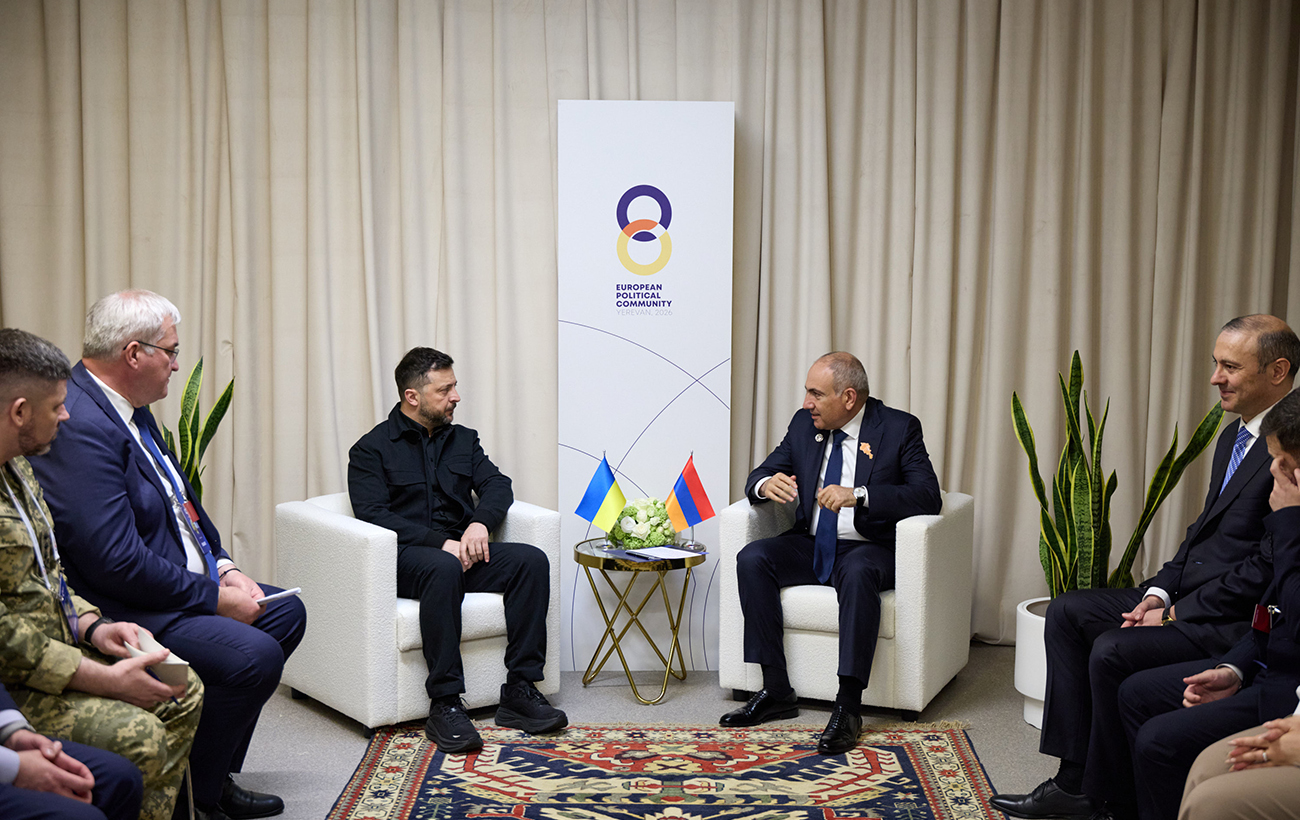 Photo: Volodymyr Zelenskyy and Nikol Pashinyan in Yerevan (president.gov.ua)
Possible outcomes
According to Stepan Grigoryan, the main question remains whether Nikol Pashinyan will be able to secure a single-party majority again.
"Whether there will be more than 50% of the vote or not is the key question. Because it is a tough fight, considering that Russia is using various methods of hybrid warfare," he told RBC-Ukraine.
According to polling data, around one-third of voters are still undecided.
"On the one hand, there are people who truly haven't made up their minds yet. These are apolitical individuals who do not participate in elections at all. And there are those who have made a decision but, for one reason or another, do not want to express their position," Ruben Mehrabyan explains.
The political analyst notes that Russia's attempts to pressure Armenia may instead mobilize pro-European voters. So the key question now is whether Pashinyan's party will win a simple majority or a constitutional two-thirds majority of seats.
At the same time, Mehrabyan notes that part of the pro-European electorate has become skeptical of Pashinyan and may support other parties that, while not pro-Russian, offer an alternative to the current government.
"There is a segment that has become disappointed with the current government due to the slow pace of reforms. They will not vote for pro-Putin forces, but the question is whether they will go to the polls at all. And if they do, who they will vote for," he adds.
In addition, Nikol Pashinyan doesn't need to reach 50%.
"Our Constitution has a provision called a 'stable majority.' That is, if no party wins outright, the party closest to 50% receives a bonus of a few percentage points to ensure state stability," says Stepan Grigoryan.
If no party secures the required majority in the first round and a coalition cannot be formed, a second round of voting is held between the two leading parties or blocs.
The winner of the second round automatically receives bonus mandates, ensuring a stable majority. If Pashinyan's party has a clear lead in the first round, it is likely to maintain an advantage in the second as well.
However, much greater concern is being raised about what radical steps Moscow might take after the results are announced.
Bet on destabilization
"The main danger will come from the following: Russia, seeing that it is not achieving its goal, will try to create an atmosphere of tension in Armenia using various mechanisms and apply destabilization tools," believes Stepan Grigoryan.
The ultimate goal of such actions is to question the legitimacy of the elections. However, Armenian law enforcement agencies are clearly taking such a scenario into account.
"If certain groups begin to carry out illegal actions, they will simply be isolated from society. At present, Armenia's law enforcement bodies and special services are in a high state of readiness, and for them, these attempts will be like playing with fire," Mehrabyan emphasizes.
By trying to punish Yerevan for its pivot away from Moscow, Russia risks producing the opposite effect. It has stepped on this rake before—in Moldova, Hungary, and Romania. And now, fully bogged down in the war against Ukraine and unable to allocate resources for new conflicts, the Kremlin will inevitably lose influence in the Caucasus as well.
Quick Q&A:
– Which parties are participating in the elections in Armenia, and who is leading?
The main favorite is the ruling party of Nikol Pashinyan, the Civil Contract Party, which leads in opinion polls. In particular, surveys give it around 30–32% of the vote.
It is challenged by three key pro-Russian forces: the Armenia Alliance of former president Robert Kocharyan, as well as the structures of oligarchs Samvel Karapetyan (Strong Armenia) and Gagik Tsarukyan (Prosperous Armenia).
– How exactly is Russia pressuring Armenia over Yerevan’s turn toward the West?
The Kremlin is using a comprehensive hybrid toolkit, combining mass bot campaigns on social media with overt economic pressure.
Rosselkhoznadzor has fully blocked imports of key Armenian goods—from brandy and fish to fresh vegetables—and Russia's Energy Ministry has threatened to terminate preferential agreements and raise gas prices from $177 to market levels of $600 per thousand cubic meters.
– What happens if Pashinyan's party fails to reach 50% of the vote?
Armenia’s Electoral Code includes a constitutional "stable majority" provision. If the frontrunner falls short of an absolute majority and cannot form a coalition, it may still be granted bonus parliamentary seats. This mechanism is implemented through a second round of elections.