Ukraine's chance to move faster towards the EU is NOW


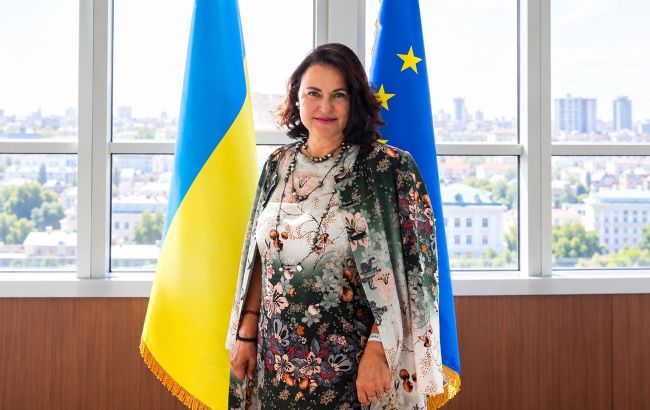 Katarína Mathernová (photo: Press Service of the EU Delegation)
Last week, the European Commission published its report on Ukraine's progress toward EU membership. Despite some slowdown in reforms, Brussels believes Ukraine has nevertheless moved closer to meeting European standards.
How this assessment was reached, Ukraine's next steps on its path to EU membership, and why comparisons with Moldova are misplaced, read in an exclusive opinion piece by EU Ambassador to Ukraine Katarína Mathernová for RBC-Ukraine.
Some of the harshest judgements I read about Ukraine last week came from Ukrainians themselves.
After the European Commission published its annual Enlargement Report, I read a few commentaries and wondered whether we had been reading the same document.
The report is very clear that reforms need to move faster to enable Ukraine to seize the historic window of opportunity for joining the EU. But the report also shows how far Ukraine has come since the Revolution of Dignity, often in extraordinarily difficult circumstances.
Read also: Russia talks about peace. Ukrainians are still dying
Wherever I go in Ukraine, people ask me when their country will join the European Union. I understand their impatience. I want Ukraine to be part of the EU Family; it belongs there.
Social media often rewards the bleakest take on things. Ahead of a decisive year like 2027, I would rather spend our energy on getting the next necessary reforms done.
I admit that the Commission’s two scales of assessment can be confusing. One asks how much progress the country made over the past year, since the last report. The other, however, assesses cumulative progress over a number of years. In other words: how far a country has come in a particular area.
Take the courts, for example. In last year’s report, the Commission found that Ukraine had some level of preparation and had made some progress. This year, its overall level of preparation rose half a point, to between some and moderate ranking.
Yet the Commission took into account the slowdown of reform earlier in the year and rated the level of progress over the year as limited. Ukraine continued to select candidates for vacant judicial posts and vet serving judges. Several changes to the law are still overdue. So Ukraine’s courts are better prepared than they were a year ago, even though they moved forward more slowly over the last 12 months.
Readiness also depends on what happens once laws are passed. Ukraine still needs to adopt its anti-corruption strategy and carry out other reforms. The Commission also looked at the work of the National Anti-Corruption Bureau, the specialised anti-corruption prosecutor’s office and the High Anti-Corruption Court. Across high-level corruption cases, their work has led to investigations, prosecutions and final convictions.
The findings of the NABU and SAPO led investigation "Operation Midas" last year shook the country. I understand the anger. I also think it matters that, in the middle of a full-scale war, independent investigators were able to pursue allegations that reached into the highest levels of power.
Holding powerful people to account is a demanding test for any democracy. Some EU member states know how hard it can be, even in peacetime.
Ukrainians have also shown what it takes to defend those institutions. In July 2025, after a law weakened the independence of the anti-corruption bureau and the specialised prosecutor’s office, thousands of young people took to the streets. Parliament then restored key safeguards.
This year’s report gives credit to the people and organisations that continue to expose corruption risks and defend the independence of investigators and prosecutors. They are doing part of the work of preparing Ukraine for EU membership and the report, rightly, refers to EU accession as a whole-of-society effort.
And now a few words on a topic that often sparks strong emotions in Ukraine: progress that Moldova has made on EU accession.
Yes, Moldova deserves credit for its reforms. It is further ahead in meeting the interim rule-of-law requirements. The same membership conditions apply to both countries, but the circumstances are profoundly different.
Ukraine is carrying out reforms while defending its people and territory against Russia’s full-scale invasion. In doing so, it is also helping protect peace in Europe.
Another round of comparisons with Moldova will do little to get important bills through the Verkhovna Rada. For me, a more useful question is which laws Ukraine needs to pass and put into practice rapidly, so it can start closing negotiating chapters.
Ukraine has already opened four of the six negotiating clusters, and the remaining two should be opened by year-end. Ukraine is one of the four frontrunners for which the Commission has drawn up a roadmap.
Ukraine's goal of concluding talks by the end of 2028 is ambitious. Getting there means moving faster with reforms. The joint EU–Ukraine task force set up in October will help prepare reforms and work out which should come first. The government must bring forward sound proposals, and parliament needs the political will and determination to consider and pass them.
Read also: Ukraine faces no more political hurdles to opening EU accession clusters
Much of the work that will determine how quickly Ukraine can join the EU is in Ukrainian hands. Journalists, civil society groups and citizens need to keep asking whether the laws on paper are changing anything in practice. We have already seen what happens when Ukrainians insist that their institutions work.
I am rooting for Ukraine to make the most of this window of opportunity. A Ukraine that joins the EU will make our Union stronger, safer and more prosperous. And the decisions that bring that day closer need to accelerate now.