Russia talks about peace. Ukrainians are still dying.

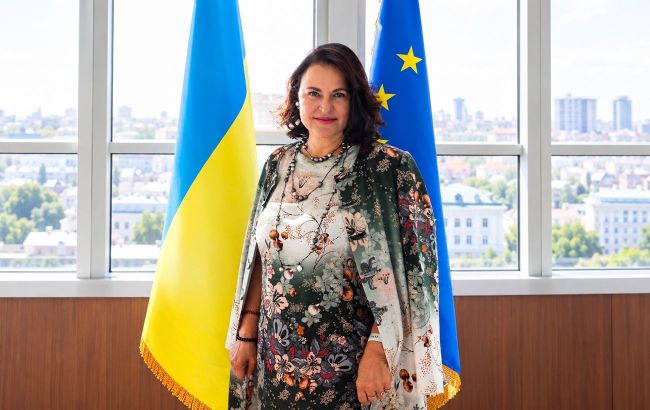 Photo: EU ambassador to Ukraine Katarína Mathernová (EU Delegation press service)
How to achieve lasting peace and the four principles guiding the EU’s support for Ukraine were outlined by Katarína Mathernová, head of the EU Delegation to Ukraine, in an exclusive op-ed for RBC-Ukraine.
Do you know what Ukrainians want?
They want peace. They want to survive the coming winter. They want their children to study in classrooms filled with daylight, not underground. They want to sleep through the night instead of running to shelters.
Only peace can give them that.
But peace requires more than an announcement. It requires commitments that both sides understand, accept, and respect.
We have no such commitment from Russia. Neither the talks in Oslo on October 20 nor US negotiators’ visit to St Petersburg on October 21 produced one. All we have are tentative statements from Putin’s adviser, Yuri Ushakov, who announced that Russia had agreed in principle to resume trilateral talks. At this point, there is no agreed ceasefire, no agreed security guarantees, and no peace agreement.
Against this backdrop, Kremlin spokesperson Dmitry Peskov’s statement sounds almost brazen. He said Moscow did not want a ceasefire. It wanted lasting peace.
Really?
Is this what a desire for peace looks like?
Russians attack Kyiv every single day, and almost every single night. I keep writing about those killed and injured. About an ambulance station in Kyiv damaged, along with six ambulances. About attacks on civilian trains, schools and buses.
On October 9, the United Nations reported that more than 100 Ukrainian civilians had been killed and at least 429 injured in just one week. In Pryluky, five children were among the dead.
More than 15,000 civilian deaths have been verified since the full-scale invasion. The real number is higher.
I have lived and worked in Kyiv for more than three years. I have watched Russian attacks damage our EU Delegation building and destroy buildings in our neighbourhood. My colleagues and I have run to shelters during working hours. We have grown used to sleeping underground.
I have seen what these attacks do to people.
And now, as winter approaches, Russia continues targeting the infrastructure that provides Ukrainians with electricity and heating.
These attacks do not demonstrate strength. I see them as signs of Putin’s frustration. Unable to achieve his objectives on the battlefield, he tries to make everyday life unbearable. He threatens Western diplomats: leave Kyiv or risk your lives.
We are all staying. And EU leaders reaffirmed their support for Ukraine at last week’s summit.
For the European Union, this reinforces four principles that already guide our support for Ukraine.
First, a ceasefire must be clear, reciprocal and verifiable.
Diplomacy is essential. Every genuine opportunity to stop the killing deserves serious consideration.
But the parties must agree on what is being suspended, when commitments take effect, and how compliance will be verified.
An announcement cannot replace those basic requirements.
Second, diplomacy needs credible pressure.
The EU has imposed successive sanctions packages to constrain Russia’s ability to finance its aggression and obtain the technologies needed for its weapons.
Their purpose is not punishment for its own sake. It is to change the calculations behind Moscow’s decisions.
The same logic applies to negotiations. Sustainable peace requires consequences for violations and evidence of compliance before restrictions are reconsidered.
Third, Ukraine’s ability to defend itself remains essential.
Europe’s commitment is reflected in concrete decisions.
On October 14, the European Commission disbursed another €2.86 billion from the €90 billion Ukraine Support Loan.
This funding supports drones, air defence systems, missiles, radars, electronic warfare equipment and ammunition.
The loan provides €60 billion for defence and €30 billion for budgetary assistance over 2026 and 2027.
These figures represent much more than financial support. They mean greater protection for Ukrainian cities and a stronger Ukrainian defence industry.
Europe also understands that the threat extends beyond the battlefield. Hybrid warfare is warfare. Sabotage, cyberattacks, disinformation and intimidation of diplomats are part of Russia’s wider strategy.
Our security and Ukraine’s security are inseparable.
Fourth, Ukraine must be able to withstand the coming winter.
The EU continues to support emergency repairs, energy infrastructure and essential public services. We have mobilised a winter preparedness package worth nearly €1 billion to help Ukraine withstand Russian attacks, providing critical energy equipment, generators and support for renewable energy. We have also connected Ukraine to the European electricity grid, helping keep the lights on when Russia tries to turn them off.
Predictable financing matters as much as emergency assistance.
That is why the EU has also mobilised proceeds from immobilised Russian sovereign assets to support Ukraine and continues working on legally sound ways to make Russia contribute to the costs of its aggression.
The principle is straightforward. Those who destroy should bear responsibility for the destruction.
These four principles are not alternatives to diplomacy. They make diplomacy more credible.
Europe remains committed to working with the United States and other partners towards a just and lasting peace.
But Ukrainians have heard enough promises.
They need to see Russian missiles stop flying. They need electricity in their homes. They need to know that their children can go to school tomorrow.
And they need confidence that any agreement will protect them beyond the day it is announced.
Peace cannot be measured by what the Kremlin says it wants.
It must be measured by what Russia actually stops doing.