Zelenskyy–Trump meeting: nuclear plant, territory, and Ukraine's security demands on the agenda


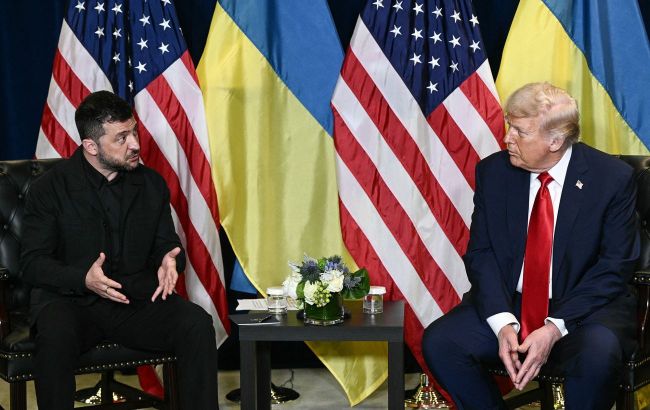 Photo: Volodymyr Zelenskyy and Donald Trump (Getty Images)
Ukrainian President Volodymyr Zelenskyy will once again meet with Donald Trump tomorrow, December 28, to discuss a draft peace plan.
RBC-Ukraine explains what will be on the agenda and what expectations surround the meeting.
Key questions:
-
What is on the negotiation agenda?
-
Why did Trump previously refuse to meet but ultimately agree?
-
What can be expected from the visit?
Despite the traditional Christmas pause in global politics, negotiations on ending the Russian-Ukrainian war have not stopped. As early as Sunday, December 28, Ukrainian President Volodymyr Zelenskyy will meet his counterpart, Donald Trump.
Draft peace plan details
Ahead of the meeting, Zelenskyy presented journalists with details of a framework peace agreement that has been broadly developed by Kyiv and Washington but has not yet been approved by Moscow.
The document is political in nature and includes annexes referring to trilateral security guarantees (Ukraine, the US, and Europe), bilateral guarantees from the United States, and a roadmap for Ukraine’s prosperity.
RBC-Ukraine has already detailed the document’s contents. Among other provisions, it includes confirmation of Ukraine’s sovereignty and a non-aggression agreement between Ukraine and Russia with a monitoring mechanism.
It also provides strong security guarantees for Ukraine, mirroring Article 5 of NATO’s charter — including a military response and sanctions in the event of Russian aggression — for a period of 15 years.
Additionally, the document would lock in Ukraine’s path to the EU with a set accession date, privileged market access, and a global development package involving reconstruction funds, investment, and rebuilding. It also includes prisoner exchanges and the return of hostages.
At the same time, two points remain unresolved between Ukraine and the US: the status of the Zaporizhzhia Nuclear Power Plant and territorial issues.
Meeting with Trump as a key signal
Ukrainian diplomats have been trying to arrange a meeting between Zelenskyy and Trump for quite some time. However, Washington initially withheld consent. In late November, Trump said he hoped to meet Zelenskyy and Putin, but “only when the deal to end this war is final or near its final stage.”
Currently, Trump is offering vague comments about the talks.
“He doesn’t have anything until I approve it. So we’ll see what he’s got,” Trump told reporters.
Washington’s decision to agree to the meeting may signal confidence within Trump’s team that tangible results are achievable in the near future.
“I think Trump feels the deal is almost ready and that there is something to talk about and some options to consider. But on the other hand, since the meeting is taking place at Mar-a-Lago, there clearly isn’t 100% certainty,” said Yevhen Mahda, director of the Institute of World Policy, in a comment to RBC-Ukraine.
Zelenskyy has repeatedly said that territorial issues — and clearly the Zaporizhzhia NPP — should be resolved in direct talks with Trump.
Thanks to negotiations, the positions of Ukraine and the US have drawn somewhat closer. The draft framework proposes freezing the line of contact as of the date of the agreement in Donetsk, Luhansk, Zaporizhzhia, and Kherson regions (“we stay where we are”), with Russian forces withdrawing from other regions, including Dnipropetrovsk, Mykolaiv, Sumy, and Kharkiv regions. A potential “free economic zone” is also being discussed for parts of Donbas.
This week, Zelenskyy stressed that if the peace agreement addresses territorial issues beyond the “we stay where we are” principle, the entire document could be put to a referendum. Such a referendum would be possible only after a full agreement to end the war, a genuine ceasefire lasting at least 60 days, and legitimate conditions for voting.
Regarding the Zaporizhzhia Nuclear Power Plant, the US is proposing joint management between Ukraine, the US, and Russia with a 33/33/33 profit split. Ukraine, however, insists on joint operation exclusively with the US on a 50/50 basis, along with mandatory demilitarization of the plant, Enerhodar, and the Kakhovka Hydroelectric Power Plant.
Kremlin’s position
Against this backdrop, Russia is sending mixed signals. On December 20 and 21, Trump envoys Steve Witkoff and Jared Kushner met in Miami with Putin’s envoy Kirill Dmitriev. Following those meetings, Kremlin spokesperson Dmitry Peskov refused to disclose the contents of any documents Dmitriev allegedly brought back from the US.
“We still believe, including at this stage, that it is extremely inappropriate to communicate through the media. Therefore, we will not talk about what Dmitriev brought back, and certainly not through the press,” Peskov said.
According to him, Moscow will continue contacts with the US through existing channels, and Russia’s position on a settlement will be formed based on the information received from Dmitriev.
Later, Russian Deputy Foreign Minister Sergei Ryabkov said that the plan presented by Zelenskyy “differs radically” from the version being discussed between Russian and US representatives.
A source told RBC-Ukraine that Russia plans to respond to the ideas outlined in the Ukrainian-American draft peace framework only after the New Year.
However, due to Kyiv’s diplomatic activity, Russia has been forced to send certain signals through the media already, including claims of supposed “readiness for a ceasefire” in order to hold a referendum in Ukraine.
According to Bloomberg, Moscow views the 20-point plan developed by Ukraine and the US as a starting point for further talks, but many of Russia’s demands are not satisfied by the plan in its current form.
These demands reportedly include guarantees that NATO will not expand eastward, limits on the size and types of weapons of Ukraine’s Armed Forces, the lifting of sanctions, the unfreezing of Russian assets, and territorial issues.
According to an RBC-Ukraine source, Russia continues to imitate interest in peace talks primarily to avoid accusations from the US of sabotaging negotiations.
“I don’t think there will be public signals of concessions from Russia. That doesn’t fit their modus operandi. They will continue publicly raising the stakes. That is their logic, and it won’t change,” Mahda emphasized.
A difficult task for Zelenskyy
Under these conditions, the risk of increased pressure on Zelenskyy and Ukraine is growing. However, past meetings suggest such pressure does not work well on the Ukrainian president — especially since European partners will also be involved.
“At the very least, we will join online, and our partners will be in contact. When we talk about the full path, we absolutely need to find a format in the near future where not only Ukraine and America are present, but Europe as well,” Zelenskyy told reporters.
During previous talks, Zelenskyy and Trump managed to reduce tensions somewhat.
“Most likely, this will be the last meeting between Volodymyr Zelenskyy and Donald Trump this year, but it does not mean the document will be finalized. It will be an attempt at finalization, but I am not sure it will succeed,” Mahda said.
Even if Kyiv and Washington manage to align their positions on the disputed points, the fundamental obstacle to peace remains: Russia’s persistent unwillingness to end the war.
Sources: Ukrainian and American officials' statements, Bloomberg, Reuters, and Axios.