US alarmed after Taiwan scales back major arms deal amid China pressure

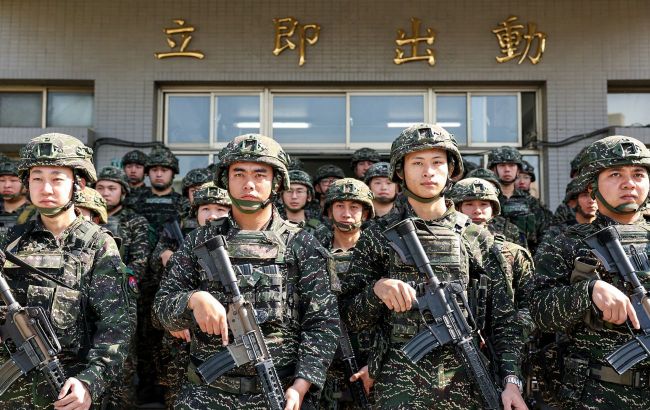 The Ministry of Defense negatively assesses the parliament's decision (Photo: Getty Images)
The US State Department said that delays in funding Taiwan’s military spending caused by the Taiwanese parliament were a “concession” to China, reports Reuters.
What happened
According to the agency, Taiwanese President Lai Ching-te requested an additional $40 billion in defense spending to better deter China. As is known, Beijing considers the island its territory and has increased military pressure.
However, after repeated delays from opposition parties that hold a majority in parliament, lawmakers on Friday approved only two-thirds of the requested funds.
It is important to note that all the requested funds were directed toward American weapons, not other projects such as domestically developed drones and missiles.
The opposition stated that although they support defense spending, the parties will not sign blank checks because the proposals are vague in places and could open the door to corruption.
What the US State Department says
A State Department official said the US supports Taiwan's acquisition of critical defense capabilities commensurate with the threat it faces.
"While we are encouraged by the passage of this special defense budget after unconstructive delays, the US emphasizes that further delays in funding the remaining proposed capabilities are a concession to the Chinese Communist Party," Reuters quoted an unnamed official as saying.
The US is Taiwan's most important international sponsor and supplier of weapons, despite the absence of formal diplomatic ties, and actively supports increased military spending.
Beijing, for its part, has repeatedly demanded an end to arms sales.
Reaction of Taiwan's Ministry of Defense and the President
Late on Friday evening, Taiwan's Ministry of Defense issued a statement saying that the approved spending completely excludes certain commercial procurements that could very likely create capability gaps.
The ministry added that the plan does not include the Chiang Kung or Strong Bow anti-ballistic missile, which is intended to be the core of Taiwan's new T-dome air defense system.
"Following its removal from the special budget, if it cannot be procured in a timely manner, air defense combat effectiveness will be severely impacted," the statement said.
Furthermore, the lack of approval for naval drones will significantly delay the development of asymmetric warfare capabilities and affect the projected economic growth and employment opportunities for the domestic industry.
President Lai noted that he highly appreciates the approval of funding, which allows the procurement of systems such as HIMARS to begin, but this is only the first step.
"Any gap will affect the integrity of the overall defense system. Any delay will increase the shared security risks borne by the people of Taiwan," he wrote on Facebook.
Strengthening Taiwan
A few weeks ago, it became known that the Taiwanese government signed six major arms procurement agreements with the US worth more than $6.6 billion.
Among these agreements are the purchase of HIMARS systems, M109A7 Paladin self-propelled howitzers, replenishment of the army's missile arsenal, and more.
According to the NYT, Taiwan is increasingly thinking about its own security against the backdrop of the threat from China, and therefore seeks to adopt Ukraine's military experience.