Ukrainian parliament appoints Mykhailo Fedorov as defense minister

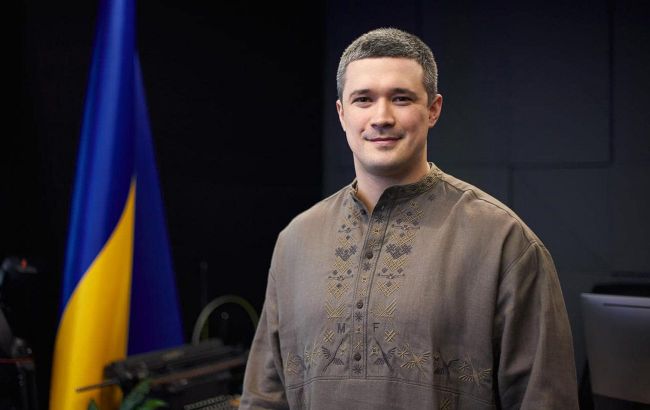 Minister of Defense of Ukraine Mykhailo Fedorov, newly appointed (photo: mykhailofedorov)
Ukraine's Verkhovna Rada (the national parliament) voted to appoint Mykhailo Fedorov as Minister of Defense of Ukraine. The decision was supported by 277 members of parliament, according to the live broadcast of the parliamentary session.
Thus, on the second attempt, the parliament succeeded in appointing Fedorov as head of the Ministry of Defense, as there were not enough votes when the issue was considered in parliament yesterday.
After being appointed as Minister of Defense, Fedorov took the oath in the parliamentary chamber.
How members of parliament voted
In total, 277 members of parliament voted in favor, 0 voted against, 9 abstained, and 32 parliamentarians did not vote.
What Fedorov said about his goals at the defense ministry
"I am taking the position of defense minister not as a minister who built a digital state and created Diia (Ukraine's government digital services platform and mobile application), but as a person whose team has spent a great deal of time working for the war since 2022," he said before his appointment, speaking in parliament.
Other key points outlined by Fedorov before his appointment as defense minister:
-
Financial support and social protection for service members are a priority. There is confidence that resources to increase payments will be found.
-
In the near future, a deep audit of the Ministry of Defense and the Armed Forces of Ukraine will be conducted to identify additional opportunities to improve support for the military.
-
Not all plans can be made public, but the relevant parliamentary committee has been informed of all details.
-
The Ministry of Defense is being handed over to me with a deficit of about 300 billion hryvnias, 2 million people on wanted lists, and 200,000 in unauthorized absence.
-
The goal is to change the system: reform the army and improve frontline infrastructure.
-
The problem of territorial recruitment centers cannot be ignored. An audit will be conducted, and a systemic solution will be proposed to address issues accumulated over the years while preserving defense capability.
-
The president has set tasks: stop the enemy in the air and on the ground, strengthen asymmetric and cyber strikes, and make the war economically unbearable for Russia.
-
Ukraine must operate in the information and cognitive domain and counter Russian propaganda, including on enemy territory.
-
An ambitious goal is to make Ukraine the first country capable of predicting and neutralizing enemy attacks using artificial intelligence.
-
My hometown of Vasylivka in the Zaporizhzhia region is occupied. For the past four years, I have lived intending to liberate Vasylivka. Therefore, my story is personal.
Who is Mykhailo Fedorov
Early life and education
Mykhailo Fedorov was born on January 21, 1991, in the town of Vasylivka, Zaporizhzhia region (southern Ukraine). He graduated from the Faculty of Sociology and Management at Zaporizhzhia National University.
While still a student, he was actively involved in civic and educational projects. In 2012, he served as student mayor of Zaporizhzhia as part of the Studrespublika project (a nationwide Ukrainian youth civic and educational initiative).
Business and digital career
In 2013, in Zaporizhzhia, he founded his own digital agency, SMMSTUDIO, specializing in online marketing and targeted social media advertising.
He also became an organizer of Facebook Marketing Conf (a professional conference on digital marketing) and worked as chief operating officer of the educational project Superliudy (an entrepreneurship education initiative).
Political career
In 2014, he made his first attempt to enter politics, running unsuccessfully for parliament with the 5.10 party (a Ukrainian libertarian political party). A turning point came in 2019. During Volodymyr Zelenskyy's presidential campaign, Fedorov headed the campaign's digital team and was publicly presented as the person responsible for the country's digital transformation.
In May 2019, he was appointed an unpaid adviser to the president.
In the 2019 parliamentary elections, Fedorov was elected a member of parliament of the 9th convocation from the Servant of the People party (sixth on the party list). However, on August 29, 2019, he relinquished his parliamentary mandate and became Minister of Digital Transformation of Ukraine.
At the age of 28, he entered history as one of the youngest ministers since Ukraine's independence.
Deputy Prime Minister in the new government
In 2023, Ukraine's parliament voted to dismiss him from his ministerial post. However, later that same year, Fedorov returned to government as Deputy Prime Minister for Innovation, Education, Science, and Technology Development, once again combining this role with leadership of the Ministry of Digital Transformation.
In 2025, he retained his positions in the new government led by Prime Minister Yulia Svyrydenko and was appointed First Deputy Prime Minister of Ukraine and Minister of Digital Transformation. Ukraine's parliament approved the appointment through a package vote on the new Cabinet lineup.
Fedorov and "State in a Smartphone"
As Minister of Digital Transformation, Fedorov set an ambitious goal of building a "State in a Smartphone," moving government services and documents online and reducing bureaucracy for citizens and businesses.
The key outcome was Diia (a government digital services portal and mobile application), launched in 2020.
Ukraine became the first country in the world to introduce electronic passports. Later, the platform added driver's licenses, education certificates, pension IDs, COVID certificates, and dozens of social and business services.
Currently, more than 160 electronic services are available through Diia.
At the same time, the Ministry of Digital Transformation developed a broader digital ecosystem, including Diia.Signature (digital signature service), Diia.Business (business support platform), Diia.City (special legal framework for IT companies), eOselya (state mortgage program), eMaliatko (child-related services), eRecovery (post-war recovery assistance), eAid (social assistance), and a nationwide network of Diia Centers (physical service hubs). The educational track is represented by Diia.Education and Diia.Digital Education platforms.
After Russia's full-scale invasion began, the ministry became one of Ukraine's key centers of technological defense. Initiatives included the eVorog chatbot (for reporting enemy activity), the UNITED24 fundraising platform, the Army of Drones project, the Drone Line initiative, the eBaly motivation system (a digital rewards program), deployment of Starlink satellite internet, and the launch of Brave1 (a defense technology cluster uniting government, military, and defense tech manufacturers).
In 2025, Diia introduced online marriage registration, added new military bonds, and launched an AI assistant that processed more than one million requests.
For 2026, Fedorov announced the rollout of 5G (a pilot project has already been launched in Lviv), as well as eExcise (digital excise system), eNotary, eCourt, and further digitalization of the construction and gambling sectors.
Personnel changes in government
At the beginning of 2026, President Volodymyr Zelenskyy announced a series of government changes. Kyrylo Budanov replaced Andriy Yermak as head of the Presidential Office, with Sergiy Kyslytsya appointed as first deputy head.
Meanwhile, former Defense Minister Denys Shmyhal was offered the post of First Deputy Prime Minister and Minister of Energy, while the Defense Ministry was to be headed by Mykhailo Fedorov. Leadership changes also took place at the Main Intelligence Directorate (military intelligence agency), the State Border Guard Service, and the Security Service of Ukraine, and the president replaced the heads of several regional military administrations.