Ukraine-US-Russia talks in Geneva: Key developments from day two


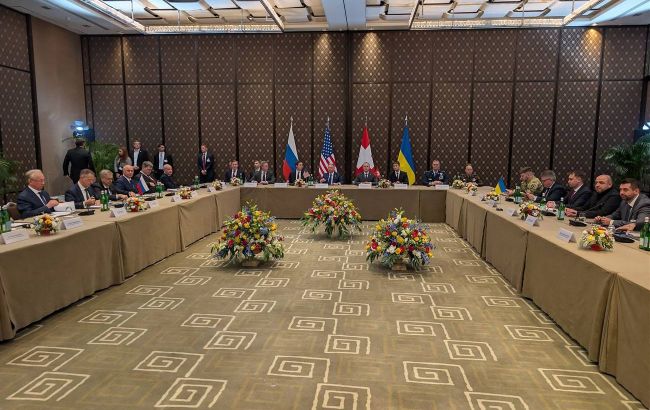 Photo: The second day of trilateral talks between Ukraine, the US, and Russia in Geneva (facebook.com/rustemumerov.ua)
Talks in Geneva between Ukraine, the United States, and Russia have entered their second day. Despite Washington’s statements about "progress," the atmosphere remains tense.
What is known about the second day of negotiations in Geneva and how the first meeting concluded - read in RBC-Ukraine’s report.
Read also: Zelenskyy’s request: New details on Europe’s presence at Geneva talks
Key points
- The second day of talks between Ukraine, the US, and Russia is taking place in Geneva on February 18.
- Consultations are continuing within political and military working groups.
- According to Diana Davitian, spokesperson for Ukraine’s National Security and Defense Council secretary, meetings are scheduled for the first half of the day.
- President Volodymyr Zelenskyy instructed the delegation to raise with the US the issue of Russia’s compliance with commitments to refrain from strikes during negotiations.
- After the first day on February 17, Axios reported a “deadlock” stemming from Vladimir Medinsky’s position, while US officials described “significant progress.”
- The most difficult issue remains territory.
12:00 p.m.
Umerov’s office has confirmed that the negotiations between Ukraine, the United States, and Russia in Geneva have concluded.
Consultations ended within both the political and military groups. This was reported to journalists by Diana Davitian, spokesperson for the Secretary of Ukraine’s National Security and Defense Council.
11:51 a.m.
Talks between Ukraine, the United States, and Russia in Geneva have ended, pro-Kremlin media report.
The meeting lasted about two hours.
11:50 a.m.
Before the start of today’s delegation work in Geneva, President Volodymyr Zelenskyy met with the Ukrainian team. The president said that yesterday’s meetings were not easy.
“And we can state that Russia is trying to drag out the negotiations that could already have reached the final stage,” the head of state said.
According to the president, among other issues, the humanitarian track is to be discussed today — specifically, steps toward exchanging prisoners of war and releasing civilians.
10:40 a.m.
The second day of negotiations in Geneva has begun.
National Security and Defense Council Secretary Rustem Umerov, who heads the Ukrainian delegation, said consultations are taking place in groups by areas within the political and military blocs.
“We are working on clarifying the parameters and mechanics of the decisions that were discussed yesterday,” he wrote.
Second day agenda
The focus is on continuing consultations within political and military groups and turning previous discussions about the “mechanics of decisions” into concrete agreements.
NSDC spokeswoman Diana Davityan told reporters that talks are scheduled for the first half of the day today.
Pro-Kremlin media announced that they would begin at 10:00 a.m. (Kyiv time).
The main goal for today is to translate yesterday's discussions on the “mechanics of decisions” into concrete agreements.
However, tensions persist. Ahead of the meeting, Russia launched another large-scale missile and drone attack on Ukraine’s energy infrastructure and changed the head of its delegation to Kremlin aide Vladimir Medinsky.
Because Russia continues attacks despite the diplomatic process — including a major strike on western Ukraine overnight on February 17 — Zelenskyy instructed his team to question US representatives about Russia’s adherence to agreements to refrain from attacks during dialogue.
Kyiv is also pushing for a direct Zelenskyy-Putin meeting, viewing it as the only way to achieve a real breakthrough.
The Ukrainian head of state instructed his team to raise the issue of a future leadership-level meeting in Geneva.
First day: "progress" or "deadlock"?
The first day of talks on February 17 lasted about four hours and produced mixed assessments.
Ukrainian officials said discussions focused on practical issues, followed by work in military and political groups. US special envoy Steve Witkoff described the talks as showing "significant progress," saying the Trump administration helped bring the sides closer.
However, Axios reported that the political group effectively stalled, citing the composition and rhetoric of the Russian delegation. Medinsky’s return reportedly frustrated the Ukrainian side, as he is known for lengthy "historical roots" that slow negotiations.
President Zelenskyy sharply criticized this approach, saying that "We don't have time for all this s***. So we have to decide, and have to finish the war."
Key sticking points
Territory remains the central obstacle. US Ambassador to NATO Matthew Whitaker called it the main stumbling block.
Zelenskyy has firmly stated that Ukraine will not agree to peace at the cost of surrendering Donbas. He also criticized what he described as pressure on Ukraine to make concessions rather than on the aggressor.
In parallel, Ukraine’s delegation held separate consultations in Geneva with representatives of France, the United Kingdom, Germany, Italy, and Switzerland to coordinate positions.
Previous rounds of talks between Ukraine, the US, and Russia were held in Abu Dhabi on January 23–24 and February 4–5. While no major breakthrough was achieved, the sides agreed to a prisoner exchange — the first in five months.
In Geneva, the Russian delegation is led by Putin’s aide Vladimir Medinsky and also includes GRU chief Igor Kostyukov, who previously represented Russia at the talks in the UAE. According to media reports, the Russian delegation exceeds 15 people.
Ukraine is represented by the National Security and Defense Council Secretary Rustem Umerov, the Head of the Presidential Office, Kyrylo Budanov, and other members of the delegation.
The US side is represented by Jared Kushner, Special Envoy Steve Witkoff, and US Army Secretary Daniel Driscoll.
The Kremlin has announced that the Geneva agenda will be broader and will include territorial issues, while Ukraine aims to achieve progress on an energy ceasefire and humanitarian agreements.